

Winter Is The Best Time To Graft The Fruit Tree In Your Yard - Here's How To Do It
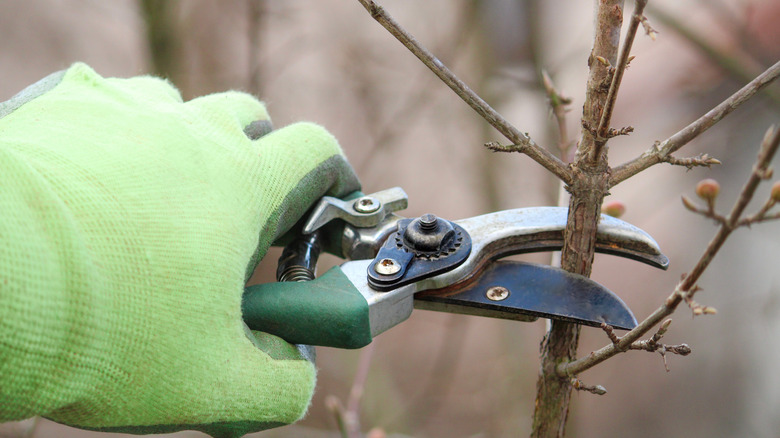
While many people have focused on the health benefits of gardening in recent years, another rewarding aspect of working with plants hasn't received quite as much attention. Gardening promotes curiosity and creativity, skills used in scientific exploration that can fuel innovation and help improve memory. During the winter, when gardeners have a little more time to learn, experiment, and be creative, it's the perfect time for grafting fruit trees in your yard and watching what happens.
Grafting is a technique that joins two or more plants together. Most fruit trees don't grow true to seed, meaning they may have different characteristics than the parent plant. Luckily, with a little know-how, you can graft fruit trees to get guaranteed results and help your fruit trees grow and produce faster. Grafting can also help you grow your favorite varieties, save space in small gardens, and turn you into an innovative and creative gardener.
With fruit trees, grafting is usually started during the winter while the tree is dormant. Since this is also the time of year when gardeners have a little more space in their schedules to learn new techniques, this is an excellent opportunity to understand how grafting works by giving it a try. At its core, grafting relies on two key parts working together: a rootstock and a scion. Once you have those ready, this ancient technique basically comes down to fitting the pieces together so the tree can heal and join together.
How to choose and prepare the scion and rootstock for grafting
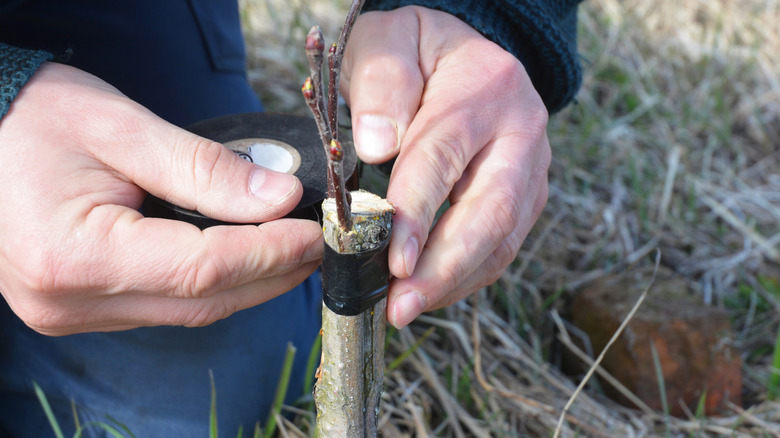
In the winter, plants are dormant and less stressed by being cut, so this is a good time to collect scions for grafting fruit trees. Scions are the part of the grafted tree that produces fruit, so carefully selected varieties ensure more apples. The scion wood should be about as thick as a pencil and cut from last year's growth. Rootstock is selected to provide a good foundation for grafting, and trees can be any age or variety. Nursery apple trees are grown on a limited number of species with proven traits like disease-resistance and dwarf sizes, but you can propagate a fruit tree from an apple scion grafted onto any of the apple trees in your yard.
Grafting doesn't require professional experience or fancy equipment, although it helps to gather your tools before you start. You'll need a sharp knife to make smooth cuts, as well as grafting tape and wax. Once you have the scion and rootstock prepared, make matching cuts on each so that you can join them together.
Make sure that the cut surfaces join smoothly together and line up the cambium layers that sit just underneath the outer layer of bark, as this is where the magic happens. After they are joined, the graft is kept in place with grafting tape and sealed to help keep it moist. In the spring, when leaves sprout from the scion, you'll know your graft was successful.