

14 Stunning Succulents That Make Statement Piece Houseplants
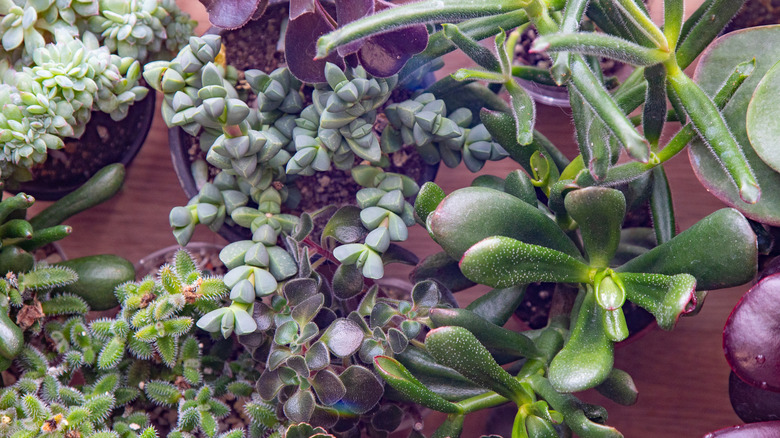
If you're thinking about leveling up your indoor succulent game beyond regular succulents, statement succulents will create more texture and interest. Statement-piece succulent houseplants have a "wow factor" that makes them stand out — whether it's their color, shape, texture, usual appearance, or all of these features.
We've compiled suggestions of, not only colorful succulents that will thrive indoors, but also flashy and fascinating specimens that may have visitors asking where you got your succulents. Virtually all of them are easy to care for. Succulents tend to have similar care needs, and statement succulents are no different. Most need lots of sunlight and are vulnerable to overwatering and roots sitting in water. Many are easy to propagate so you can multiply your statement succulents and give some to those admirers who asked where to get them. While many succulents, including some on our list, can be grown both indoors and outdoors, all the statement succulents below will grow nicely indoors. Some flowering succulents may not bloom indoors without sufficient light. Ready to make a statement? Let's dive in.
Pagoda village Crassula
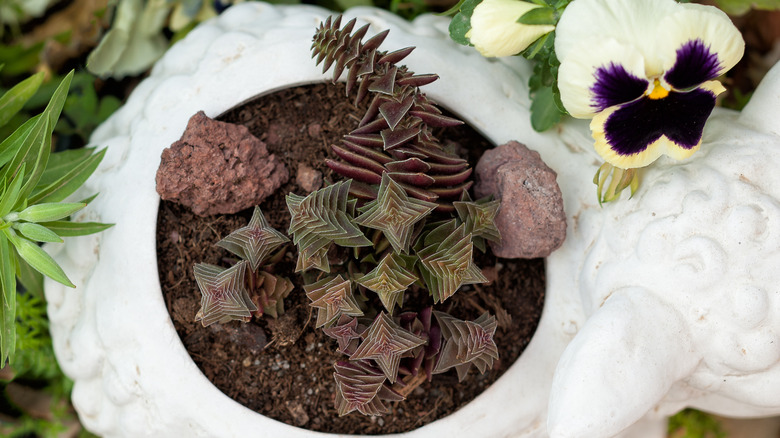
The striking and easy-to-grow pagoda village Crassula (Crassula capitella subsp. thyrsiflora) makes a charming statement with its colorful pagoda-like branches. The branches, which grow to 8 inches long, change colors as they grow, turning from light green to a vibrant red under strong sunlight. Succulents in the Crassula genus are vulnerable to fungal diseases and mealybugs. It's important not to overwater them or let their roots sit in water. Pagoda village' is simple to propagate by division or leaf cuttings.
Pebbled tiger jaws
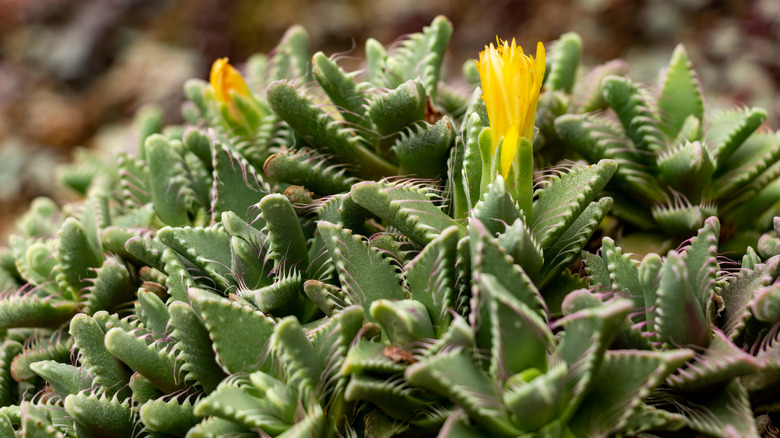
Despite being named after the jaws of tigers, the pebbled tiger jaws succulent (Faucaria felina subsp. tuberculosa) might look more like a pileup of hungry alligators to you. Not to worry; these "teeth" are tame because they're soft and pliable. The slow-growing pebbled tiger jaws puts out yellow flowers in fall or winter. With appropriate care, this succulent will live a long time, and its offsets (shoots) can be cut off and placed in pots to create more pebbled tiger jaws.
Pies from Heaven
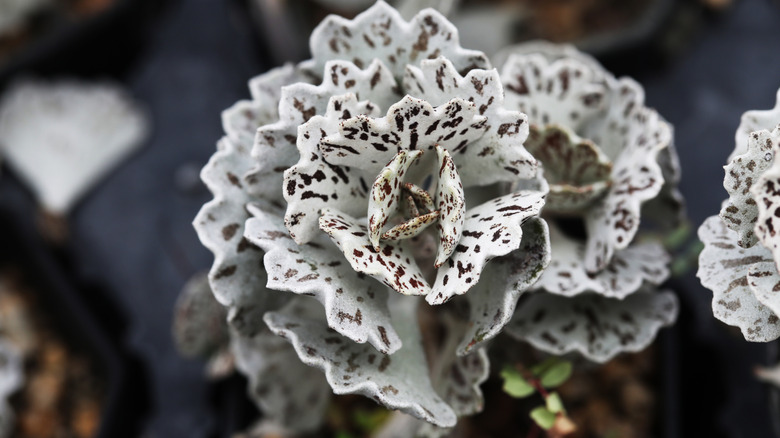
If you're looking to add texture with your statement succulents, pies from heaven (Kalanchoe rhombopilosa) is an excellent choice with its silvery, slightly wooly leaves with contrasting brown spots. It also blooms with small flowers in the spring. Texture abounds in this plant's scallop-edged leaves. Pies from heaven, which grows to about 12 inches tall, needs very little care. Place pots in a location with partial sun, but beware of sunlight that is intense enough to burn the leaves. You can propagate with leaf or stem cuttings.
Crassula 'Buddha's Temple'
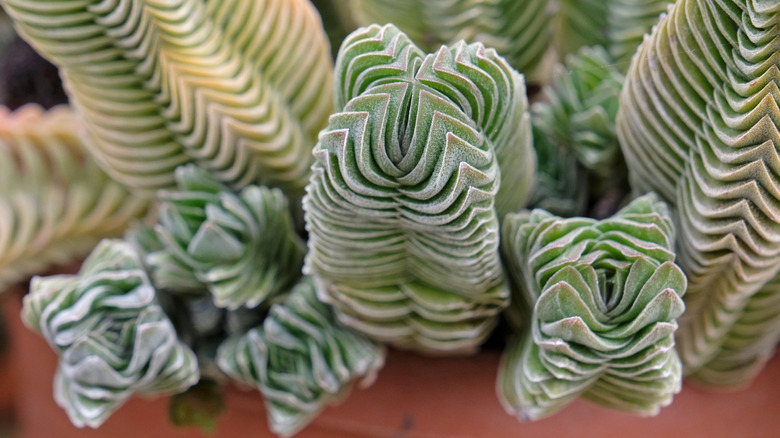
Crassula 'Buddha's Temple' gives the impression of a particularly orderly plant, making its statement with leaves stacked on top of each other. The stacks grow to about 6 inches tall. In spring and summer, clusters of white and pink flowers emerge from the top of the stacks. This succulent is a hybrid cultivar of Crassula pyramidalis and Crassula perfoliata var. minor. Though fast growing, Crassula 'Buddha's Temple' has weak roots, so the stacks tend to fall over. You can prop them up with stakes, and pruning will help keep them from toppling.
Baseball plant (Euphorbia obesa)
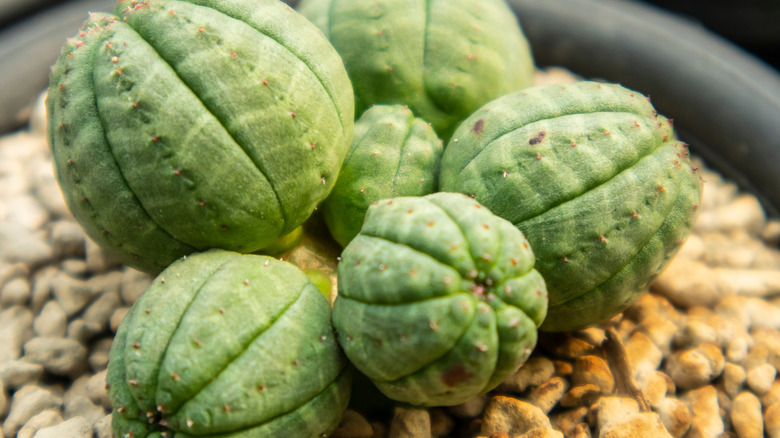
Who doesn't want to make a statement by growing baseballs — or at least orb-shaped succulents that resemble baseballs? Meet baseball plant (Euphorbia obesa). Scars left by a type of flowering (not true flowers, but colored bracts), add to the baseball illusion because they look like stitching. Baseball plant will grow to about 8 inches tall and likes a sandy or gritty growing medium, such as a cactus and succulent formulation. Be aware of baseball plant's toxic, milky white sap that irritates eyes and skin.
Kalanchoe 'Pink Butterflies'
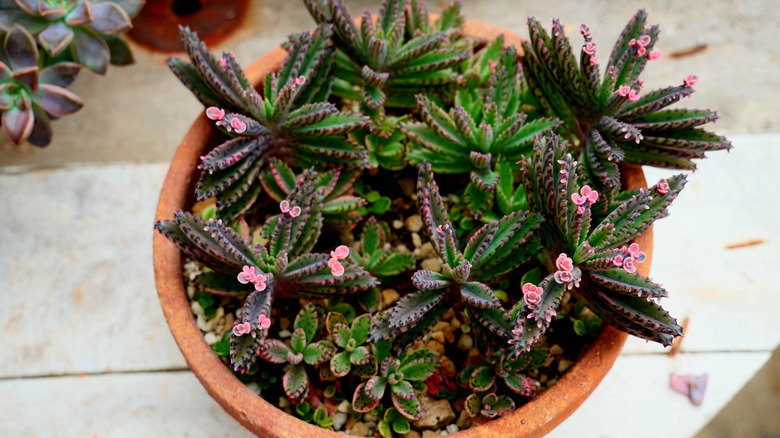
Kalanchoe 'Pink Butterflies' (Kalanchoe × houghtonii) makes its colorful statement as a result of its low chlorophyll supply that enables the plantlets that emerge from leaves to show a pink color instead of green. Bonus: These plantlets fall off, and each one can grow roots and become a new plant. You can also propagate Kalanchoe 'Pink Butterflies' from stem cuttings. This succulent should be watered thoroughly but only when the soil is completely dry. Place your Kalanchoe 'Pink Butterflies' in a sunny location. The succulent has a complex breeding history and is a cultivar of a hybrid Kalanchoe.
Flapjacks (Kalanchoe thyrsiflora 'Flapjacks')
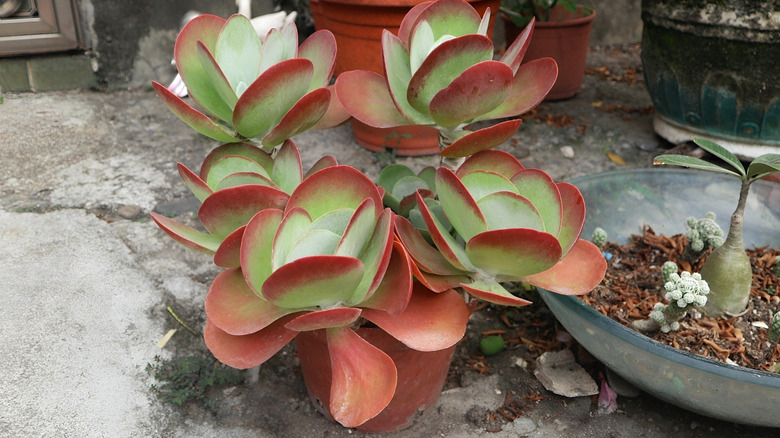
Flapjacks (Kalanchoe thyrsiflora 'Flapjacks'), which has several other common names, including paddle plant and dog tongue, is among the succulents that grow beautifully indoors throughout winter. This succulent makes its statement with large, paddled-shaped leaves that turn red at the edges if they get enough sun exposure. You may notice a powdery substance on your flapjacks that makes you question whether you have dust on your succulents. It's actually farina, scientifically known as "epicuticular wax," and it protects your plant, so don't try to rub it off.
Ruby blush chenille plant
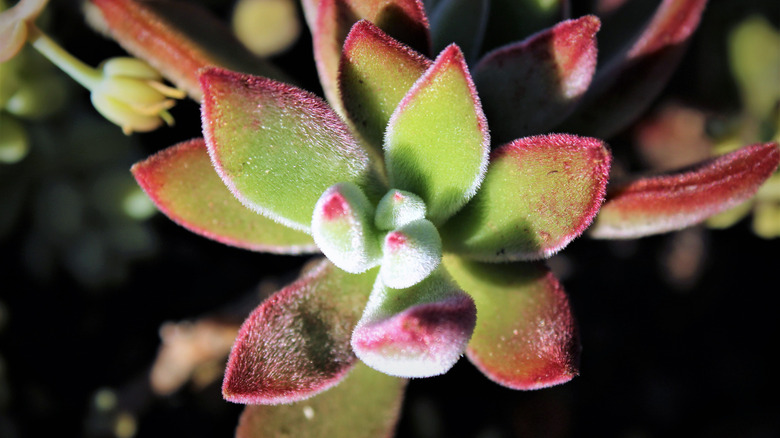
Both texture and color enable ruby blush chenille plant (Echeveria pulvinata 'Ruby Blush') to make a statement. Its leaves have a velvet texture and ruby-red tips, the color of which intensifies in cooler temperatures. Cooler times of the year also bring orange, bell-shaped flowers to this striking succulent. Texture and color work together to make a dazzling display as light shimmers on the hairs on ruby blush chenille plant's leaves. To avoid fungal diseases, keep water off the leaves, and remove dead leaves so they don't encourage pests.
Cathedral window
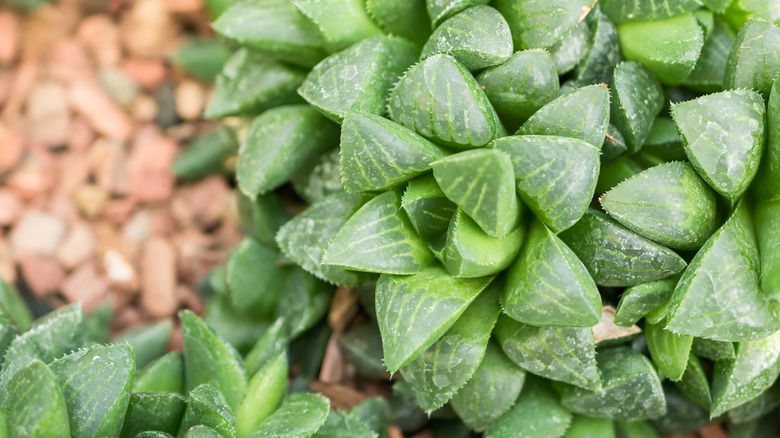
The interplay of sunlight on translucent, bright green, fleshy leaves makes a statement for cathedral window Haworthia (Haworthia cymbiformis). This compact succulent will grow to about 3 inches tall and is easy to care for. Avoid overwatering this slow-growing beauty; water only when soil is completely dry. Like many of the succulents listed here, cathedral window Haworthia can suffer burned leaves if sunlight is too intense. The succulent is most commonly propagated with leaf cuttings and offsets.
Echeveria 'Blue Curls'
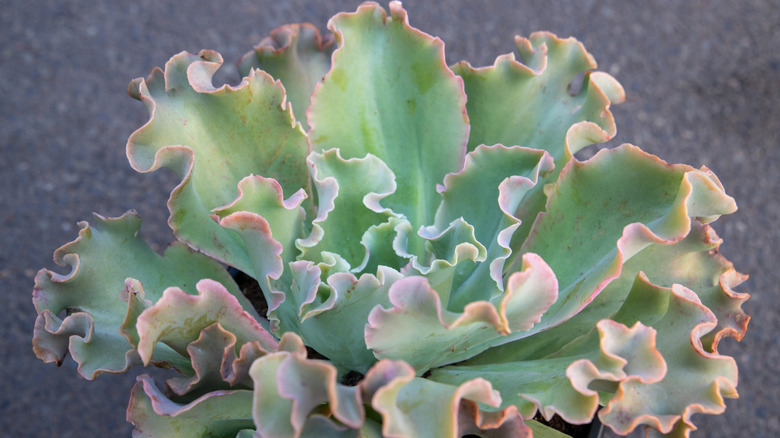
What a show Echeveria 'Blue Curls' puts on with its scalloped, pink leaf edges and blue-green leaves, with color softened by the farina coating common to Echeveria succulents. The leaf edges get even frillier when the plant matures. Selections like 'Blue Curls' in the Echeveria genus are fast-growing succulent plants that will grow as large as 12 inches wide. Pink bell-shaped flowers may appear on stalks in spring or summer but not until the plant has matured. Propagate using stem or leaf cuttings.
Ruby necklace plant
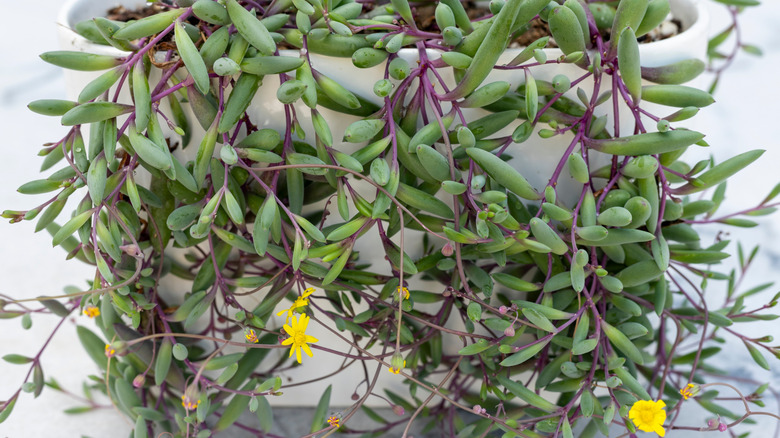
Make a statement with the colorful stems, pickle-shaped leaves, and yellow flowers of ruby necklace plant (Othonna capensis), also known as string of rubies or string of pickles. Ruby necklace plant makes a statement as a trailing plant that adds variety and texture to your succulent collection. It's perfect for a hanging basket. Those red stems are the result of the sun; they start out green but turn red under bright sunlight. A daily six-hour dose of sunlight should do the trick in retaining those ruby stems.
White velvet
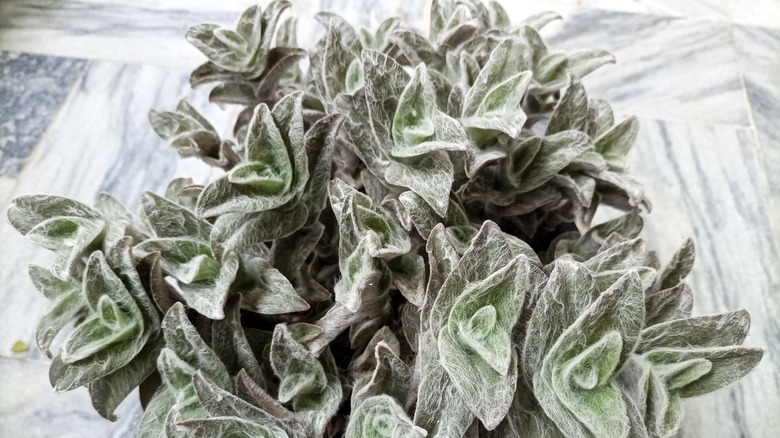
You'll find texture galore on white velvet (Tradescantia sillamontana), which is covered with white hairs on both leaves and stems. This showy statement succulent, also known as cobweb spiderwort, grows up to 12 inches tall and 18 inches wide. You can keep the plant bushier if you pinch off growing tips. As is the case with several succulents on this list, sunlight intensifies and changes colors on the plant, with leaves turning a brilliant purplish-red in bright sun; the leaf undersides are already that color. Expect bright purplish-pink flowers in the summer.
African milk tree
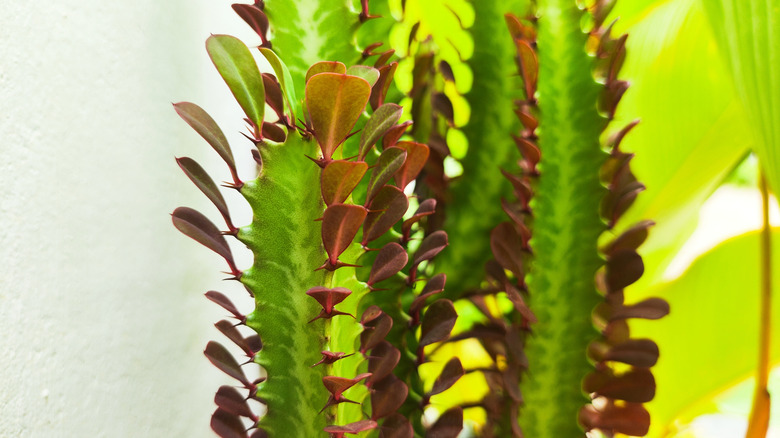
Shapes, colors, and textures come together to make a statement in the form of African milk tree (Euphorbia trigona), which bears a resemblance to a cactus. The succulent comprises columnar stems with three sides, and maroon leaves emerging from short spines. Like most succulents on this list, African milk plant has significant light needs, which could make it a challenge to grow indoors; be sure to give it bright, indirect sunlight. Propagate this succulent with stem cuttings and air layering (learn what to know about air layering your indoor plants).
Variegated string of pearls
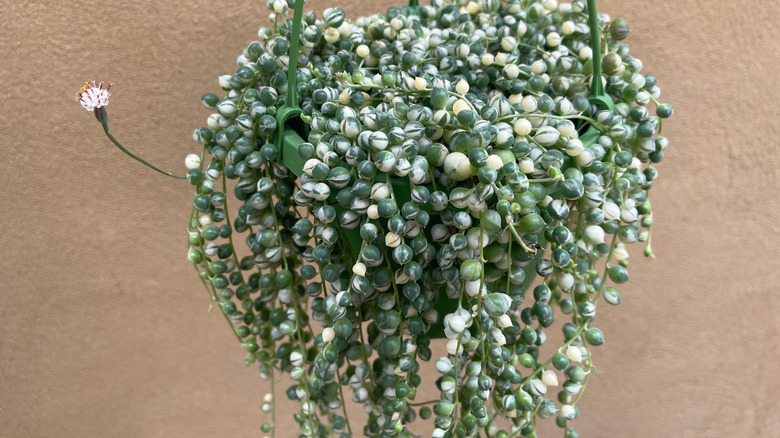
The string of pearls (Curio rowleyanus) succulent is a show-stopping statement plant to begin with because of its resemblance to a pearl necklace, but the variegated string of pearls (Curio rowleyanus f. variegatus) further adds the nuance of color differences on each "pearl." The pearls are the leaves of this popular succulent, and variegation shows up as mottled areas of both green and creamy white on the pea-sized leaves. Variegated string of pearls may produce long stalks with white brushy flowers in the summer.