

Color Block Your Furniture For A DIY Update Anyone Can Handle

Updating your home doesn't have to mean completely overhauling the entire design. Sometimes it can be as easy as revitalizing a piece of furniture you already have. Color blocking is a simple method you can tackle even if you don't consider yourself crafty. You'll be amazed at how much of an impact it can have. Often associated with the fashion industry, this style of painting involves applying distinct blocks of color to a piece of furniture. If you're not a fan of the distressed look or abhor stencils, color blocking is a common design trick that puts a fresh spin on the minimalist design trend.
"Don't be afraid to try color-blocking other items around your house, like a coffee cart, a pantry door, or a dresser," says Jenn Pike, blogger and lifestyle influencer at Wild Rose Country Home, via The Spruce. Pike painted the bottom of the legs of four barstools light gray to add subtle detail to her kitchen island design. This quick, beginner-friendly method is highly versatile because all you need is some paint. Don't just stop at the furniture you already have — use this affordable DIY to upgrade thrifted furniture instead. Now, let's break down the basics on how to color block furniture.
How to color-block furniture using paint
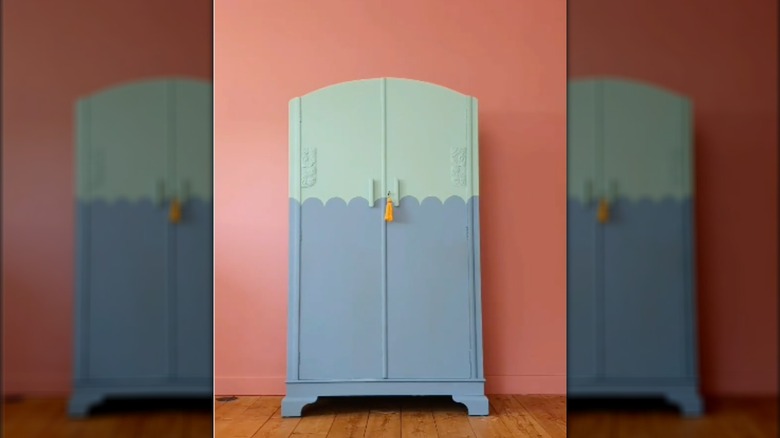
Want to use bold colors in your home? You can do it easily with color blocking. The key to pulling off this trend is finding harmony and balance in your color selection. You can use a color wheel to identify compatible color schemes. Colors next to each other on the wheel are analogous; colors directly across from one another are complementary. In slightly more advanced color theory, three colors at equal distances from each other on the wheel are triadic — they work well as a group of three on a piece of furniture. You can also pick one bold color for a monochromatic look or pair warm and cool shades of the same neutral hue.
Once you've picked out your preferred paint colors, it's time to plan out your color-blocking pattern. For a simple furniture flip, paint one half of the piece one color — say, the bottom half of a free-standing closet. You can leave the other half (the top half, in this example) unpainted or paint it with an analogous or complementary color. Divide the colors with a straight line or get as decorative as you wish — think diagonals, scallops, or even a mild ombre effect. If you're ready to tackle a bigger challenge, try coordinating your color-blocked furniture with the color-blocked walls of a room. There are near-endless design configurations to explore.