

See A Big Swarm Of Honeybees In Your Yard? Don't Panic — Here's What's Really Going On
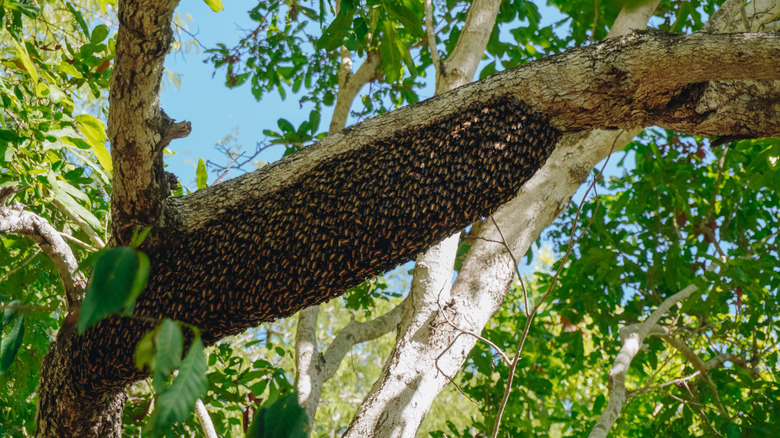
While certain fast-growing trees will turn your yard into a pollinator haven, what do you do when native insects like honey bees bring the party to your doorstep? In case you're an experienced beekeeper, you might see this as an opportunity to lovingly manage one more colony. But it can be quite disconcerting to see hundreds or thousands of tiny insects buzzing about your porch (or patio) if you aren't friends with them. To help you remain calm and take the right steps, we reached out to Elina L. Niño, Ph.D. — professor of Cooperative Extension for Apiculture, Department of Entomology and Nematology, University of California, Davis. Explaining why the tiny creatures might suddenly appear in your yard, she shares in her House Digest exclusive, "Swarm is a natural process of colony reproduction, where a part of the colony buds off and leaves an original nest to create a new colony."
Although generations of bees can cohabitate without issues, they usually start looking for new nesting sites when the current one gets overcrowded, she elaborates. "Queen pheromones are no longer effectively being transmitted to most of the workers, [and] this signals that it is time to swarm," she says. They stop feeding the queen to help her lose weight. After they reach the goal, the younger workers fly away with her to hunt for a new temporary home, reveals our expert. However, you won't just see a swarm in your backyard at random. "Honey bee colony size varies throughout the year. In the spring time, as the colony comes out of winter the queen starts ramping up egg laying which increases population size.," divulges Niño.
What to do upon noticing a swarm of honey bees in your yard
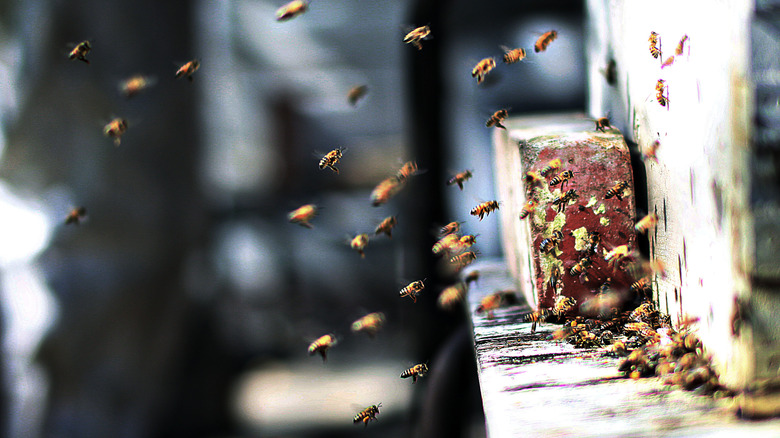
When you notice a big swarm of honey bees in your yard, there's no need for you to panic. That being said, you shouldn't disturb the insects, either. Niño agrees and says in her exclusive interview with House Digest, "While swarming bees are docile (primarily because they do not have a nest to defend at this point), the best course of action is to not disturb them and admire them from a far." These sudden house guests won't stay for long, so you don't have to get rid of the honey bees in your backyard or worry about them harming you, your family, or pets. Laying out the most probable timeline a swarm will inhabit your porch, she clarifies, "A swarm settles in a location (e.g., tree branches, bushes, under awning, sometimes in more unusual places such as car side mirrors) for a short time period and is usually gone within a few hours to a day or so, depending on the weather."
The exact time frame will depend on how soon they find a new site good enough for building a nest. While lounging on your property, "they dispatch scout bees to locate possible new nest sites. Scouts return to the swarm and communicate the location and 'quality" of the nest.'" Then, all the information is collated and deliberated on. "Upon reaching the quorum, the swarm departs to the new nest location and they start a new colony," according to Niño. She also mentions that the worker class will get busy building combs from their wax.
Is it possible for you to keep a honey bee swarm in your yard?
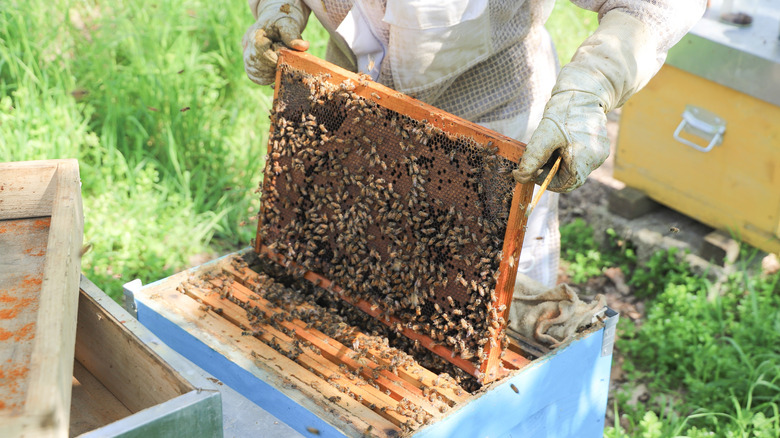
Although the benefits of having a bee house in your yard are undeniable, enticing a swarm to permanently take shelter there might be tough. Explaining the rationale behind this in her exclusive sit-down with House Digest, Niño mentions, "Technically, one cannot keep a 'swarm' in their yard as this is a transitioning stage — [the] swarm will move on to a new nest and will form a colony." That being said, she feels that it isn't impossible for the bees to settle down on your property. "However, sometimes a swarm ends up staying in a location if they were not able to leave due to weather, for example, or other circumstances, and they can start building a nest," she says. Under such circumstances, she feels you now have two options: Get in touch with a local beekeeper to remove the swarm or let them stay long-term.
In case you choose the latter, know that you'll be legally responsible for the colony, warns our expert. She illustrates, "Many states will have specific rules for keeping honey bee hives on your property. For example, in California, colonies need to be housed in hives that have removable frames so an apiary inspector can check the colonies as needed for any sign of diseases or pests." That's not all. "There are also regulations about marking and registering colonies," she adds. So, do your research, check out what it takes to be a beekeeper, and go through the state, county, and local (if any) decrees to care for the buzzing insects responsibly and avoid legal issues later, concludes Niño.