

Snake Vs Bird Eggs In Your Yard: How To Tell The Difference
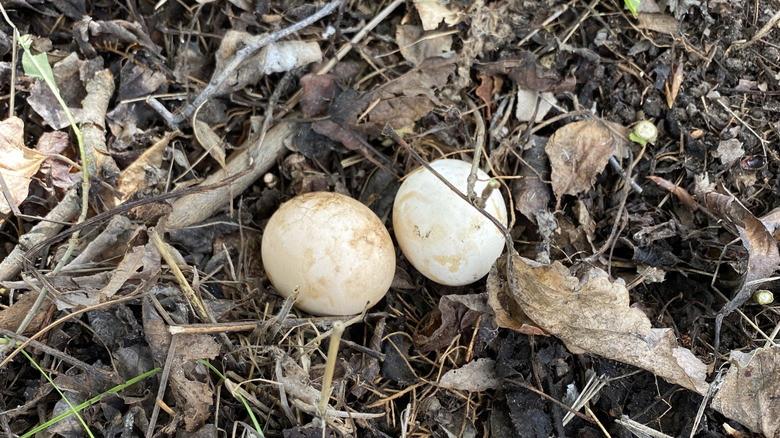
You wake up, head out to check your mail, and see a collection of small, strange eggs nestled in the grass. Are you looking at a clutch of snake or bird eggs? The clues as to whether the eggs are the product of a slithering snake or a feathery bird lie in their texture, shape, size, color, markings, and thickness of the shell. The laying style, or how the eggs are grouped, is also a big indicator. Bird eggs can vary dramatically in appearance, so determining what you're dealing with requires paying attention to these important details.
The appearance of snake eggs is one of the surefire signs you have a problem and may be facing the slithering arrival of baby snakes in your yard. Some snake species give birth to live young, so it's possible the eggs aren't reptilian. On the other hand, if the eggs originate from a bird, then you may worry whether the eggs fell from a nearby nest. There's no need to panic, though, because there are some ground-nesting birds, such as killdeer.
In either case, it's best to avoid disturbing the eggs and call for a professional for identification or removal, if needed. Knowing precisely what animal you may be dealing with can help you figure out the next steps, as well as who to call for assistance.
Telling the difference between snake vs bird eggs in your yard
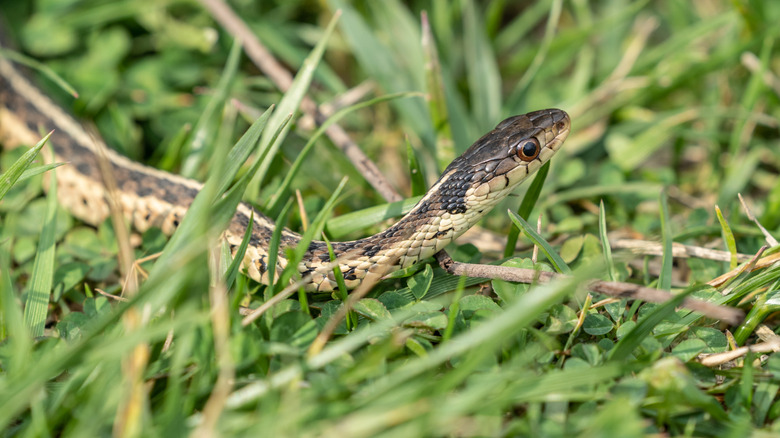
Identifying whether you're dealing with backyard bird eggs or snake eggs in your yard can start with looking at the eggshell. Do the eggs look soft enough that you could easily squish them? Snakes lay pliable "leathery," soft-shelled eggs with a sticky coating, while a bird's egg will feature a hard shell. In addition to these differences, snake eggs are typically white or off-white without markings. In contrast, there's a wide range of bird egg colors, including blue, green, and brown. Avian eggs may be speckled, spotted, or even banded, though some species, such as doves, lay plain white eggs. Depending on their age and condition, snake eggs may be opaque or even translucent.
Shape is another determiner of whether it's a snake versus bird egg. A snake egg will typically feature an elongated, oval shape which is described as symmetrical. Depending on the species, a bird egg may be asymmetrical or featuring an ellipse shape. Finally, if you're still unsure about whose eggs they might be, pay attention to how they're clustered. Birds' eggs may be gathered together, but aren't attached to each other like snakes' are. After you determine whether you have snake eggs or bird eggs on your property, be careful. Moving the eggs may damage or kill them, so trust a wildlife expert to handle the situation. Then, if needed, you can take steps to deter snakes from your yard.