

The Unique 19th Century Home Design You Rarely See Anymore
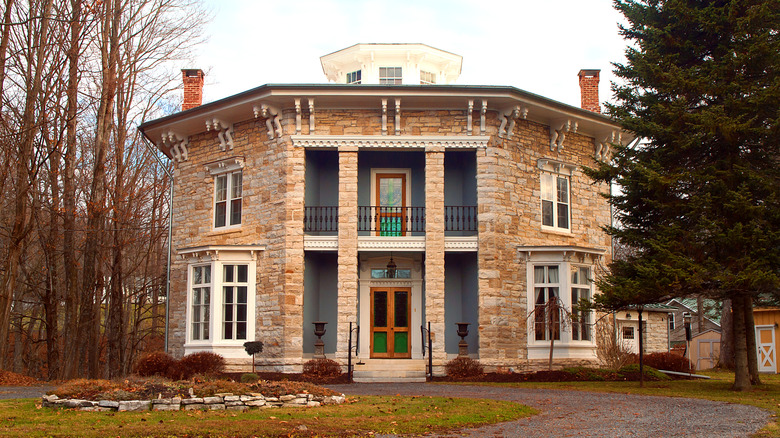
Architecture has seen some fascinating, and relatively quirky, designs over the years. But perhaps none are more interesting and odd than the one popularized in the United States by lecturer Orson Squire Fowler in 1848. Rather than a square or rectangle, Fowler promoted the idea for an octagon-shaped house after feeling dissatisfied with the lack of progress in the architectural sphere. Have you seen one of these houses yourself? Well, according to a paper published in the journal Perspectives in Vernacular Architecture, around 560 specimens of this house design have been identified. However, some of them have since been demolished, so spotting one these days is pretty rare.
But what exactly is an octagon house? These were eight-sided buildings often designed as personal residences, though the shape was also used in company structures, barns, schools, and churches. This is because their eight-sided design was believed by Fowler to promote a more communal feeling between the occupants. That wasn't the only benefit, however. The octagonal style actually allowed for 20% more space than a traditional square and, because windows could be placed on every side, the layout made it possible for more natural light to enter the rooms as well. In addition, the design featured less external wall surface area, so it was said that these buildings were cheaper to keep warm because less heat escaped from the walls. Do you think the vintage octagon house is one of the historic home design trends that should make a comeback today? Let's dive into the history of these fascinating structures to see just how practical they really were in their heyday.
History of the octagon house
Orson Squire Fowler was a lecturer and phrenologist — that is, someone who studied the now discredited pseudoscience of measuring someone's skull to learn about their mental traits and personality. He was also an activist interested in innovation and progress, so when it came time to design his own home, he was captured by the idea of an octagon-shaped one because he believed it would be cheaper to build and thus more available for the poorer classes. He wrote two books on the subject: "The Octagonal Mode" in 1848, followed by "The Octagon House: A Home For All, or A New, Cheap, Convenient, and Superior Mode of Building." The latter publication was so popular that it went through seven printings, resulting in many of these oddly-shaped buildings being erected, particularly along the East Coast and Midwest of the United States.
However, the octagon house is not one of the trends that stand the test of time for a variety of reasons. First, Fowler rented out his own eight-sided home in the late 1850s because of a financial hit he took during the economic downturn known as the Panic of 1857. The following year, some of the residents within it suffered from typhoid, possibly due to sewage leaking through the walls made of gravel, which Fowler believed was a stronger, more affordable alternative to wood. The house was eventually torn down in 1897. The lack of success in Fowler's own home and other quirks of this eight-sided design — such as weird closet angles, triangular rooms, and the awkward placement of the staircase — likely contributed to the octagon house's ultimate decline in popularity along with changing tastes.