

The Common Evergreen That's Attracting Snakes To Your Yard
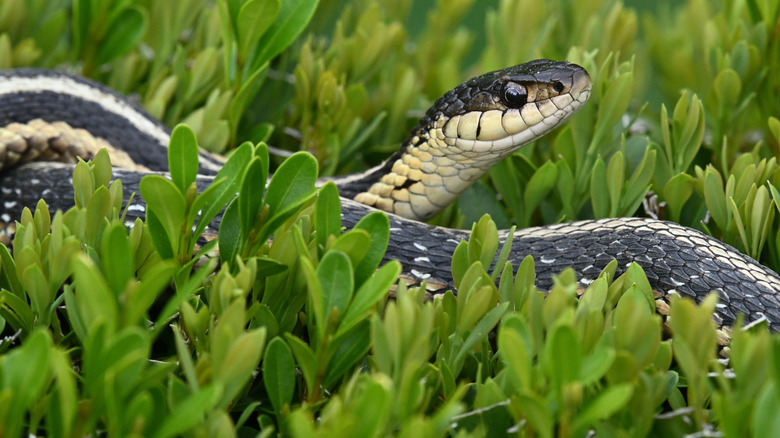
Seeing a snake slithering through your yard can be quite a shock, especially when you realize your own plant choices might be inviting them in and giving them a cozy home. While homeowners often pick evergreens for their year-round color and privacy, the dwarf cypress (Cupressus) is a top offender for attracting snakes. These trees, including common varieties like "Tiny Tower" (Cupressus sempervirens) or the silver-blue Arizona cypress (Hesperocyparis arizonica), are commonly found in residential areas because they grow compact and neat.
These evergreens grow well in USDA Hardiness Zones 7 through 11, though certain cold-hardy trees can survive in Zones 4 through 6. Because they don't lose their leaves in winter, they provide a permanent home that keeps snakes safe and hidden throughout every season. Dwarf cypress trees are usually planted near foundations or near the front door but this creates a direct path for snakes to wiggle right up next to your home. Because the branches of dwarf cypress trees are stiff and sturdy, they provide an excellent hiding spot, allowing snakes to squeeze into tiny crevices where bigger predators can't reach them. Fortunately, once you understand why these trees attract such reptiles, there are simple but effective ways to deter snakes from your yard.
Dwarf cypress trees create the ideal environment for snakes to shelter and hide
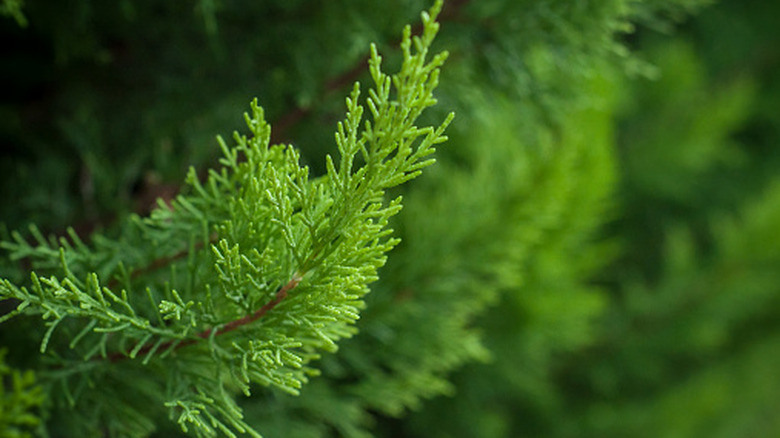
The way a dwarf cypress tree grows makes it an irresistible piece of real estate for a snake. These trees have incredibly tight, scale-like needles that form a wall of green, making it impossible for a hawk or anyone walking by to see what's resting inside. Because these evergreens need to be planted in direct sun to stay healthy, they offer the best of both worlds for a reptile. And since snakes are cold-blooded, they need spots where they can regulate their temperature. The deep shade of a dwarf cypress provides a cool spot during a hot afternoon, and a snake can easily pop out from the shadows to soak up some rays when it needs to warm its body.
The branches of these trees usually start right at the soil line, so a snake can slip from the grass into the tree without ever being spotted. This ground-level coverage also keeps the soil underneath dark and damp, which is exactly the kind of humid atmosphere many snakes look for to stay healthy. The interior of a dwarf cypress typically has a collection of dead and dry twigs which give a snake a place to rub against when they shed their skin. Having a tree that touches the ground is like giving a snake a private, climate-controlled home. So if you want to avoid creating these inviting hideouts, consider looking into plants that can help keep snakes out of your yard.
Dwarf cypress trees also provide sustenance for snakes
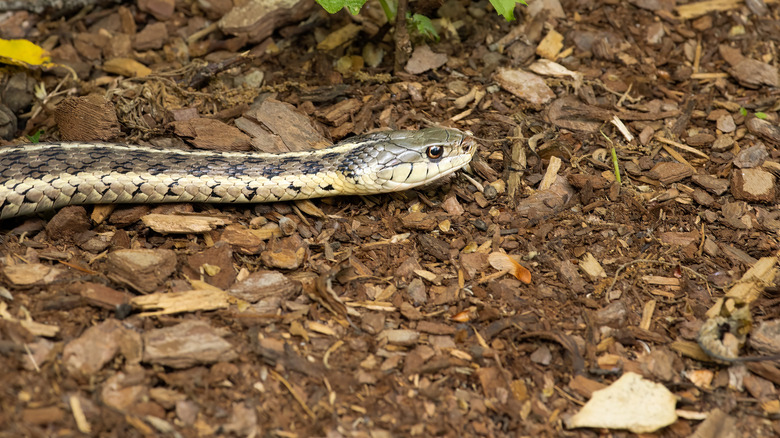
A dwarf cypress doesn't only provide snakes a place to sleep — it gives them a spot to find their next meal. The dense structure of the tree makes it a popular place for birds to build nests and for rodents to scurry for cover. Mice and other rodents are naturally attracted to the heavy cover of the dwarf cypress, and they often set up their own homes in the soil at the base. The constant carpet of fallen needles also holds onto moisture, which brings in frogs, slugs, and large bugs.
As these trees drop their small cones, they contribute to the thick layer of debris on the ground. When this pile starts to break down, it acts as a natural, heat-generating mulch that attracts all types of insects. Since the dwarf cypress sheds its needles, this prevents the ground underneath from drying out or thinning. This means that once a food source moves in, it usually stays put, giving snakes a reason to hang around your yard instead of just passing through. When you plant these trees in your yard, you're providing a full ecosystem that covers both shelter and food for the snake.
To keep snakes from moving in, you should rake away the fallen cones and needles to prevent a thick layer from forming. You can also prune the lowest branches so they sit at least six inches off the ground, which removes the shelter snakes love and allows more light reach the soil. Switching to a sharp or prickly mulch, like crushed eggshells or gravel around the base of the tree is a trick that helps keep snakes out of your garden because it makes the area much less comfortable for a snake to live there.