

The Invasive Ornamental Tree You May Want To Reconsider Growing In Your Yard
We all want our homes to look good both inside and outside, and when it comes to the outside, one of the easiest ways to enhance the visual appeal is by planting trees. Now, naturally, when choosing trees for their garden, most people want something that grows quickly and looks good. This might lead some people to choose the Russian olive tree (Elaeagnus angustifolia). It grows fast — as much as 6 feet in a single year. Plus, it can live for around a century. On top of that, it looks extremely good, thanks to its striking silvery foliage, which brings an airy, shimmering look to the landscape. And if that wasn't enough, the Russian olive also produces fragrant flowers in the spring. Sounds like a dream tree, right? But you might want to reconsider growing it in your yard. The Russian olive is an aggressive spreader and a declared invasive species in the U.S.
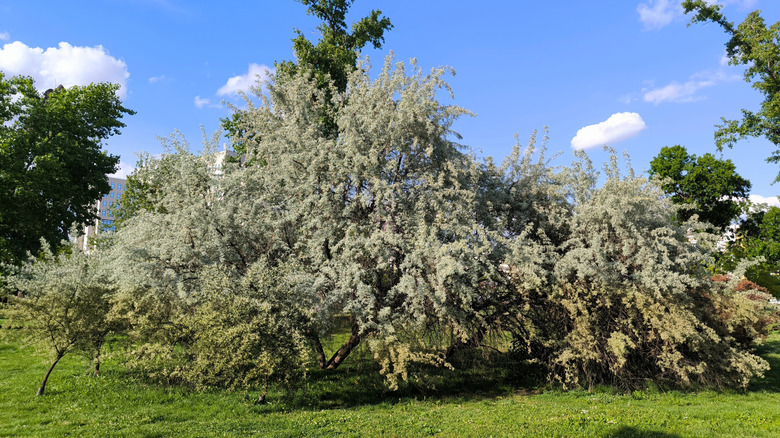
The Russian olive can even appear in places and homes where it was never planted. If you suspect one of these trees has appeared on your property, you'll need to know how to identify it. For the Russian olive tree, its signature foliage is often the biggest giveaway. The leaves are narrow and measure between 1 and 4 inches long, and they are covered in silvery scales. Besides that, you can also identify the Russian olive by its reddish-brown and dark gray bark. Also, as the tree grows, it develops an extremely thick canopy. This can crowd out native plants and disrupt the local system. So, if you're thinking about planting it in your yard, consider another beautiful flowering tree instead. And if you find it growing on your property, try to remove it as soon as you can.
Removing the Russian olive tree and what to grow instead
When it comes to getting rid of invasive and unwanted trees, just cutting them down is often not the most reliable option. The same is true for the Russian olive tree as well. It has a resprouting habit and grows again very quickly if the conditions are right. This means if the plants are young, you need to pull them out in a way that gets the root system out as well. If the tree is large, you will have to take measures to cut down the tree and remove the tree stump as well. Put simply, cutting alone is not very successful when it comes to getting rid of the Russian olive.
That is where chemical control options can help. These involve injecting the underground parts of the Russian olive with a systemic herbicide like glyphosate. This not only kills the root system of the tree but also stops new sprouts. Just make sure that you follow all package instructions when applying an herbicide or get it done by a professional.
Finally, what tree can you grow in your yard instead of the Russian olive? Since the Russian olive is hardy in USDA Zones 3 through 7, one of the best alternatives is the American silverberry (Elaeagnus commutata) tree. It is native to the US, it grows in the same zones, and it looks somewhat like the Russian olive as well. You won't find a better alternative than this. However, if you do need more options, you can also consider the Amur chokecherry tree (Prunus maackii) or the white fringe tree (Chionanthus virginicus).