

The Valuable Pottery Brand That Collectors Always Hunt For At The Thrift Store
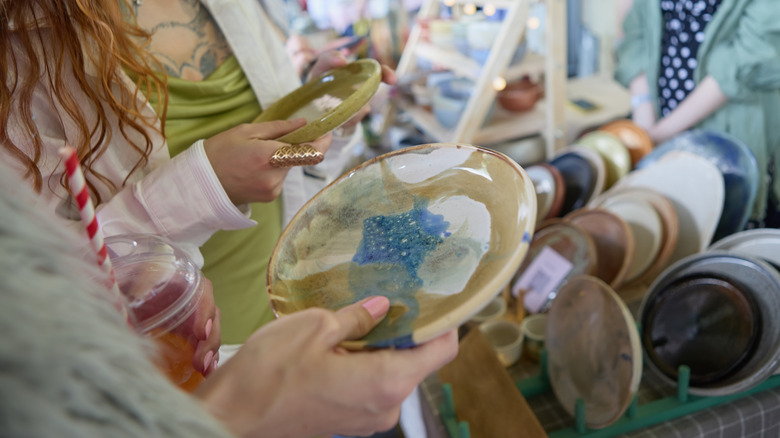
If you regularly visit thrift stores looking for items that would make "Antiques Roadshow" appraisers gasp, pay close attention to the pottery. A valuable pottery brand that collectors always seek at the thrift store is The Rookwood Pottery Company, a cornerstone of the American Arts and Crafts movement. Founded in 1880, the company has a long ceramic legacy, having produced millions of pieces over its history.
The Rookwood Pottery Company began in Cincinnati, Ohio, under the direction of artist Maria Longworth Nichols Storer. A member of the wealthy Queen City Longworths, she worked as a china painter. She was inspired to go into pottery after viewing a Japanese pottery exhibit at the 1867 Centennial Exposition in Philadelphia. When naming her company, Storer borrowed her father's 100-acre estate title, where she grew up in Cincinnati's Walnut Hills neighborhood. She began with a single kiln, firing ceramics from clay sourced from the Ohio River Valley, and started her studio in an old schoolhouse in the city's Over-the-Rhine neighborhood. Early pieces made with this clay often had a yellowish-orange tint due to mineral deposits from the region.
After winning an award at the 1889 Paris Exposition, Rookwood became renowned for work in American ceramics, even popularizing a glaze nicknamed "Cincinnati Limoges." It created Japanese-inspired pottery with motifs of flowers and animals, eventually bringing in artist Kitaro Shirayamadani. Shirayamadani became Rookwood's star artist, wrapping vases and other pottery in intricately detailed art. Rookwood prices vary based on age, artist, glaze, and condition. Commonly thrifted vases may go for $100 to $400, though pieces from the company's early years can fetch $1,000 to $3,000. Shirayamadani's work is highly prized, with some pieces valued as high as high as $33,000, and one reportedly setting an auction record at $350,000.
Identifying pieces of Rookwood Pottery
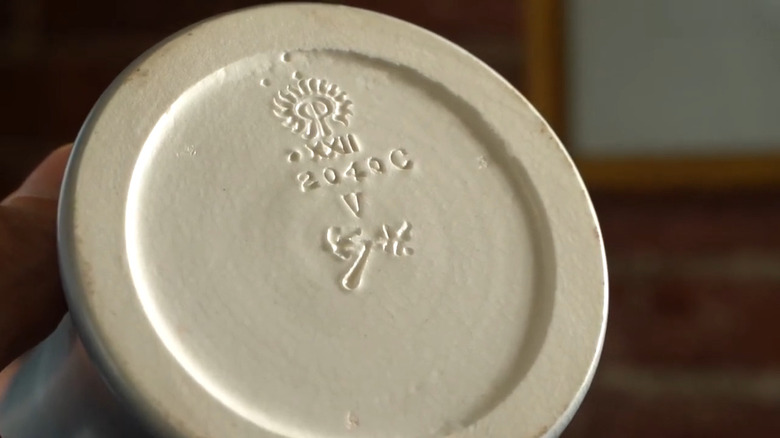
When examining thrifted vintage ceramics, look for a bottom stamp. Early stamps simply read "Rookwood," but in 1886 the company began using a backward "R" next to a "P," adding a flame for each subsequent year until 1900. Counting the flames will help you date Rookwood pre-1900 ceramic art, after which the company began stamping pieces with Roman numeral dates. In addition to these markings, some ceramics may have an artistic cipher, monograms, or signatures of the artists. There are also some specialty pieces that were not part of a production line, marked with an "S." Early pieces made prior to 1900 also feature an internal clay code. Per Just Pottery, these include G (ginger), O (olive), P (soft porcelain), R (red), S (sage green), W (white), and Y (yellow-bodied clay).
Pay attention to the pottery's appearance and texture, as Rookwood featured many glazing styles across its creations. The earliest pieces of the 1880s featured a standard clear glaze on pieces in earth tones. Later years introduced the Iris glaze, Black Iris, Vellum, and other colorful glazes, expanding beyond the earlier matte finishes. When holding a vase, bowl, or other piece of pottery, you should notice the depth and smoothness of the glaze. Subtle imperfections echoing its handcrafted artistry are also common, as is crazing, a series of tiny cracks on the surface from age or the glaze shrinking after firing. If you're fortunate enough to find a piece of Rookwood pottery, you can check online databases and determine whether you want to sell it or use your vintage ceramics as decor.