

12 Reasons Your Driveway Is Sinking (And How To Fix It)
We may receive a commission on purchases made from links.
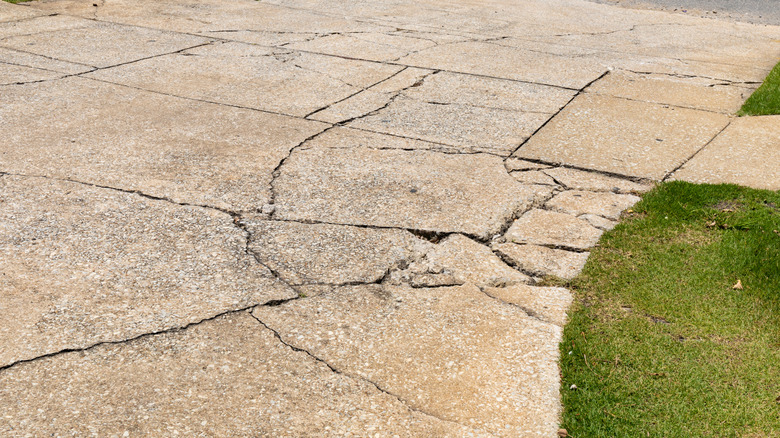
Driveways don't always get the attention they deserve — until they're no longer looking their best, that is. The reality is that driveways are a set-it-and-forget-it thing for many people. After all, concrete driveways are supposed to last for about 25 to 30 years, and asphalt driveways for 15 to 30 years. But sometimes driveways can start to show wear and tear far before those timeframes. Once a driveway starts to crack and become uneven, many homeowners can't help but feel like it has become an eyesore. But while aesthetics tend to be the thing that gets people's attention, a sinking driveway can actually pose real risks. When driveways become uneven, they can become tripping hazards for homeowners and their guests. Additionally, a sinking driveway can also be an early sign of trouble for your home's foundation.
Fortunately, there are things that can be done to fix sinking and prevent it from getting worse. If you're wondering why your driveway may be sinking, you've come to the right place. Whether you have a concrete or asphalt driveway, keep reading to learn about 12 reasons your driveway is sinking and how you can fix it.
Tree roots growing under your driveway
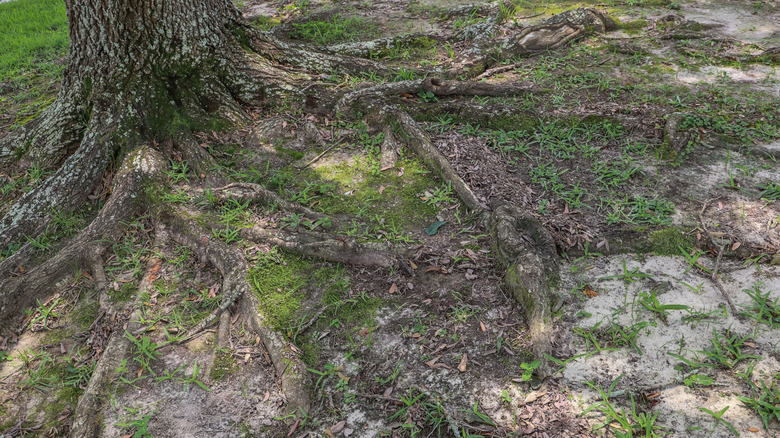
Trees can be a beautiful part of your home's landscape. Unfortunately, though, their roots can spell disaster for your driveway. As trees grow, their roots begin to spread below the ground. In fact, tree roots can eventually become wider than the tree's canopy by two to three times. As roots grow and find their way under your driveway, they can create pressure that forces your driveway to push upwards in some sections. This can eventually cause cracks and lead to an uneven driveway.
The good news is that if the cracks in your driveway are small, they can be repaired with concrete filler or asphalt filler. If the damage is more severe, for example, if you can see cracks coming up under your driveway, you'll want to call an arborist before calling a concrete or asphalt contractor. An arborist will be able to assess the roots to determine if they can be trimmed without destabilizing the tree. After cutting the tree roots (or tree), the damaged sections of your driveway will need to be replaced. A root barrier should be installed to prevent future damage.
Animals burrowing below your driveway

Seeing the occasional chipmunk or squirrel running around in your yard probably doesn't give you much cause for concern. However, that might change once you realize that these animals, among several others (gophers, mice, etc.), could potentially damage your driveway. When small animals dig tunnels under your driveway, it can shift the soil and create gaps, which can ultimately cause your driveway to sink over time due to a lack of support under the concrete or asphalt.
Once pests have started digging under your driveway, the first thing you'll want to do is call a professional pest removal service. In addition to removing pests, a professional can help prevent them from returning in the future and causing more damage. To repair the damage done to your driveway, concrete leveling can be done to fill in the gaps in the soil and raise the sunken parts of your driveway so they're level again. One common concrete leveling technique is called polyurethane foam lifting. In this process, professionals inject high-density polyurethane foam under the slab. The foam fills in the gaps in the soil and gradually lifts your driveway so that it's level again. If you have an asphalt driveway, professionals may use a technique called asphalt patching, a similar solution that involves removing the sunken area, rebuilding the base, and adding new asphalt.
Parking heavy vehicles and/or machinery on your driveway
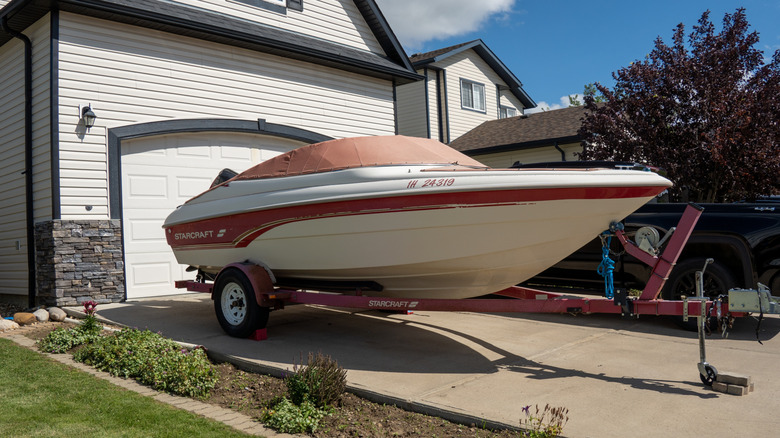
It goes without saying that driveways are meant to have vehicles on top of them, but did you know that some vehicles can damage your driveway? Heavy vehicles like RVs, boats, and construction equipment can put extra wear and tear on your driveway by creating more stress and weakening the base layer. At first, you may only notice minor cracks in your driveway. However, these cracks can eventually expand and lead to sinking.
If heavy vehicles have caused your driveway to sink, it can be repaired by reinforcing the base of your driveway with thicker gravel or geotextile fabric. This fabric provides stability by reinforcing the layers of soil under your driveway. Once your driveway is repaired, it's important to remember to avoid parking heavy vehicles and/or machinery in the same spot on your driveway for long periods of time.
Improper installation
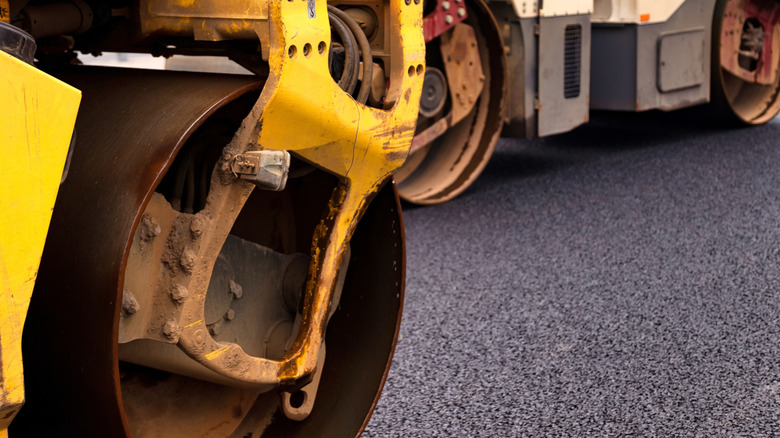
While it may seem like all driveways are more or less the same, that isn't the case. When driveways are installed incorrectly or with low-quality materials, it causes the driveway to be more likely to crack and sink. For example, if the installer did not thoroughly check the soil to determine that it needed to be stabilized, your driveway could be prone to sinking. Additionally, low-quality materials, such as loose sand, which can easily wash away, can lead to a shorter lifespan for your driveway.
When improper installation is the cause of driveway sinking, it's important to stabilize the foundation with concrete leveling or asphalt patching. This ensures that the gaps beneath your driveway are filled and the pavement is lifted to the proper level. In some cases, the foundation may need to be entirely rebuilt. It's important to contact a driveway installation professional so they can assess your driveway to determine the best course of action.
Flooding/heavy rain
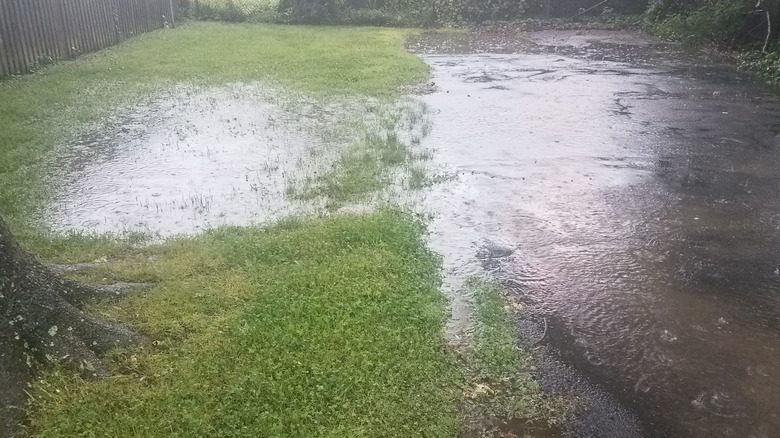
When heavy rain or flooding happens, it can create serious problems for your driveway. Excess water can cause the soil beneath to wash away, which creates gaps and holes under your driveway that can lead to instability and sinking. However, it's important to keep in mind that while rain may seem like the culprit, it's actually poor drainage that causes issues for your driveway.
The first step you'll want to take is to improve the drainage around your driveway by installing something like a French drain or a catch basin. Ensuring proper drainage will help prevent further damage, but it won't undo the damage that has already been done. If your driveway is sinking significantly, you may need to lift the slab and restabilize it using concrete leveling or asphalt repair.
Incorrect slope
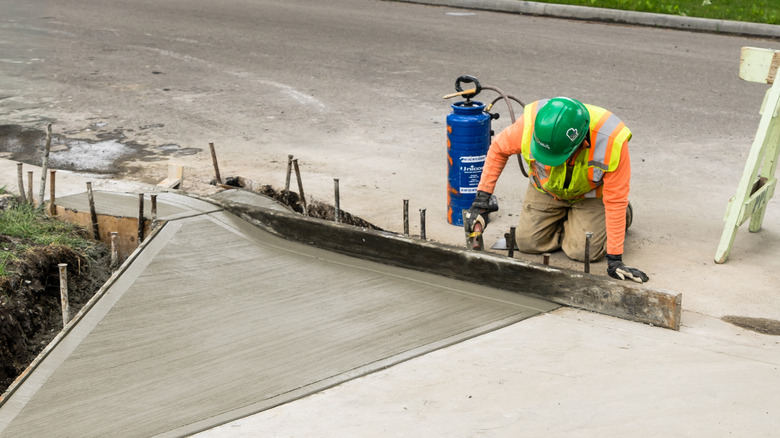
Did you know that driveways should typically have a slope of under 12%? This allows for proper drainage by preventing water from sitting on your driveway and helping move water away from your home's foundation. When a driveway isn't sloped correctly, it can lead to excess moisture, which can weaken the soil beneath the slab, causing it to shift, crack, or sink.
Although a driveway with an incorrect slope may feel like the end of the world, there are a few possible fixes. Minor slope correction can be done by installing a channel drain to carry water away from your driveway and your home. If the slope needs to be corrected by less than two inches, a concrete overlay or asphalt resurfacing can be the best solution.
Freezing and thawing
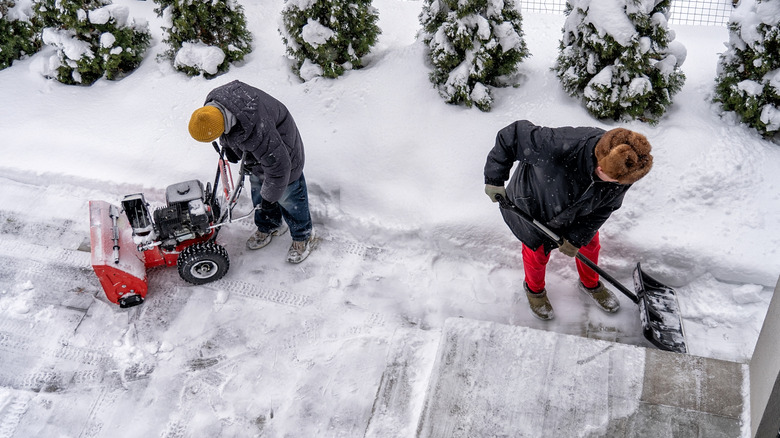
If you live in a place that deals with extreme cold, your driveway. During repeated freezing and thawing cycles, moisture seeps into the ground below your driveway's surface and expands as it freezes, lifting the soil, then shrinks again as it melts. When this happens, your driveway can start to shift and sink.
Although you can't control the weather, there are things you can do to prevent your driveway from being damaged by it. For starters, it's important to repair driveway cracks before the weather starts to get cold. This will help keep water from getting in and freezing. You can also seal your driveway to help keep moisture out. Additionally, you'll want to be mindful when using rock salt on your driveway during the winter months. While salt can be a great tool for melting snow, it can speed up the process of freezing and thawing. It's important to note that while rock salt can be more harmful to concrete driveways, it can damage asphalt driveways, too. Preparing your driveway for winter can help minimize the damage.
Inadequate or missing base material
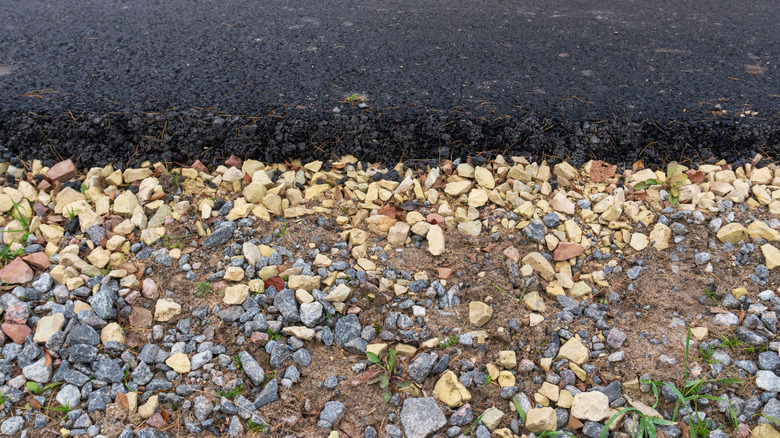
A strong foundation is essential for most things in this world, and a driveway is no exception. Whether you have a concrete or asphalt driveway, a strong base is essential to prevent sinking and other kinds of damage. Driveway bases sit on top of the soil and provide support by distributing weight to prevent sinking. Bases can be made from a variety of materials, including crushed stone and gravel. As mentioned earlier, however, sometimes installers try to cut corners by using weaker materials like loose sand. In some cases, installers forgo the base entirely.
Minor damage can often be fixed with concrete leveling. However, more severe cases may require the driveway to be excavated so the base can be rebuilt properly. The cost of rebuilding a driveway will depend on the size and the type of pavement you wish to use. For concrete driveways, the price is $8 to $15 per square foot on average. Asphalt driveways are typically $6 to $12 per square foot.
Soil naturally settles over time
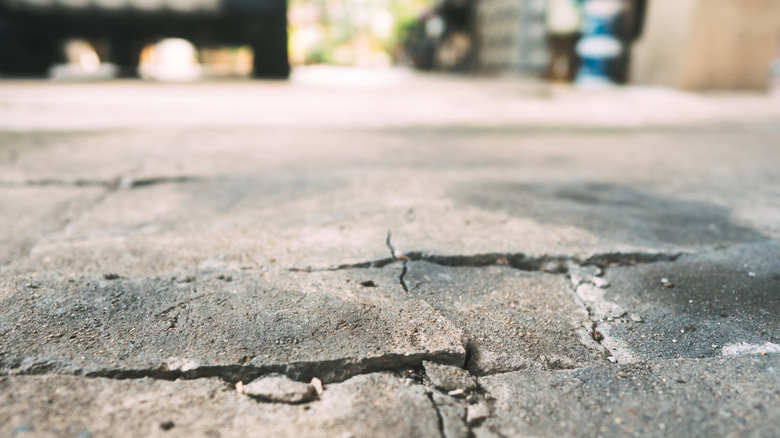
Over time, the soil under your driveway will begin to settle. Even though settling happens naturally, it can be expedited as water moves through the soil and causes it to shift. As a result, the soil becomes compressed. With time, gaps can form in the soil. When heavy objects (like cars) are constantly being put on the concrete above the soil, it creates pressure that can eventually cause the soil to shift.
Depending on the level of sinking, driveways can typically be fixed by leveling the surface through slabjacking or foam injection for concrete. It's important to note that concrete driveways are more susceptible to sinking from soil settling due to the rigidity of the material. Although asphalt can also start to sink due to soil settling, the material is more flexible, which allows it to adapt more easily to small shifts beneath the surface.
Poor drainage around the edges of your driveway
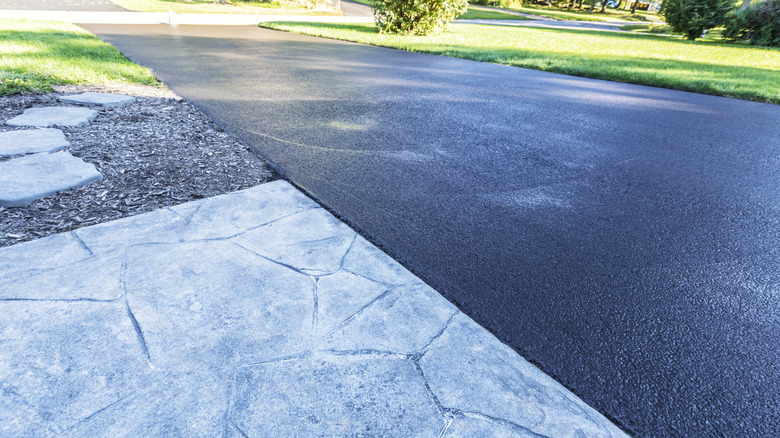
Many people are unaware that the edges of their driveways are especially vulnerable to damage. Not only do the edges have less support than the areas in the middle, but they also tend to get more water runoff than other areas of the driveway, which can weaken the soil below and cause erosion.
To minimize your driveway sinking at the edges, you can add edging drains, re-slope the surface, or install gravel channels to move water away. If the sunken area is small, it may be able to be fixed by having the edges of your driveway rebuilt and reinforced. You can also add a border made from a durable material like pavers, steel, or brick to prevent future damage. If you're feeling especially creative, you can even try out some gravel driveway edging ideas. It's also important to avoid driving and/or parking on the edges as much as possible. Since these areas have less support, they are more likely to crack under the weight of vehicles.
A sinkhole under your driveway
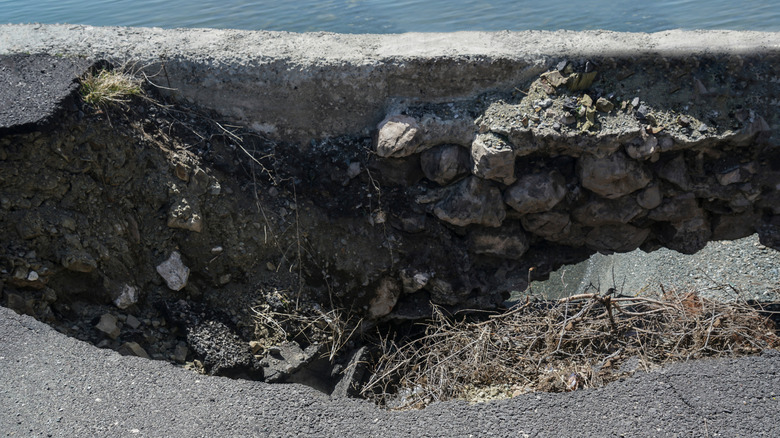
Oftentimes, when people think of a sinkhole, they envision a large hole opening up in the ground and swallowing people and/or buildings. While sinkholes can certainly cause catastrophic damage, they can also cause problems that aren't so obvious. When the soil below your driveway is washed away, it can create a large hole. Since sinkholes form slowly, you may not even know that one has developed until you start to notice your driveway sinking in certain areas.
Before any repairs can be done, the sinkhole must be assessed to determine how wide and deep it is. From there, the damaged pavement needs to be removed, and the area needs to be cleaned thoroughly. The hole will then need to be filled. Sinkholes in asphalt driveways are typically easier to repair because empty space can often be filled with asphalt cold patch. Concrete driveways, however, may require leveling and new concrete to be poured.
Unstable soil types
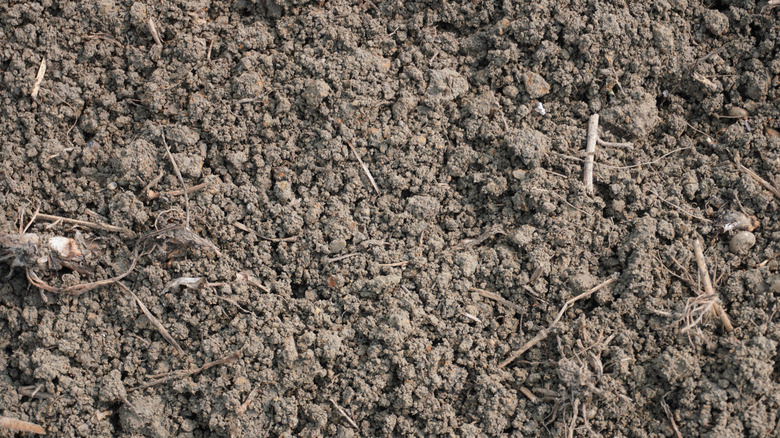
It's easy to think of the ground below your driveway as nothing more than just dirt. But the type of soil under your driveway is more important than you may realize. Driveways built over sandy or loosely packed soil are more likely to sink because these soil types shift and compress easily under weight. Clay soil can also suffer from this problem. Unfortunately, clay or looser soil types are common in several parts of the United States, including places like Florida and Georgia.
If unstable soil is causing your driveway to sink, concrete leveling can repair the damage without forcing you to replace your entire driveway. To prevent further damage, it's important to have a strong base installed. If you have an asphalt driveway, the process involves removing the affected pavement and rebuilding the base. Regardless of the pavement type, improving drainage and stabilizing the soil by mixing in a soil binder like cement or lime is also a good idea.