

The Best Way To Prune A Bonsai Tree For A Strong & Healthy Plant
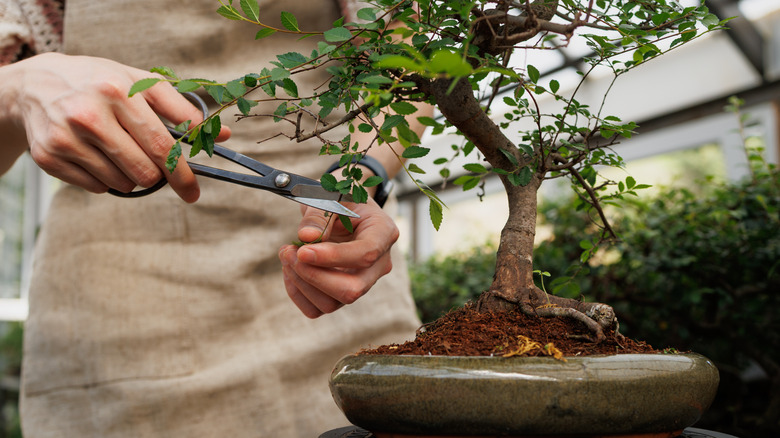
Learning how to grow and care for your own bonsai tree is an exciting hobby. Maintaining these small trees provides a creative outlet, as well as a way to relieve stress in your day-to-day life without requiring the same time and effort as a full-blown garden. However, even the easiest bonsai trees for beginners require some regular maintenance. This means learning how to prune away any branches that threaten your bonsai's well-being or aesthetic for an overall stronger, healthier plant that acts as a statement piece in your home.
Typically, when you're pruning a tree, it's solely for practical purposes, such as pruning those large branches growing from your favorite shade tree right over your home. With a bonsai tree, trimming branches does create an overall healthier tree, but it's also key for achieving the right look for an aesthetic, miniature appearance.
However, before diving into pruning, it's important to have the right tools for the job. Choosing pruning supplies specifically designed with bonsais in mind can help protect your plant from accidental damage. For the pruning itself, you'll want a variety of shears, pruning scissors, and cutters; for training your bonsai, you'll need pliers and bonsai wire. You'll also want to brush up on your specific species, as some plants such as pines require unwanted foliage to be pinched by hand rather than snipped away.
Pruning your bonsai for health and aesthetics
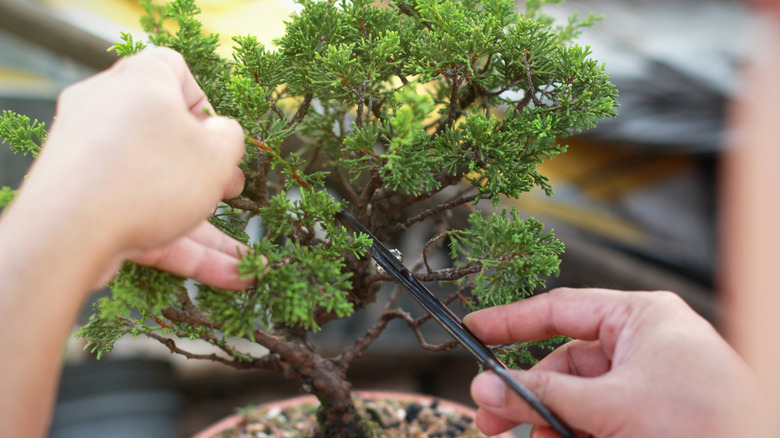
The first step to trimming your bonsai tree is maintenance pruning, which targets any branches that may lead to concerns later down the road. For this, you can utilize the Three D rule of pruning, removing any branches that are diseased, damaged, or dead. Remove dead branches entirely using your preferred scissors. For live but unhealthy branches, cut only a portion away, leaving any healthy parts untouched to continue growing. A single problematic branch can comprise the health of the entire tree, so it's important to prune these away regularly — typically at the end of each winter to promote healthy spring growth.
After you've taken the steps to prune your bonsai tree for health, then you can address the aesthetics through training pruning. Start by assessing the overall silhouette of your bonsai; is there anything that sticks out? Whether it's a stray leaf or branch, it's often safe to prune away any stragglers. From here, how you prune your tree will mostly depend on the species and your personal creative expression. Some popular areas to target are any branches that grow in unfavorable spots (such as close to the ground, across another branch, or toward the main trunk) and any that impact the overall size of your bonsai. Afterwards, you can shape your tree using wire and pliers.
Take care not to over-prune your bonsai by avoiding removing more than a third of foliage during one session. Don't worry though: pruning should be a regular part of caring for your bonsai if you want a strong and healthy plant. This means you can slowly develop your desired shape over time.