

How To Identify Gems Hiding Right In Your Yard

Have you ever heard stories about people finding a rare treasure in their yard, whether it was a fossil in their garden, a rare coin, or even a gemstone, and thought, "Wouldn't it be amazing to find something like that in my yard?" You are definitely not alone. It's an unusual occurrence, although, depending on where you live in the U.S., you might have a better chance than most. The key to identifying true gems and not just pretty rocks is knowing their defining characteristics. Gems differ from rocks by their unusual density, luster, hardness, and crystal structures. Don't worry, you don't have to have a degree in geology to learn how to tell the difference between a pretty rock and a gem.
Many areas in the U.S. can actually hold valuable deposits of gems. If you live in North Carolina, you have a higher chance than the rest of us of finding these precious treasures. Idaho, Montana, Oregon, Nevada, and Arkansas also have some large areas where gemstones are often found. Sadly, most gems are overlooked because a homeowner might not think it's possible to find something like that in their suburban neighborhood.
Gems are typically heavier for their size than a regular rock. They will have patterned crystalline structures or look like broken glass. But you shouldn't ignore an unusual rock just because it isn't shiny. Many gemstones are rather dull in their raw state and only shine when they are faceted. And before you go digging a bunch of random holes in your yard, don't forget to call and find out where your utility lines are buried.
Tips for identifying specific gems
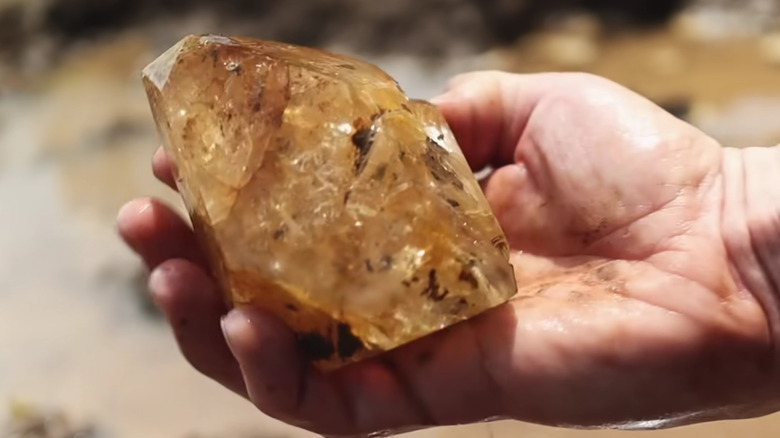
The first thing you need to do if you want to find gems in your yard is to identify what gems are possible in your location. You can consult a local rockhounding group, university geology department, or professional gemologists to help you out. These professionals could also help you with the best locations on your property to search for gems. But before you start searching, be sure you know where your property lines are or you could end up finding something in the wrong area and make your neighbor rich instead.
If you come across a shiny, clear rock in your yard, it's most likely quartz. Diamonds in the raw often look like round or octagon-shaped pebbles that are strangely heavy for their size. They will also have almost a greasy sheen to them and come in clear, yellow, brown, and possibly green. Garnets are actually quite common and can look like small blood red pebbles. They do come in a variety of colors, but red is the most common. Emeralds are well-known for their bright green color and hexagonal shape. These are just a few examples of gems you might possibly find in your yard. Another identifying characteristic you can test for is hardness. Gemstones are notoriously harder than other more common stones or minerals, with diamond being the hardest. If you think you have a truly valuable gem, you can test it by carefully scratching it on a piece of glass or porcelain. If it scratches the glass or porcelain, you may have just found a real treasure.