

How The Exterior Color Of Your Home Can Impact Your Energy Bills
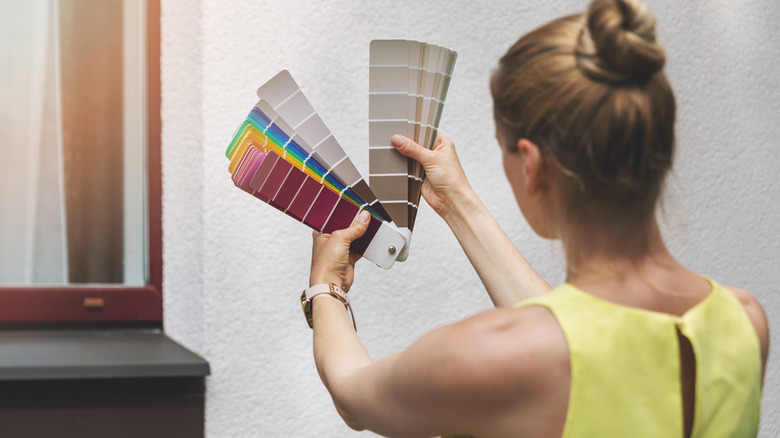
Picking an exterior shade for your home isn't easy. You need to take into account several important factors, including the style prevalent in your neighborhood, your landscaping, and how different tones complement it throughout the day. Additionally, you must consider a few architectural elements when selecting your outdoor paint color. Basing your decision on these things will help you choose the right shade without issues. Plus, if you'd like to lower your energy bills, you must think about your region's climate, too. To understand how different exterior colors impact your utility bills and ways you can conserve energy, we got in touch with Audrey McGarrell, a LEED Green Associate, and the communications manager at Cool Roof Rating Council (CRRC), for an exclusive interview with House Digest.
"A building's exterior color can affect the fraction of solar energy absorbed and heat emitted by its surface and by extension the energy consumption of the home's space conditioning systems. This is because the color affects the overall radiative properties — solar reflectance and thermal emittance — of a material," McGarrell says. "Materials with a higher solar reflectance — measured on a scale from 0-1 — stay cooler in the sun than materials with a lower solar reflectance."
But the color you choose isn't the only factor in how your home handles the sun. McGarrell adds, "there are paint and siding materials on the market that utilize 'infrared-reflective' pigments, which strongly reflect invisible infrared light and help the surface stay cool, even if they appear dark to the naked eye." Consider both color and material when improving your home.
Light paint colors can lower HVAC bills
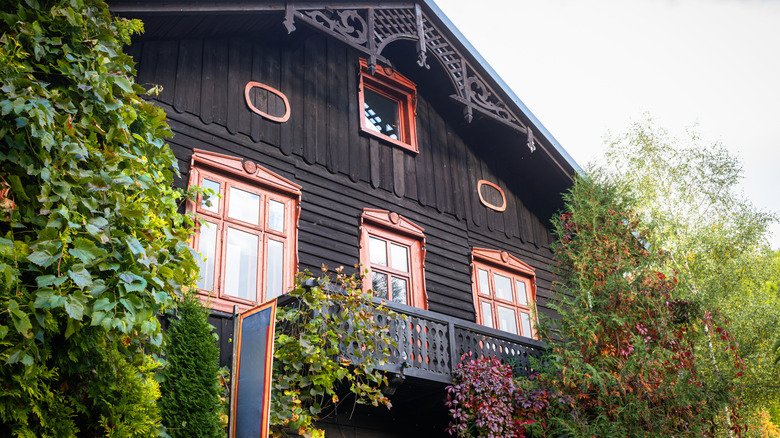
Although a color's tone isn't the only factor that influences the absorption of solar radiation, it plays an important role. Audrey McGarrell said in an exclusive interview with House Digest, "Generally speaking, for an exterior material that isn't formulated with infrared-reflective pigments, lighter colors tend to absorb less solar radiation than the same material in a darker color." If you're in a similar boat, McGarrell suggests switching to a lighter exterior color, which will increase passive cooling by reflecting more sunlight. But be sure to take your climatic conditions into account before investing in a new shade. As McGarrell explains, there are many benefits to incorporating the climate in your color choice, using passive cooling to your advantage.
"In warmer parts of the United States (ASHRAE Climate Zones 1-4B), using highly solar-reflective 'cool' exterior walls generally results in net positive annual HVAC energy savings." she adds. "In cooler parts of the country, cool exterior walls can have a neutral or negative impact on overall HVAC energy savings."
So, be sure to consider how a color will impact your exterior's solar radiation absorption before deciding. And if you're open to experiments, you may want to invest in the revolutionary new paint that can reduce building temperatures.
How infrared-reflective paint and materials perform in certain climates

In addition to your home's color, it's important to consider materials such as lighter or infrared-reflective paint or siding, Audrey McGarrell tells House Digest in an exclusive interview. "Switching to a more solar-reflective exterior can reduce air conditioning bills in warm climates with hot, sunny summers."
The amount you stand to save on utility bills will depend partially on the climate you experience and partly on your home's architecture. "For example, an older 2,000-square-foot home with gas heating in Miami, Florida might save about 5 cents per square foot on annual energy bills by increasing the exterior walls' solar reflectance from 0.25 to 0.60," McGarrell says. "This equates to about $100 a year in annual savings." Remember, this number will be change depending on your home's size, insulation quality, and age.
These savings are less pronounced if you live in a colder climate, McGarrell adds. "In cooler climates, the impacts of cool exterior walls on energy savings may be more modest savings, neutral, or an overall penalty." In the meantime, you can employ these tips to keep your home warmer and HVAC running more efficiently. Offering a last piece of advice to help homeowners pick the right color for their exteriors, McGarrell suggests comparing the radiative properties of various products, ultimately saying that homeowners should "choose the product that meets their needs."