

How To Propagate Rosemary Cuttings In Water For An Endless Herb Supply

We may receive a commission on purchases made from links.
Gardeners in cold climates often struggle to keep rosemary plants alive through winter. Except for a few varieties like 'Hill Hardy' and 'Arp,' most die back when frost arrives. While overwintering them indoors is an option, most lack the space to house such large sub-shrubs. Fortunately, you don't have to splurge on new plants every year. Instead, you can take stem cuttings and root them in water. This approach also works when you wish to clone a favorite variety for your garden or share it with your friends.
Propagating rosemary cuttings in water isn't challenging. From the youngest, non-flowering, healthy shoots, chop off a few 4- to 6-inch-long cuttings. Ensure they each have at least three nodes – small bumps on the stem from which leaves typically emerge. When cut, hormones are released that encourage these nodes to produce roots. After removing the lowest leaves, pop the cuttings in a water container, making sure foliage is above the water line. You can expect new roots in about six weeks.
Best time and technique to take rosemary cuttings
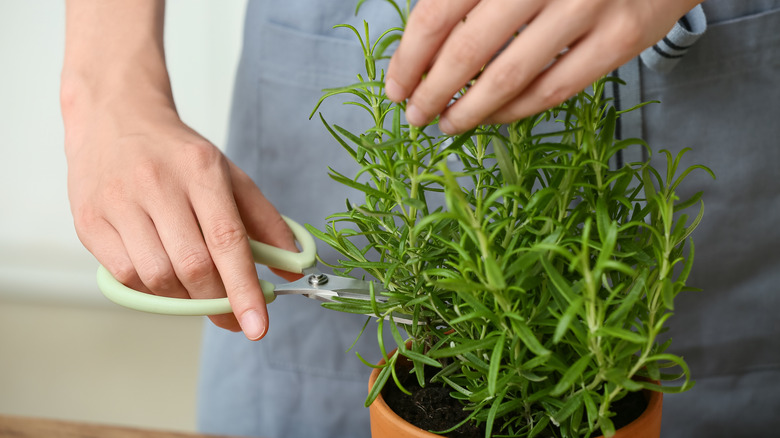
Ideally, the best time to take cuttings from a rosemary plant is in early or mid-summer. By this time, the plant has pushed out sufficient new growth, and the stems are semi-woody. You should be able to easily snap off the top 6 inches of the stem by bending it at a right angle, so it counts as a good cutting. Although softwood cuttings, which are taken early in spring, are more popular because they root faster, they're also at a higher risk of rotting in water. For this reason, semi-hardwood cuttings are preferred for water propagation, though they take longer to develop roots — about four to six weeks. Change the water frequently before it turns milky to stave off rot.
If you're preparing to save rosemary for winter propagation, you can take cuttings in the fall. Limit yourself to the top-most, green growth, and avoid cutting into the brown woody portion because it's unlikely to root. With clean pruning shears, make a cut at a 45-degree angle. This can improve the cutting's ability to absorb water. Also, ensure it has multiple pairs of leaves. Remove leaves from the bottom one-third section and place the cutting in water. Take several cuttings, as only half of them are likely to root.
Caring for water-propagated rosemary cuttings

Although there are many plants you can grow in water indefinitely, rosemary isn't one of them. Even after regular changing, the cutting will struggle to meet its nutrient requirements after it hits the three-week mark. Keeping the cuttings in a clear glass container enables you to monitor root growth. Once each cutting has produced about four roots that appear ½ inch long, pot it up in soil. Use a 4-inch-wide container filled with a perlite-based or seed-starting potting mix, such as the Premium Organic Potting from Burpee. Dig a hole with a pencil and add the cuttings an inch or two apart. Lightly firm the potting mix around the roots for full contact, and water them well.
Place the container on a west-facing windowsill where it receives bright indirect light for around eight hours a day. Hook up artificial grow lights if propagating during winter. As rosemary can grow quite large, continue sizing up its container when it outgrows its current planter. A fully mature rosemary specimen can fit in a 10 inch pot. However, if you would like to grow rosemary outdoors, wait for temperatures to moderate to 70 degrees Fahrenheit and late spring frosts to pass. Harden off the plant to help it adjust to outdoor conditions by slowly raising exposure every day. Continue this for a week before finally placing it in a full-sun location, either in a container or in the ground. Confirm the top 1 inch of soil is dry with your pinky finger before watering.