

The Sturdy Shoe Rack You Can Build Using Scrap Wood
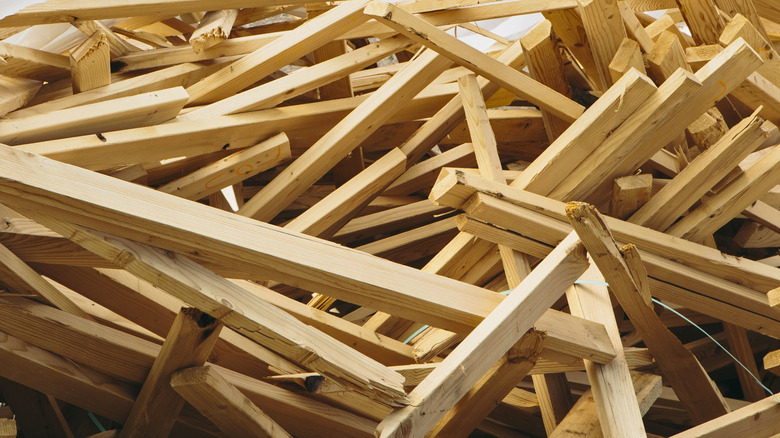
There are lots of useful tips for keeping shoes organized, but often the problem is simply not having enough space. You can buy shoe storage, but a more budget-friendly and very satisfying option is to build a sturdy shoe rack using scrap wood. You need only modest DIY skills and just a drill driver and a saw. Any saw will do, although a miter saw (which is one of the tools worth investing in to start woodworking at home) is quick and accurate.
The dimensions of the scrap wood are not important. 2x4 is commonly used for construction and often left over, but other sizes can be adapted. Old pallets or other rustic scrap is another option, although removing nails and staples can be a chore.
If you have boards 6 inches wide or more, you can simply cut two uprights and three horizontal shelves. Shelves can be level, which is easier, but a 20-degree angle is nice for shoe presentation. Spacing depends on the height of shoes you have, but for rigidity, one shelf should be a few inches from the ground, one near the top, and one in between. Simply drive screws (they provide a stronger grip than nails) through the uprights into the ends of the shelves. Before assembly, cut semicircles out of the ends that rest on the floor. This gives the shoe rack four 'feet,' whereas flat board ends tend to rock.
Making a sturdy shoe rack from 2x4 lumber or similar sizes
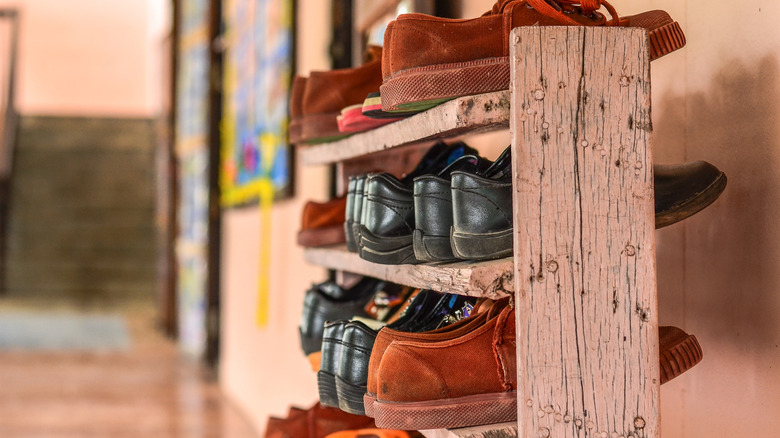
If you have smaller lumber, such as 2x4, use a frame construction. For the two ends, imagine a ladder but with the rungs at a 20-degree angle. The ends of the rungs need to be cut at 70 degrees so you get that slope. The height and the size from front to back depend on the shoes the rack needs to accommodate. It can be whatever length you like. You might want to sketch a quick plan before starting.
Cut the pieces for the ends and assemble them by screwing through the uprights into the rungs. Cut three lengths for each shelf, space them equally from front to back, then screw down through them into the top of the rungs. You could cut a thinner rail to go across the front of each shelf to prevent the shoes from sliding off, but it shouldn't be necessary.
Even if you are happy with a rustic look, you won't want splinters when reaching for your shoes, so give all the edges a light sanding. If you want a smarter finish, then doing a more thorough job (maybe with a random orbital sander) is one of the important steps before staining or painting. If you want a high-quality finish, then sanding before assembly is much easier than trying to get into all the nooks and crannies later.