

People Are Using Bleach To Kill Tree Stumps. Why It May Not Be The Best Choice
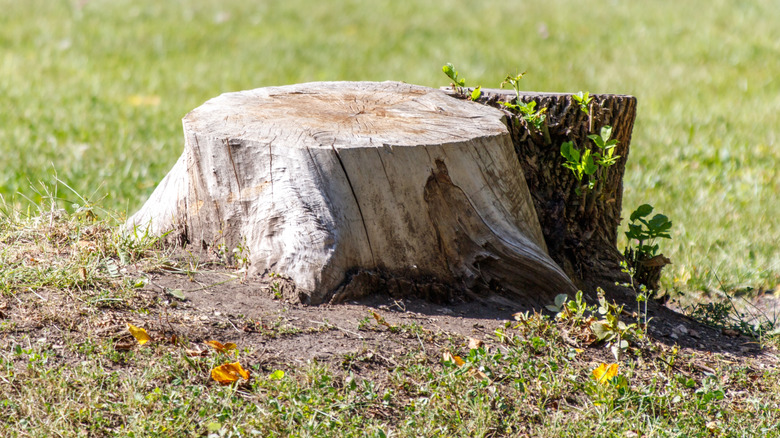
Bleach kills. It disinfects by killing bacteria, viruses, and other pathogens. Bleach (sodium hypochlorite) is a handy gardener's companion, as it is often recommended for disinfecting garden tools, flower pots, and other outdoor items. Bleach is inexpensive and readily available, but is it something you might use to kill an unwanted tree stump? Gardeners are always looking for easy ways to remove tree stumps, and you can find any number of websites recommending that you use bleach to kill one. But does it work? It might, but you would need to use a lot of it repeatedly, and you would need to not care that you're potentially damaging your soil and killing the plant life around it.
Bleach kills by oxidizing cells, rupturing them. But it's primarily a surface cleaner, recommended for non-porous surfaces such as glass, stone, metal, or plastic. You might be able to kill the cells on the top of a tree stump, but the bigger the tree, the more times you will need to reapply bleach to kill the entire stump. And the more bleach you use, the more harm you are doing to your soil. There is more life underground on Earth than there is above ground, including 90% of the fungi and 50% of the bacteria that break down organic material, including tree stumps. If you've ever used bleach to remove mold and mildew (two fungi), you can imagine how bleach will also kill off these vital underground organisms, creating an environment that's unnaturally sterile. Bleach will also damage the growing cells of emerging plants, leading to yellowing leaves, stunted growth, and even plant death.
Accelerate the natural degeneration of tree stumps
Keep in mind that most of the wood (the "heartwood") in a tree stump is non-living material, and bleach can't kill what's not even living. Bacteria and fungi, on the other hand, will slowly break down the dead heartwood, but since bleach kills bacteria and fungi, you actually may be slowing down the decomposition of the stump by applying it. The roots are the still-living parts of a tree stump, which bleach won't reach. Many hardwood trees (unlike conifers) can regenerate from their cut stumps when dormant buds reactivate and draw nutrients from the living roots of the tree.
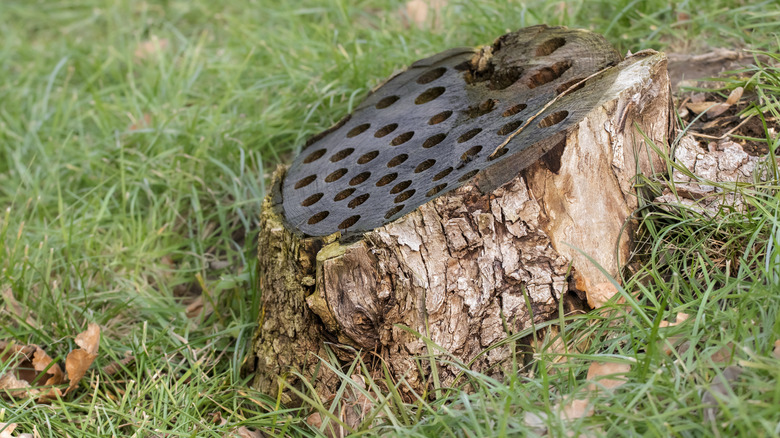
There are ways to remove an old tree stump from your yard without resorting to digging it out or using lethal chemicals like bleach or herbicides. The goal is to simply speed up the natural process by which trees decompose. Drill wide holes in the stump to expose more surface area where fungi can flourish. Keep the surface moist and cover it with organic material, such as compost, to retain water and attract decomposers to the surface. Cut off any sprouts that re-emerge from the trunk. Eventually, the sprouts will stop emerging as the roots exhaust their nutrient supply. You're not just doing less harm: You are improving the soil, as a decomposing tree adds valuable organic material and attracts beneficial micro-organisms to your soil. Bleach does just the opposite, and letting nature take its course is even cheaper.