

15 Old School Lawn & Garden Tools Nobody Uses Anymore
We may receive a commission on purchases made from links.
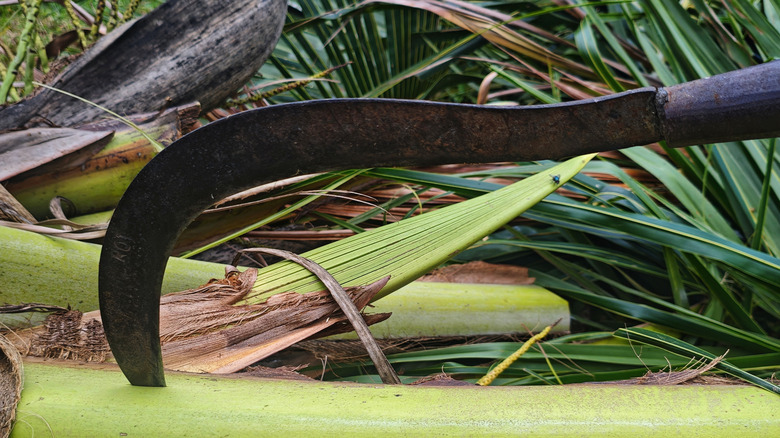
It's often said that necessity is the mother of all invention. But if you ask us, this saying is problematic. If necessity is really the only reason we humans come up with new contraptions, then why don't we still mow our lawns with a scythe? Why does nobody still have a billhook hanging in the shed, and why have many modern gardeners never even heard of a seed dibber?
The truth is that necessity is but one of several catalysts for human creativity. Another — one that's arguably more potent — is our desire to make our lives easier, and this often involves improving upon the tools of our ancestors. For example, it's much easier to plug in a lawn mower and push it around than it is to keep a scythe sharp and wield it.
With all of that being said, it's nevertheless fun to look back and remember the tools that our forbears used. What's more, for those of us who find ourselves frustrated in the height of summer when the grass refuses to stop growing, it's also a healthy reminder that plugging in the mower and pushing it around for 10 minutes is far from the chore we think it is. Whether you need a reminder of just how good we modern gardeners have got it, or you're merely curious about the technologies of yesteryear, you're sure to find something of interest in this guide to old-school lawn and garden tools.
You'd need the strength of an ox (plus a lot of skill) to cut your lawn with a scythe
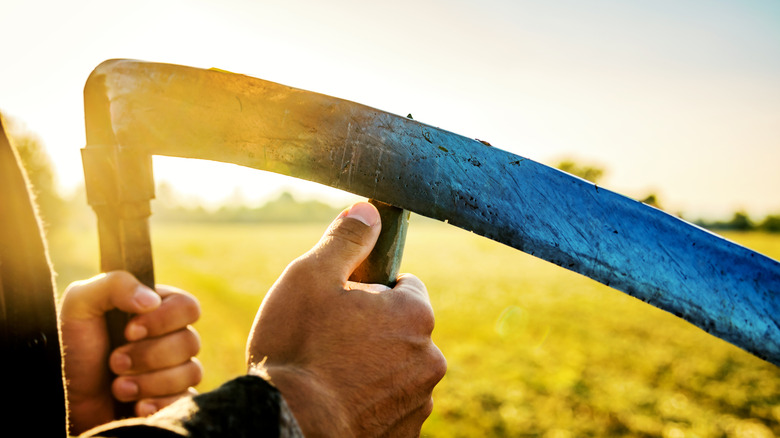
Featuring a long wooden handle and a curved steel blade, the scythe was once the tool of choice for farmers and landowners who needed to cut the grass. And while knowledge of how to wield it — and how to keep it sharp enough to be effective — was once commonplace, using a scythe is now something of a lost art. Scythes need to be swung in a wide, rhythmic arc, which is problematic in larger gardens for the simple reason that they can be awfully heavy to hold. They also require a great deal of stamina to maintain the technique for an extended period of time.
In meadows and on farmland, the scythe has long been outdated by tractor-pulled machinery, and in the garden, we're sure we speak for most when we say we'd prefer to stick with our electric mower and weed whacker. Sure, cutting the lawn with a scythe is an eco-friendly alternative to gas-guzzling and energy-greedy power tools. And yes, standing in the garden after dark with a scythe by your side is a surefire way to go down in your neighborhood's Halloween hall of fame. But given the time and effort it takes to use one, we think it's perhaps the least likely old-school tool to make a comeback in modern sheds.
The sickle has long since been replaced by motorized weed whackers
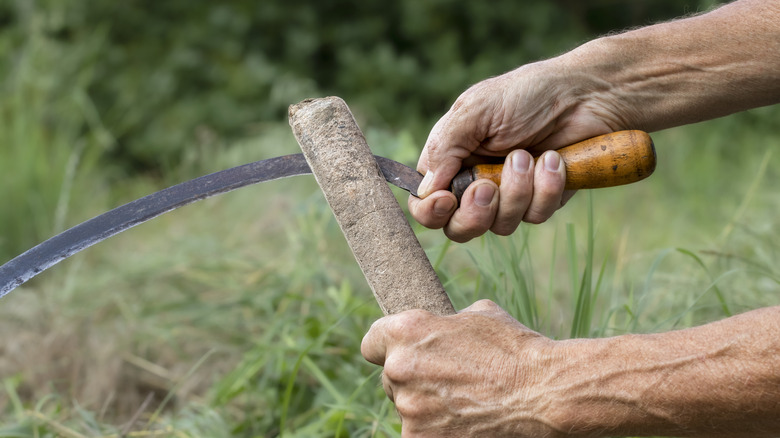
Similar to a scythe, but shorter and with a semi-circular blade, these stout, wood-handled tools were once invaluable for gardeners who needed to trim and thin out awkward areas of grass and weeds. They were also used for harvesting small, awkward patches of grain. As for why they're not used anymore, there are several reasons.
Firstly, they make the process of cutting, thinning, or harvesting painfully slow. They also require their users to sink to their knees in order to use them, and even if you don't mind doing that, doing so can be a pretty thankless task since sickles offer little protection from accidental cuts. Generally speaking, your back, knees, and hands are all better off if using a string trimmer (or weed whacker) to perform most sickle tasks. You could keep one in reserve for any especially awkward corners, particularly if you have corded tools that don't quite stretch to the farthest reaches of your yard. It might also be a valuable asset if you're trying to make your gardening strategy more sustainable, as it requires zero gas or electricity.
Push-reel mowers struggle to cope with anything other than short grass
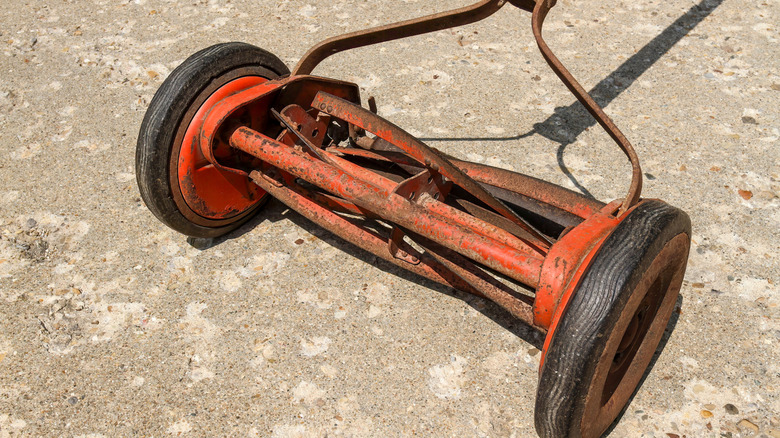
Once upon a time, the push-reel mower would have been the very height of horticultural technology. These old-school tools feature cylinders of helical blades, and when you push them along, those cylinders rotate, trimming the grass underneath them as they go. Unfortunately, they aren't much good when it comes to cutting longer, thicker grass. Neither are they much use on rough or uneven ground.
However, if your lawn is level, then they are still fantastic (even today) for keeping on top of your grass during the summer. These mowers are especially useful on smaller lawns. They're handy in areas that are tricky to reach with your corded mower, and they can help you save on fuel in the summer when the grass seems to need cutting every other day. They're also very useful for giving your teens a means of earning their pocket money. Instead of teaching them to mow the lawn with a potentially dangerous gas or electric mower, you can start them off with one of these and rest reasonably assured that they won't accidentally sever a toe.
Half-moon edgers are much harder than modern motorized stick edgers
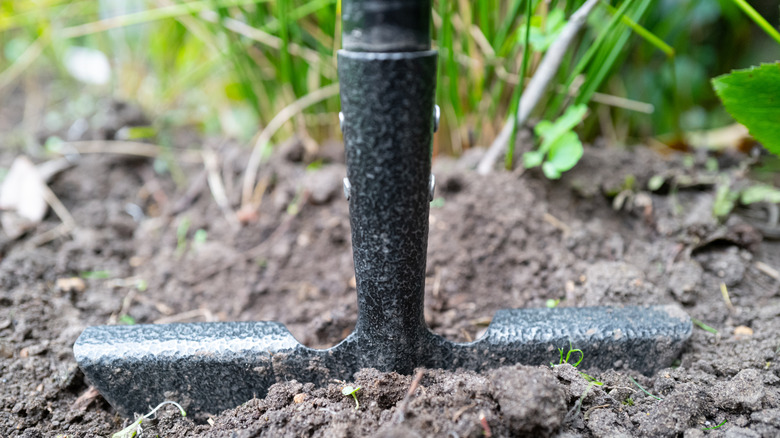
Featuring a long wooden shaft just like a shovel or rake, but with a half-moon-shaped blade at one end, half-moon edgers were designed for slicing clean, vertical lines between grass and flower beds. They remain a useful tool to have in your arsenal, especially if you only have a few flower beds on which to perform edging work. They're certainly much cheaper than buying and maintaining a motorized lawn edger.
The issue with these tools is that if you have a large yard that yields lots of edging work each year, then, like your shovel, they can become tiresome to use. In that case, a motorized edger is likely to make your life much easier. Mechanical edgers are also much quicker to use — ideal if you're limited on how much time you're able to spend in your garden.
Heavy lawn rollers do more harm to your soil than good
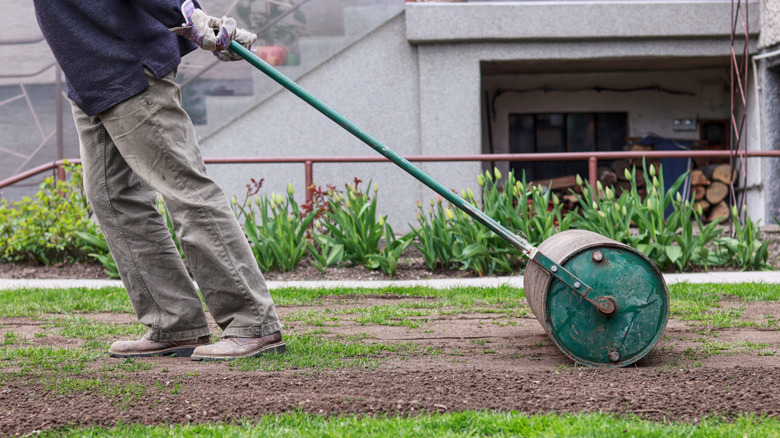
These old-school garden tools typically featured an iron, stone, or water-filled cylinder, which was mounted on a long, heavy-duty handle and designed to be pushed around your lawn. They were designed to flatten bumpy lawns, and while they were undoubtedly very effective, they've nevertheless fallen irrevocably out of favor. The reason? Well, just like our feelings, suppression is rarely the answer when it comes to managing a bumpy garden.
Whether you have moles causing chaos around your yard or your grass is naturally bumpy and imperfect, trying to flatten it with brute force is one of the biggest mistakes you can make when trying to level your lawn. Yes, in the short term, you'll resolve the problem. But in the long run, you'll end up compacting the soil, meaning your grass's roots won't be able to receive enough moisture or nutrients. In the end, you'll be left with a patchy, threadbare lawn — one that'll have you ruing the day you decided to buy that old-school roller from the thrift store.
Large metallic garden syringes and atomizers are beautiful to look at, but far from practical
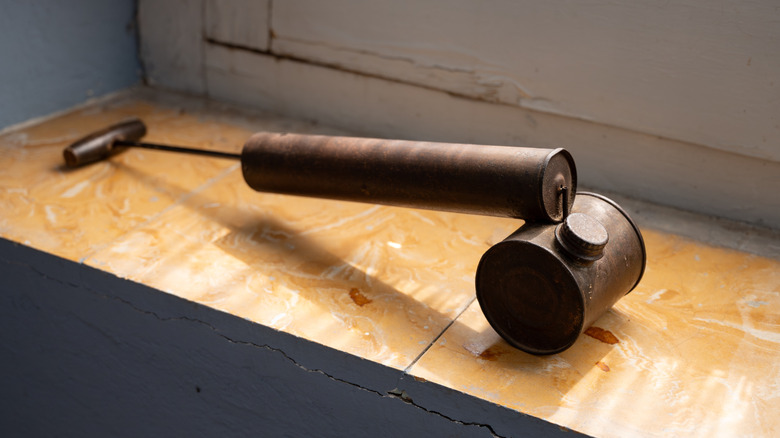
Once used to spot-treat plants with water and pesticides, you'd be more likely to see a garden syringe on the wall of a museum these days than you are in the shed of a regular gardener. Consisting of a cylindrical metal tube — often brass or copper — with a plunger at one end and a perforated nozzle at the other, per the name, they resembled a giant syringe. They remain useful, if only for decorative purposes, and if you happen to spot one at your local thrift or garden store, then by all means, grab one to adorn the wall of your potting shed.
Just don't bank on putting up with it for long if you actually intend to use it to spray your garden. If that's your reason for buying one, then you'd almost certainly be better off with a modern sprayer or a hose. These offer superior pressure control and, in most cases, have a much higher capacity for whatever it is that you need to spray.
Glass bell cloches have fallen out of favor for cheaper, less-fragile alternatives
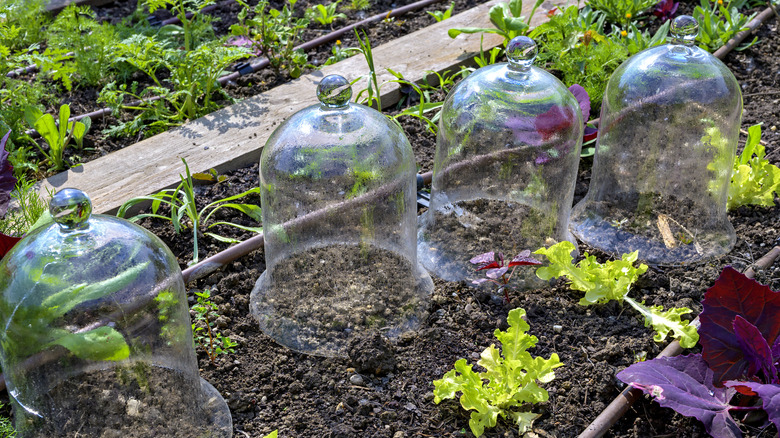
These heavy glass domes — often resembling oversized cheese lids — were once widely used in gardens for protecting plants from the weather. They're like miniature greenhouses: they defend the plants underneath from snap frosts, which is ideal in the spring, and in the warmer months, they amplify the power of the sunshine, allowing you to make the most of the weather and speed your seedlings along. Unfortunately, there are two key attributes that make glass cloches an unlikely candidate for a comeback in modern gardening. Firstly, they're highly breakable and very expensive to replace. Secondly, they're not the most practical solution for protecting larger beds and planting schemes.
For example, if you have multiple rows of vegetables growing in your garden, then it's likely to be much easier to install a low plastic polytunnel top rather than multiple glass cloches. Even if you're growing on a smaller scale and you like the aesthetic of a bell cloche, it's possible nowadays to buy ones made from rigid plastic, like this set of 30 clear bell-shaped plastic garden cloches from Remerry. Not only are these much less likely to break than glass, but they're also considerably cheaper.
Little gets said about seed dibbers these days, yet they remain essential for uniform planting
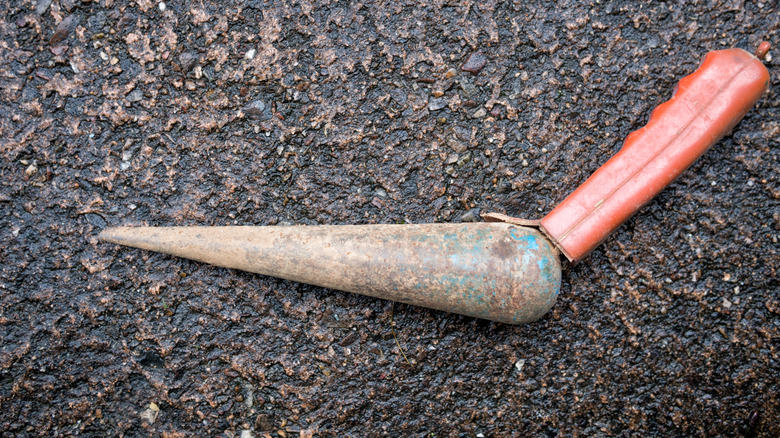
The humble seed dibber is one of the simplest tools in this guide. Essentially a wooden or metal stake with depth markings etched into it, it's one of those timeless tools that can make gardening much easier. It allows you to plant seeds and bulbs at uniform depths, which in turn helps to improve germination and promote consistent growth.
While you could argue that mechanical transplanters and bulb augers make the job easier and much less "manual" for large-scale planting tasks, such equipment feels like overkill for most home-sized gardens. Instead, if you don't already have one of these timeless tools in your gardening kit, we'd recommend getting one. You can even buy multi-pronged seed dibbers, like this 24-hole seed spacer from Gardinnovations, which is sure to save you time in the spring.
Cucumber straighteners have never really felt essential
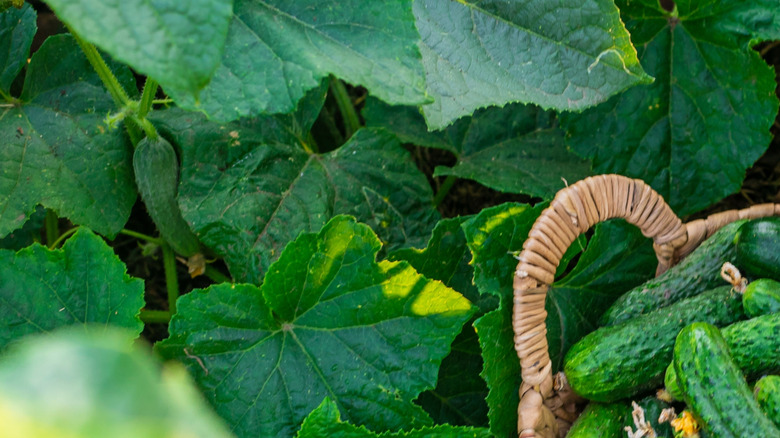
If we asked you to go out and buy a cucumber straightener, you'd be forgiven for thinking we were hazing you. However, unlike tartan paint, the cucumber straightener is actually very real, and while it's hard to imagine that it was ever used by a majority of gardeners, it was nevertheless effective. Essentially an open-ended glass cylinder, the cucumber straightener was designed to do precisely what the name suggests.
Invented by Victorian engineer George Stephenson, this tool serves as an interesting reminder of the Victorian demand for uniformity — to both rationalize and tame the natural world. With that in mind, it also represents the antithesis of what matters most to many modern gardeners — to restore a sense of wilderness to their surroundings. In other words, if the cucumber straightener failed to catch on when it was first invented, then it seems unlikely to do so now.
Pole pruners are only really practical for small-scale pruning tasks
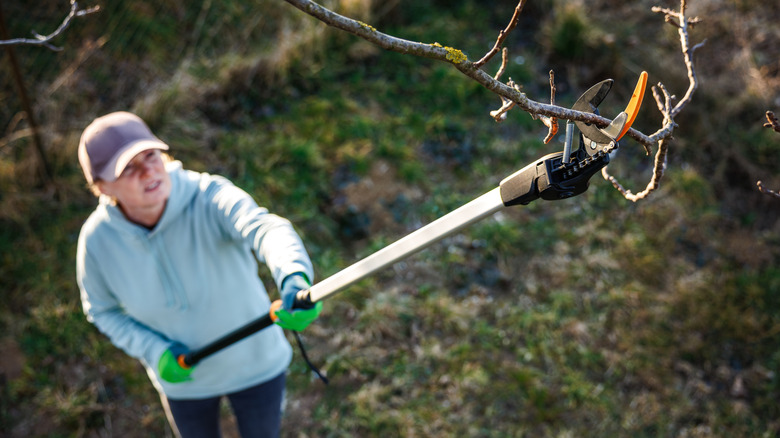
Operated by cord and pulley, pole pruners (otherwise known as "averruncators") feature a long pole with a shearing blade at one end and a handle at the other. They're a very useful tool, especially for gardeners who need to both reach and prune areas of their shrubs and bushes without the aid of a ladder. But they're tiring to use, and if you have a large hedge that needs frequent pruning, you're unlikely to favor a pair of pole pruners over, say, an electric or gas-powered pole saw.
This isn't to say that there's not still a place in modern sheds for an averruncator. For small jobs — like trimming rogue branches after a storm — it's likely to be quicker and easier to use a pair of pole pruners than it is to plug in your pole saw or to fill up the tank with gas. These tools are also great for jobs where precision is key, like pruning your prized magnolias or rhododendrons.
Billhooks are more versatile than modern gardeners give them credit for

Featuring a thick, hook-shaped blade, billhooks were once the tool of choice for the kinds of jobs you'd tackle today with a chainsaw or mechanical brush cutter. And while mechanical tools usually make this kind of work easier, safer, and more precise, that's not to say that there's no place for a bill hook in your box of tools. In fact, there are several ways they can still come in handy.
For example, if you have any tight or awkward spaces that have become overgrown, a billhook (and a heavy pair of long-sleeved gloves) is perfectly designed to help clear them. If you have wood that needs cutting or splitting, perhaps when building a fence, then again, a billhook is sure to come in handy. Provided that you keep it sharp and take steps to prevent your tools from rusting, you may just be surprised by how much use you have for a tool as humble as a billhook.
Weeding spuds are likely to feel too laborious for most modern gardeners
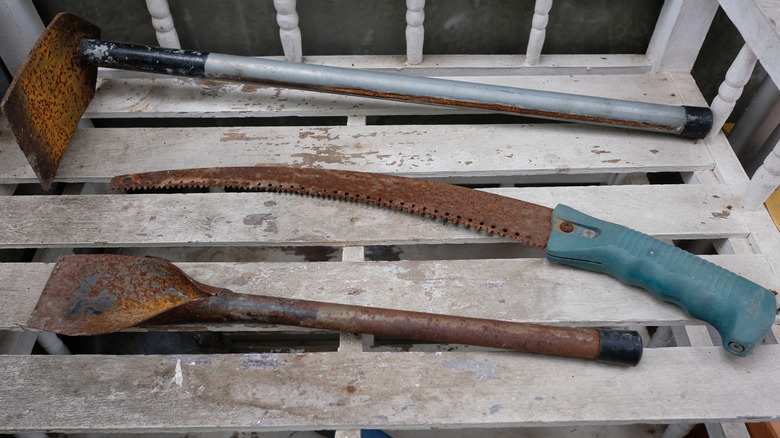
Usually built with a wood handle and a stubby, two-to-three-inch blade at the head, weeding spuds were made for uprooting deeply-bedded weeds, as well as for pulling out individual crops. They're designed to pierce the soil and sever taproots, rather than just cutting off the tops. They've been around for centuries, and while it's hard to say for sure, it's believed that the term "spud" (now widely used to describe potatoes) actually originates from this tool.
In an age of modern power tools and chemical weed control, it's hard to argue the case for keeping a weed spud in the shed. There are countless types of weed killer that you can choose from to neutralize unwanted weeds with little more than a simple spray. If a more active approach is required, weed whackers and string trimmers are much easier to work with than manual hand tools, and don't forget that if all else fails, you can always fire up the propane torch.
Manual aerators can help to restore soil health and reduce your need for power
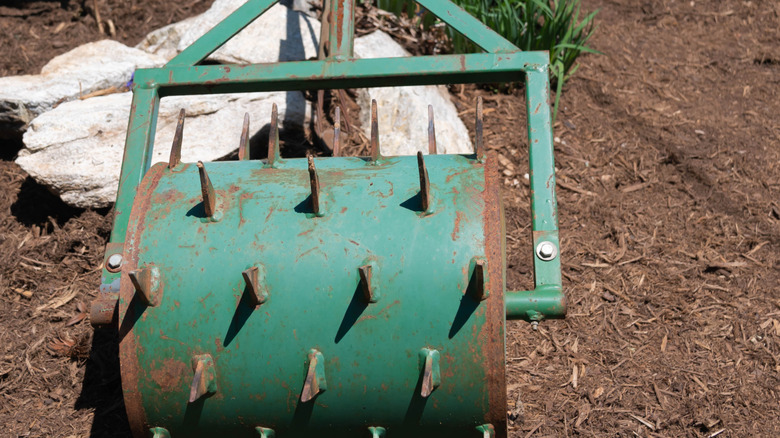
Manual aerators are designed, as the name suggests, to aerate your soil. They feature a roller either studded with spikes or made of star-shaped disks, which is mounted on a frame with a long, mower-style handle that you use to push along. When you do, those spikes or disks punch lots of holes into the soil, thus improving its ability to absorb vital nutrients and moisture.
As you might expect, these manual tools have fallen out of favor in modern times for more mechanical means of aeration, like gas- and electric-powered cultivators. However, as more of us seek ways to make our gardens and the way we manage them more sustainable, manual tools like star-wheel aerators might just be on the cusp of a comeback. They're eco-friendly, requiring nothing more than human power; they're quiet to use (which is always nice), and since they have no electrical parts (and no gas engine) there's comparatively little that can break or go wrong with them. They also tend to be lightweight, which means they won't accidentally compact your soil.
Hand-operated hedge shears have fallen out of favor for more mechanical means of shrub shaping
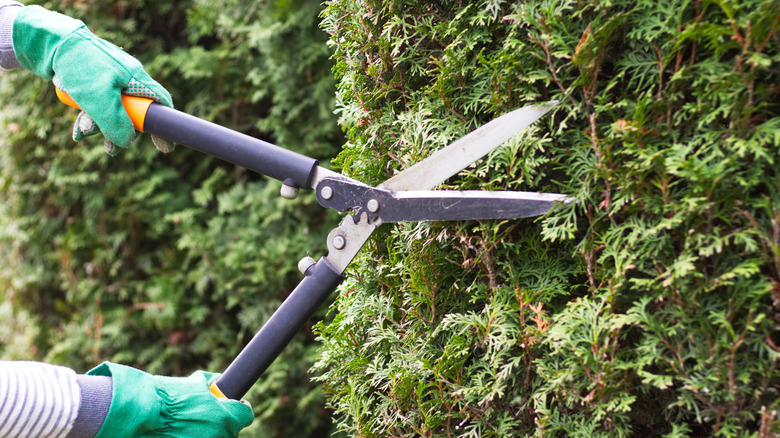
Hand-operated hedge shears feature large, scissor-like blades and long wooden handles. They often include a notch at the base of the blades for thick, stubborn branches, and they're typically used for shaping things like boxwoods, privets, and ornamental evergreens. As with so many other old-school tools, they are excellent at the task they're designed for, and were it not for more mechanical alternatives that have come to the fore in recent decades, they'd still have a permanent place in the sheds of households around the country.
Tackling a large hedge with a pair of old-school shears demands the kind of time that most modern gardeners simply can't afford to spend. It also requires a level of physical exertion that most would rather avoid, and if you're hoping to achieve a clean, professional finish on your hedges, you'll find it's infinitely easier with mechanical cutters. Not only do they cut much faster, but many modern power tools feature telescopic and adjustable blades, allowing you to trim your entire hedge — the top included — without the need for a ladder.
Daisy grubbers are ideal for spot treatments but far too laborious for who lawns
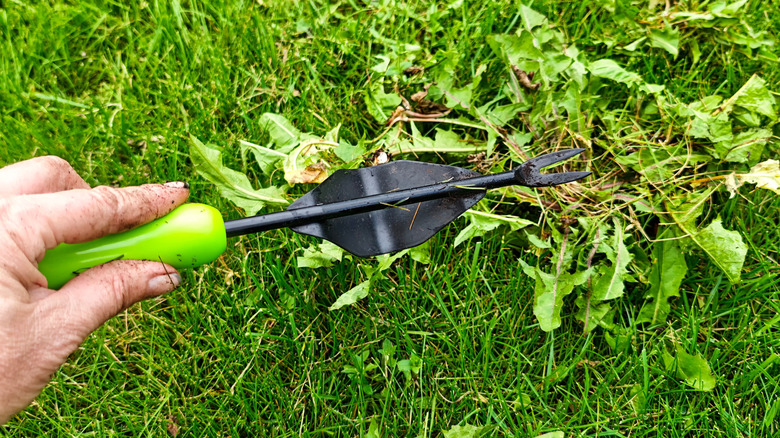
Featuring a wooden handle with a small, forked metal tongue at the business end, daisy grubbers are made to pry daisies, dandelions, and other similarly short-rooted weeds up and out of the ground. You slide the fork underneath the crown of the weed in question before leaning the handle back and popping it out. It's a simple tool to use, and when you don't have acres of grass that need de-daisying, it's also highly satisfying.
The problem is that on large, daisy-strewn lawns, you'd have to work very hard — and for a long time — in order to make a dent. Even if, by some miracle, you managed to clear an entire lawn full of daisies, you'd be left with a lawn full of "scrapes" where you tore the weeds from the ground. For these reasons, most modern gardeners would prefer to use a sprayer to control the spread of weeds.