

The Easy Way To Propagate Mint For An Endless Supply Of Fresh Herbs
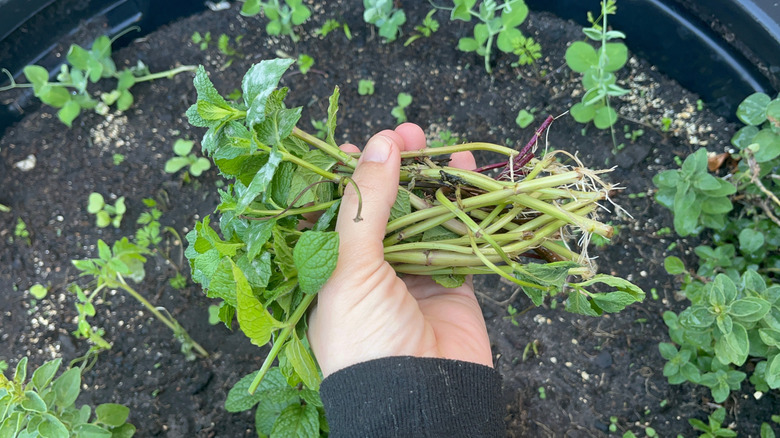
Mint is one of the most versatile herbs that you can grow in your garden. Mix it through salads, scatter it over curries, crush it into cocktails, or swirl it into yogurt-based dips – mint just has endless uses in the kitchen. The only problem? When something has so many uses, it is pretty easy to run out of it. And while mint isn't expensive, wouldn't it be great to have an endless supply right in your home? Honestly, it is pretty easy! All it takes is one established plant and some healthy cuttings. Plus, the whole process takes 1 to 2 hours and gives you ready-to-harvest mint in just a few weeks. Just make sure to use clean tools when taking cuttings. Using dirty tools is a common mistake that too many people make when propagating plants.
Other than cuttings, layering is another propagation method you can use to propagate a mint plant. In fact, mint naturally spreads via runners. The problem, though, with layering is that it is slow. Plus, it produces fewer plants than cuttings. Just keep in mind that you need an established plant for layering, too. But what if you don't have an established plan? Then your only option is to use seeds. The problem, though, with seeds is that they do not produce true plants. Mint grown from seeds can have a different taste, a different aroma, and even a different growth habit. Put simply, if you want a quick and abundant harvest, you need to propagate mint from cuttings.
Creating a never-ending mint supply using cuttings
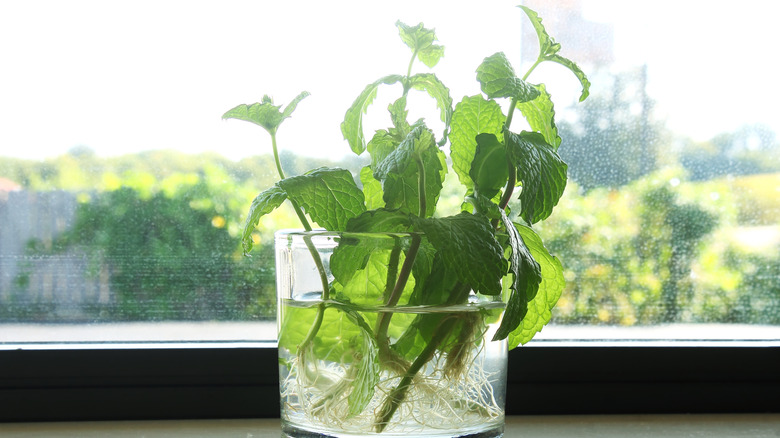
When it comes to propagating mint from cuttings, you have two options: stem cuttings and root cuttings. However, propagating with stem cuttings is often the preferred option since it is easier and has a lower risk of developing fungal rot. Nevertheless, to propagate your mint via stem cuttings, choose a healthy, non-flowering plant and take a 4- to 6-inch-long cutting from the top of its growth. This should ideally be done in spring, when the mint is actively growing. Just make sure to cut below a leaf node and don't forget to remove leaves from the bottom half of the cuttings.
From here, you again have two options: root cuttings in water and plant them directly in the soil. If you want to grow them directly in the soil, just make sure that the rooting medium is sterile and drains well. A mix of equal parts of perlite, vermiculite, and peat usually works the best. Also, there are many types of rooting hormones available to improve the chances of success with your stem cuttings. As for propagating cuttings in water, all you need to do is place the cutting in a jar of water. Just make sure that the nodes from which you stripped the leaves are submerged in the water.
But no matter what rooting technique you use, once the cuttings are in the rooting medium, make sure to place them in a bright spot with indirect sunlight. Then, once the roots have been established, which takes around two weeks, you need to shift them to a permanent spot. Just avoid growing mint directly in the ground. Mint is an aggressive spreader that can quickly take over entire beds and become invasive.