

The Crucial Step Your Strawberry Plant Needs To Thrive
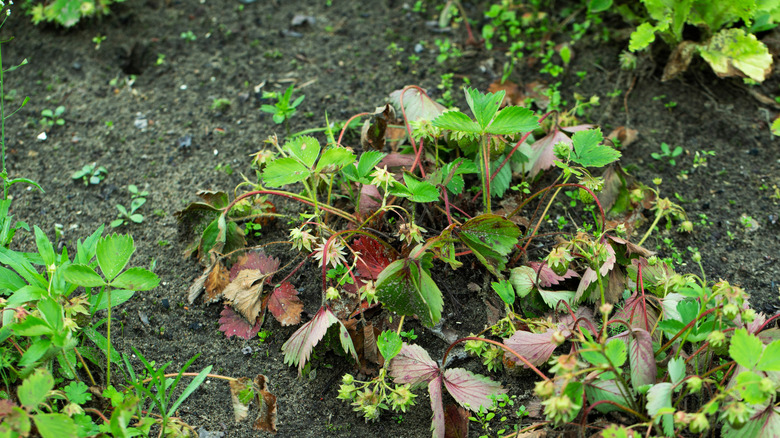
Strawberries are a staple for spring gardens. They are a very beginner-friendly plant with a huge payoff for minimal effort. Who doesn't love harvesting tons of juicy berries? It can be extremely frustrating when your strawberry plant has a multitude of blooms and no fruit. You're anticipating luscious strawberries, and instead you get nothing. It may not be anything you, the gardener, have done. Your strawberry plant might just need a little help with pollination. You might have to hand-pollinate each flower. What is hand pollination, and why should you try it?
While it's true that strawberry plants are pretty low-maintenance, it doesn't mean we as gardeners should just have a set-and-forget attitude with them. This is one of the mistakes everyone makes when planting strawberries. There are factors outside of our control that can affect a plant's ability to thrive — often in ways we may not even realize. For example, strawberries rely heavily on insects for pollination. If your region has a warmer than usual spring, there might be a mismatch between flower bloom and pollinator arrival. Any flowers your plants have may not get pollinated. In some seasons, insect populations fluctuate irregularly in response to various climatic factors, and there simply aren't as many bees around. Depending on where you live, pesticide drift can reduce overall pollinator populations. Of course, if you're growing strawberries indoors, the blooms rely on you entirely for pollination.
How to hand-pollinate your strawberry plants for more fruit
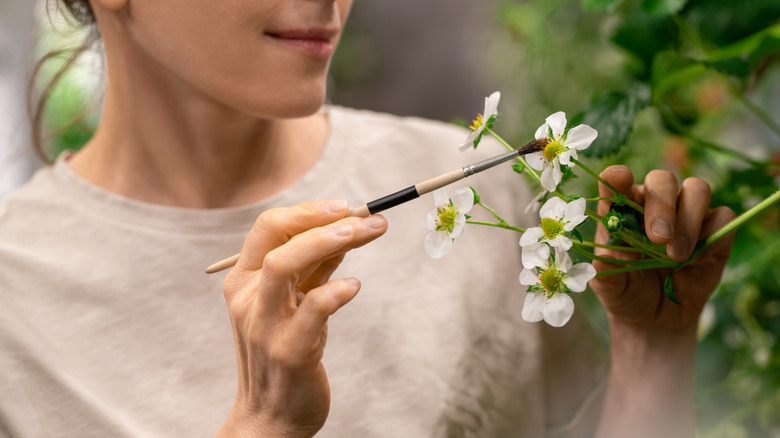
Hand pollination helps your outdoor strawberry blooms transform into berries. It's essential if you are growing strawberries indoors where pollinators can't get to them. Strawberry flowers contain both male (stamens) and female (pistils) parts, and are technically self-pollinating. However, they benefit from a little assistance. The wind can only do so much, so if there is a shortage of pollinating insects in the area, blooms may experience incomplete pollination. Your job, through hand pollination, is to move the pollen from the male parts of the flower to the female parts. Ideally, you want to perform hand pollination as soon as a flower has opened completely, when pollen levels are at their highest.
All you need for hand pollination is a soft brush, like a paintbrush, and a little time. Gently touch the brush to the strawberry bloom's stamens — the golden stalks surrounding the yellow, button-like center of the flower. Move the brush toward the center of the flower using gentle, circular motions. Perform the process just a couple of times for each flower on your plants. With all your effort and a bit of luck, your strawberries should produce higher yields than if you were to leave them to their own devices. If, after hand pollination, your strawberry plants still aren't producing many berries, you may need to address their growing conditions. Most species and cultivars need full sun and regular watering, especially during drought conditions, to thrive.