

You've Been Warned: This Sweet-Smelling Vine Can Take Over Your Whole Yard
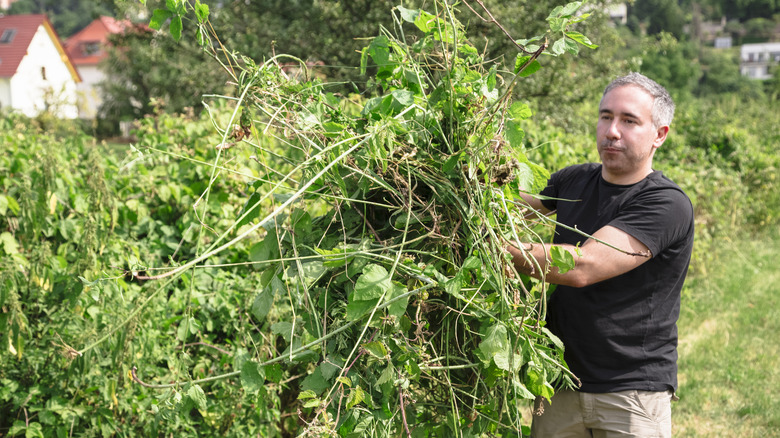
Some plants have a scent that people love, but is it possible to have too much of a good thing? One pleasant-smelling plant that's not all sunshine and roses (literally) is Japanese honeysuckle (Lonicera japonica). While the small white and yellow flowers look beautiful draped over a garden fence, this vine grows so fast that it can easily bury your other plants in just a few seasons. This woody perennial is famous for its aggressive growing habits and is known as one of the top invasive plants to avoid in your fall garden. It wraps around tree trunks and native shrubs. Over time, these vines get heavy enough to break branches or even pull down smaller trees, and they often end up shading out the grass and flowers growing underneath them.
Japanese honeysuckle is considered invasive in certain areas, but not everywhere in the United States. This plant is listed as an invasive species across a large portion of the country, specifically in Connecticut, Delaware, Florida, Georgia, Hawaii, Illinois, Indiana, Kansas, Kentucky, Maryland, Massachusetts, Michigan, Missouri, New Hampshire, New Jersey, New York, North Carolina, Ohio, Oklahoma, Pennsylvania, Rhode Island, South Carolina, Tennessee, Texas, Vermont, Virginia, West Virginia, Wisconsin, and the District of Columbia. You shouldn't plant this plant in any of these states. Anywhere else in the country, it may be okay to plant this vine, as long as you give it plenty of space and follow all local regulations. It generally thrives in USDA Hardiness Zones 5 through 8. This vine spreads quickly by sending out long runners and forming thick underground mats that use up all the water and nutrients in the soil. It also drops a massive number of seeds that can sit in the soil for years and still sprout when the conditions are right.
How to tell if you have Japanese honeysuckle in your yard
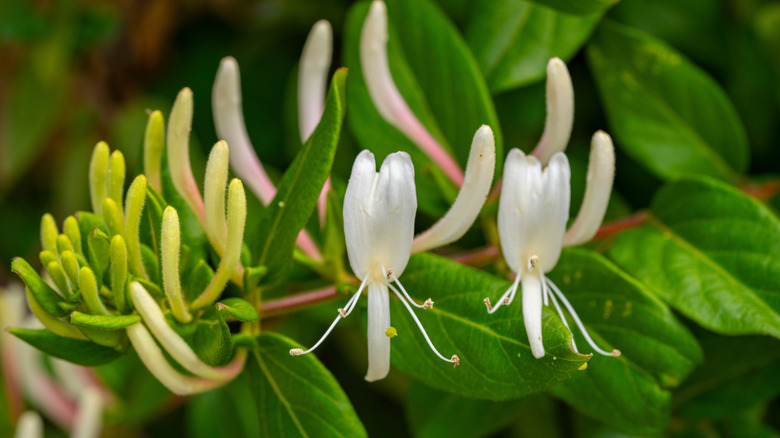
Finding this vine early is the easiest way to keep it from spreading across your entire property. One of the best times to look for it is during the winter. Because it stays green much longer than most native plants—remaining semi-evergreen or even fully evergreen in warmer spots—it stands out when everything else has turned brown. Each leaf has a partner growing directly on the other side of the stem. They have a simple oval shape with smooth edges. Younger stems feel a little bit fuzzy, while the older wood becomes hollow and has bark that peels off in long, thin strips.
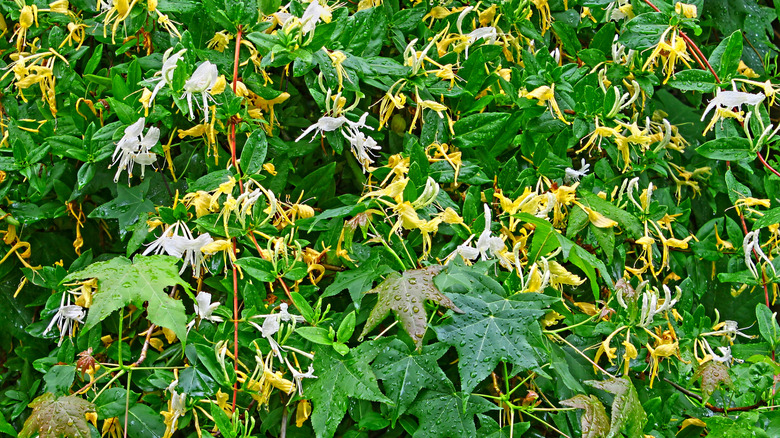
During the late spring and summer, Japanese honeysuckle grows tubular flowers that start out white or pale pink and turn yellow as they get older. While they smell wonderful, the real issue starts in the fall when the flowers turn into small, shiny black berries. Birds eat these berries and drop the seeds all over the place, which is how the plant ends up in parts of your yard where you never planted it. This is what makes it one of the most popular plants you should actually avoid planting in your garden. Since a single vine can grow 30 feet in one year, those seedlings can turn into a thick wall of greenery that blocks the sun from reaching your lawn and garden beds.
How to remove Japanese honeysuckle
Clearing out Japanese honeysuckle takes effort because it spreads through seeds and a fast-growing root system. Knowing how to get rid of Japanese honeysuckle starts with choosing the right method. For a few small plants, pulling them out by hand is the best approach. Doing this when the ground is wet from rain helps the roots pull out smoothly. You need to get the whole root, because even a tiny piece left behind can sprout a new vine quickly. If vines have climbed into the trees, cut them at the bottom to stop them from tightening around the trunks.
For larger areas where you can't pull everything out by hand, a more direct approach is usually needed. Many people find that cutting the thickest stems right at the ground and immediately putting a glyphosate solution on the fresh cut is the best way to kill the roots. You should always use extreme caution when using a glyphosate solution, since it's a non-selective herbicide that will damage or kill any green plant it touches. Always wear protective gear and apply it carefully to avoid any overspray on your lawn or flowers.
If you want to avoid synthetic chemicals, there are alternatives. Repeatedly cutting the vine back to the soil line every few weeks eventually starves the roots, though this takes many seasons to see any results. Some gardeners use heavy-duty horticultural vinegar with at least 20% acetic acid to burn back the foliage, but you have to be careful not to get it on surrounding grass. Late fall is perfect for this because the honeysuckle is still active while most of the other plants are dormant. Smothering the area with thick layers of cardboard and mulch is another way to kill off growth.