

What Kinds Of Eggs Are In Your Garden, And Steps To Take
Whether you're simply curious to know which members of the animal kingdom you're sharing your garden with, or need to know which pest is laying eggs on your precious garden plants, it can be hard knowing where to start. There are so many North American species that lay eggs, including birds, amphibians, and reptiles, and despite the often-obvious differences between the parents, it's considerably more difficult to identify the offspring when they're hiding behind a layer of shell or spawn. And even when you do know which animal is behind the clutch in your yard, what then? Should you get rid of the eggs, or contact pest control? Or is it best to just leave them alone?
The answer is that it depends on the species you're faced with. Some of the animals likely to lay eggs in your garden should be allowed to do as nature intended. In many cases, they should even be encouraged. Others, however, ought to be treated with caution. You're unlikely to mind a clutch of hummingbirds or cardinals making a nest for themselves around your yard, and provided that you don't have children or pets, then snapping turtles burying eggs in your soil should be no reason to lose out on sleep. But if you have certain snakes or spiders in your garden, or your summer soirées are being plagued by mosquitoes, then it's important to take species-specific action to ensure that the clutch of eggs you found doesn't simply serve to proliferate an annoying and potentially dangerous problem.
Mosquito larvae are known as wigglers and lie just below the surface of still water
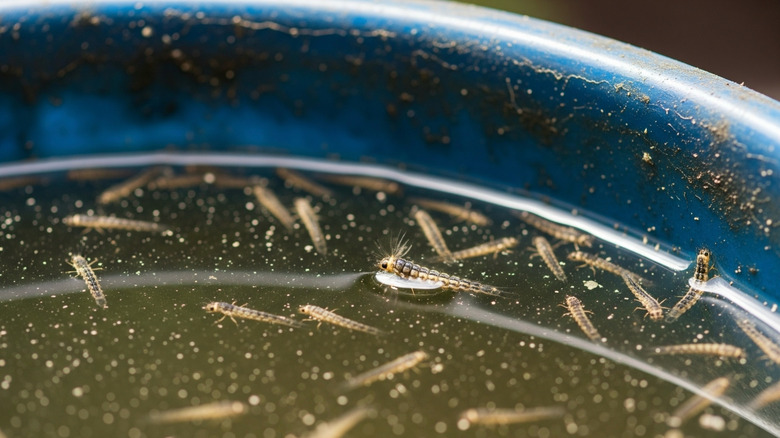
Mosquito larvae are typically tiny – around ¼ inch long — and they tend to be found just below the surface of still or standing water. This could be in your gutters, a bucket, a rain barrel, or even in the bottom of an old tire swing. If the water's still and goes untreated, then any marauding mosquitoes in your area are sure to lock onto it and lay their eggs. If they do, you should be able to see them "wriggling" beneath the surface. They may also seem "suspended" at an angle from the surface.
As for what to do, one of the most effective ways to get rid of mosquitoes from your yard is to first address those areas of standing water. Empty that old bucket that's been sitting in the corner for the last 2 years, and consider replacing the old tire swing with another seat that doesn't collect and hold water. There are various plants and herbs that may repel mosquitoes from your garden and patio, and if sources of standing water are absolutely unavoidable, you could try adding a couple of drops of oil to the water's surface. This interferes with the surface tension of the water, effectively trapping the mosquito larvae (while preventing adults from landing on it and laying a fresh batch). Just don't use this method on water sources where other species are likely to use the water, like a bird bath, as you could end up doing more harm than good.
The answer to whether you have frog, toad, or newt spawn lies in where its laid
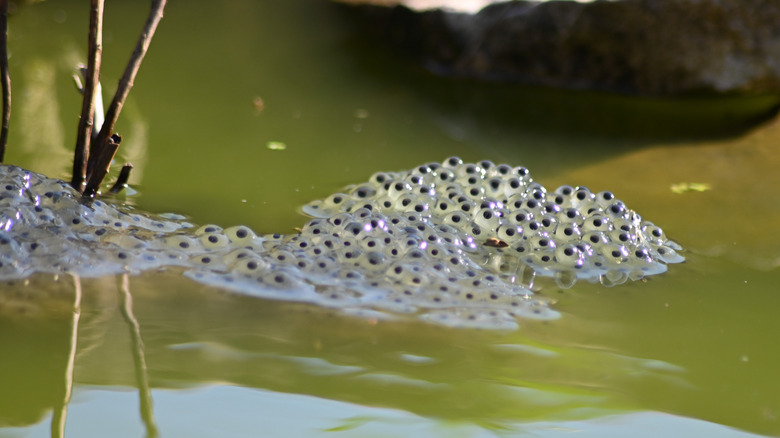
If something has spawned in or around your pond, then the best way to identify the creature behind it is to examine exactly how — and where — the spawn has been laid. Frogs, for example, tend to lay clumps of spawn in shallow water. Toads, often favoring slightly deeper water than frogs, lay their eggs in strings around vegetation, and newts lay their eggs individually, usually on submerged leaves.
When these creatures spawn, particularly frogs (whose spawn tends to be the most visible), they can leave garden owners fretting that they're on the cusp of an amphibious invasion. But before you get too worked up about it, don't! The presence of frogs, newts, or toads is almost always an indicator of environmental health, and if they're present in your yard, then you can rest assured that your garden is contributing positively to the wider local ecosystem. You should also know that, while frogs lay lots of eggs, they do this in order to counteract the activity of nearby predators. As few as 1 in 50 frogs actually make it past the egg stage, and since frogs perform an array of beneficial functions in the garden, those that manage to survive in yours should be encouraged to stick around.
Snapping turtles can lay over 40 one-inch eggs at a time
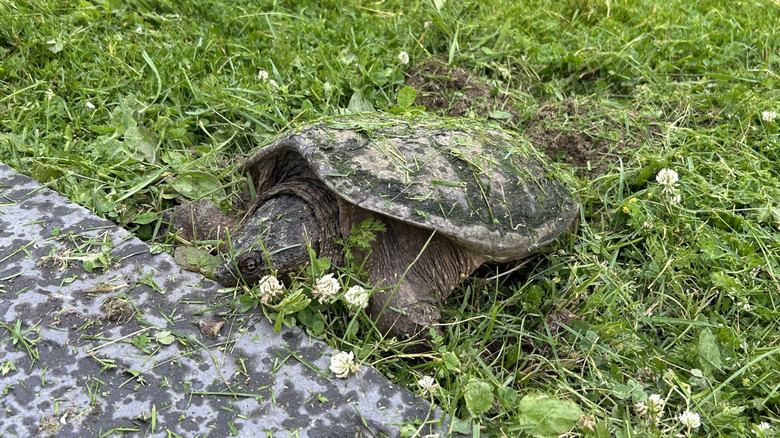
Growing up to 20 inches in length, it's hard to miss a snapping turtle if one finds itself intrigued by the pond in your garden. However, their eggs can be a little harder to discern, not least because they're usually laid in loose soil and then buried until ready to hatch. Snapping turtles tend to lay up to 40 eggs at a time; the eggs themselves are usually white and around an inch in length. These turtles usually lay their clutches between May and June, and since they try very hard to hide them, it's unlikely that you'll spot them unless they've either hatched, been snaffled by your pets, or been raided by a local predator, like a raccoon, fox, or mink.
If you do find a clutch that appears in good condition, then try to replace the soil around them gently, then leave them be. While snapping turtles get a bad rap for their fearsome bite, they don't actually pose much of a threat to you or your yard. Unless you absolutely hate them, or you have pets that are likely to cause them harm (or children that the turtles could bite), then they are usually best left alone.
Snake eggs are usually oblong-shaped and found in natural hidey holes
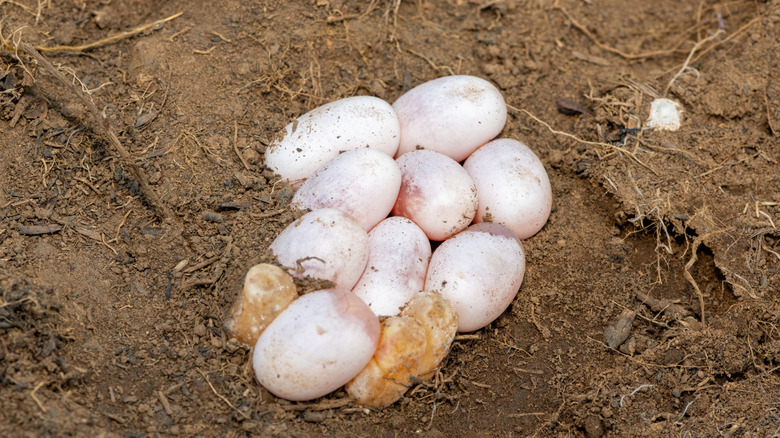
Since snakes can't dig their own holes, they usually lay eggs in spots that afford them natural camouflage. This could be in long grass, loose dirt, inside a log pile, in your compost heap, or even just a natural depression in the ground. Provided that it offers cover, it's likely to attract a snake looking for a place to lay. If you come across a mysterious egg (or a clutch of eggs) and it has a wrinkled, leathery appearance, then it could well belong to a snake.
Now, if you suspect you have snake eggs in your yard, then the first thing to do is work out which snakes are most likely to cause danger in your area. Not all snakes lay eggs, and in North America, there is only one dangerous snake that does: the coral snake. This species usually lays clutches of between 3 and 12 eggs, and when the babies hatch, they are immediately — and potently — venomous. If you have coral snakes in your region and you find what you think are snake eggs, then it's best to let a wildlife expert remove them for you. When they're gone, take steps to deter snakes from entering your yard in the future, like removing (or elevating) log piles, shortening your grass, and making your yard less attractive to rodents.
On the other hand, if there are no dangerous snakes in your region, then the best course of action is to simply leave the eggs alone. Snakes can perform miracles in gardens, particularly those plagued by rodent infestations. Yes, you may want to snake-proof your garden's bird nest boxes, but otherwise, they ought to be treated as useful and natural allies in the management of your yard.
Hummingbird eggs are tiny and often come in pairs
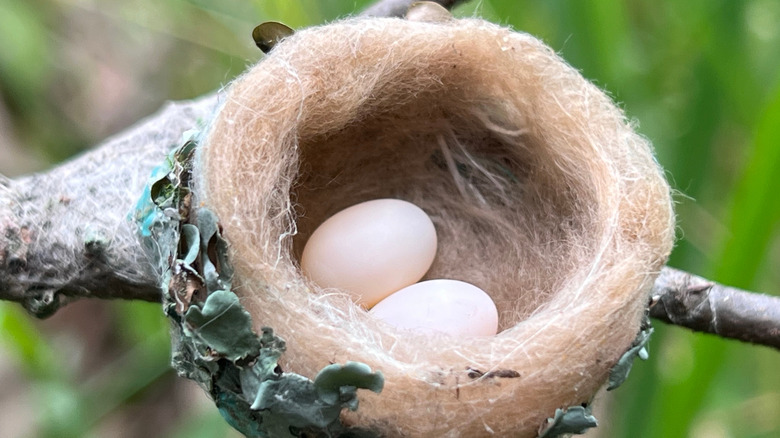
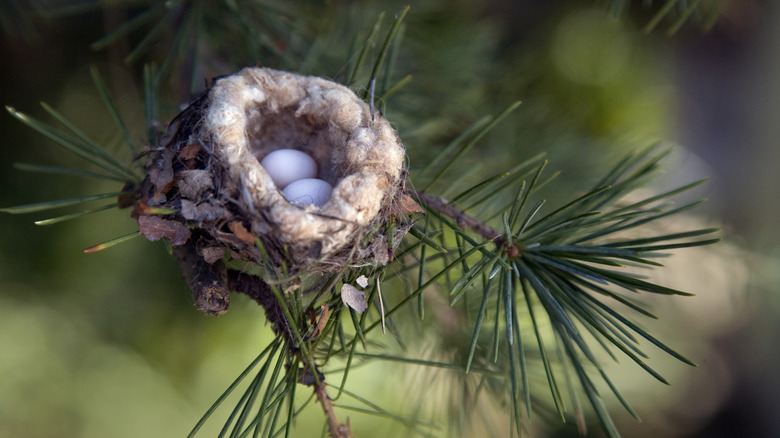
If you've taken steps to encourage hummingbirds to nest in your yard and you've stumbled across something you suspect is a hummer's nest, there's usually not much to see. We don't mean that the sight isn't a beautiful one — that's really down to the eye of the beholder. All we mean is that hummingbird nests and the eggs contained within them are rather inconspicuous.
The eggs of common North American species like Anna's, ruby-throated, and rufous hummingbirds usually come in pairs, and are generally no more than a centimeter each in length. They look like teeny, tiny jellybeans, and while the nests are also small and hard to spot, a close inspection will usually reveal various nesting materials bound together with spider's silk.
As for what to do if you spy a hummingbird, it almost goes without saying that you should leave it well alone. Some hummingbirds travel thousands of miles in order to breed in your area, and any interference from humans (unless the eggs are in dire peril) could have grave consequences. These birds often return to the same nest site each year, too, so if you're careful and leave the nest alone (and don't scare the birds away), you could find yourself hosting the same breeding bird for multiple years to come.
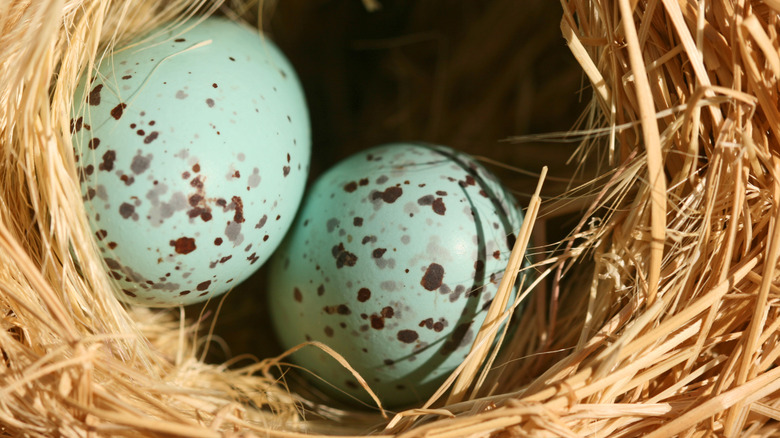
European starling eggs are usually oval-shaped and pale blue
There are certain species of birds that you simply don't want in your yard. Perhaps chief among them is the European starling. Not only are they invasive, but starlings can cause an array of problems in your garden. They can strip your trees and shrubs of berries, and because of their tendency to hang out in groups, they can quickly crowd out other birds from your bath and feeders. Unfortunately, if they're allowed to nest, then your problem is only likely to get worse.
Starling egg colors range from pale blue to pale green. They're typically oval-shaped and around an inch in size, and while clutches usually number between four and five, up to seven eggs are possible. If you spot these, then you're encouraged to take action. Given their "invasive" status, European starlings aren't protected by the Migratory Bird Treaty Act, which means you can actually remove the nest. To prevent breeding pairs from getting too comfortable, look out for nesting activity, and if you spot it, try to remove their nesting materials every few days to put them off. It may take up to a week, but with persistence, the birds should start to get the message and move on.
Cardinal eggs are nearly indistinguishable from those of the Pyrrhuloxia
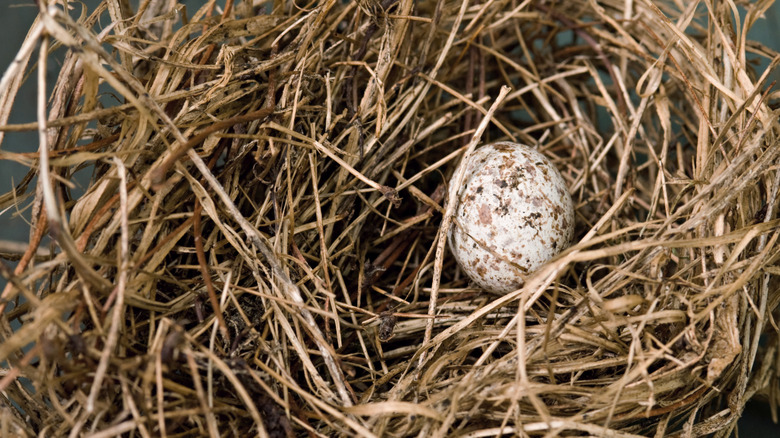
Technically speaking, cardinal eggs are difficult to tell apart from those laid by Pyrrhuloxia, since the two species are very closely related. The eggs from both usually come in clutches of three or four, and can range in color from grayish to green-white. Nests tend to be built in small trees or shrubs; they usually comprise a bowl-shaped structure, and are made from twigs, branches, leaves, and other bits of natural detritus from around your garden. However, by far the easiest way to discern whether or not it's a cardinal's nest is to identify the bird sitting inside it. Once they've laid their eggs, the females of both species tend to stay with them until they've hatched, which makes the nests and the eggs within much easier to identify than other species.
Now, whether or not you've been trying to attract cardinals to your yard, then the best thing to do if you spot them nesting is nothing. It means that your efforts have finally paid off, and that it's time to sit back and enjoy watching these beautiful birds go about their daily routines. If you keep an eye on the nesting site, you should spot the iridescent colors of the male coming and going as he works to keep his mate fed. The only exception to this rule (and this is true with any bird) is if the cardinals make a nest within reach of either your or your neighbor's cat. If that happens, don't interfere with the nest, but try to protect the site from aggressive kitty intrusions. A fence of wire or netting around the base of the tree or shrub will prevent the cat from climbing up it, and to be safe, consider having your feline wear a bell.
Koi eggs are tiny, transparent, and usually laid around rocks and plants
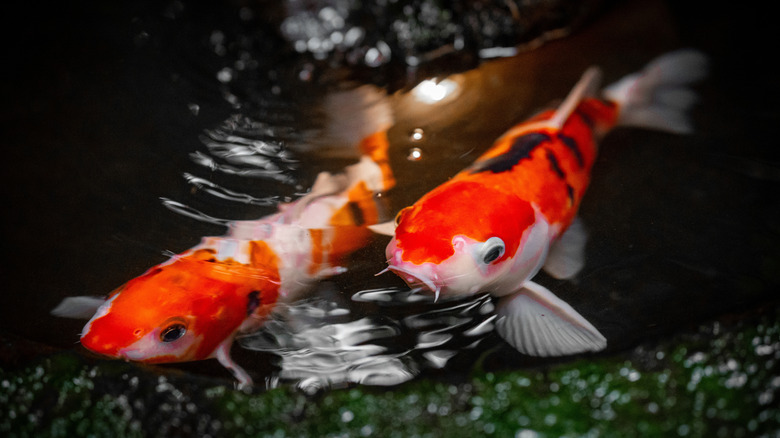
A koi pond is the kind of backyard feature that can add serious value to your home, but only if you build it properly. That means ensuring that it doesn't leak, and managing the water properly to ensure healthy fish. Fortunately, if you've started to notice fish eggs in your pond, then that's a surefire sign that you've done it right. If you're unsure how to determine between fish eggs and those of, say, frogs, then the first thing to look at is their size. Koi eggs are tiny — roughly 2 millimeters in diameter — and are usually laid on whatever organic (or non-organic) matter is available in the pond.
The real trick with koi is knowing how to identify between eggs that are and aren't fertilized. Those that are usually remain clear or slightly yellow, and they feature a dark spot in the middle. Unfertilized eggs usually turn white or opaque, and can become fuzzy with the growth of certain fungi. In either case, the best thing to do upon discovery of koi eggs is to maintain good water quality. If fertilized, eggs usually hatch in less than a week. And while the sight of lots of eggs might incite fear of a boom in your pond's population, it shouldn't be cause for concern. Young fish have plenty of natural predators, including reptiles, amphibians, insects, and various predatory birds, which means the odds are stacked rather harshly against their survival. Add to this the fact that koi will gladly eat their own eggs, and unless you want to breed your prized fish, you can usually just relax and let nature take its course.
Aphids overwinter as eggs on your favorite plants
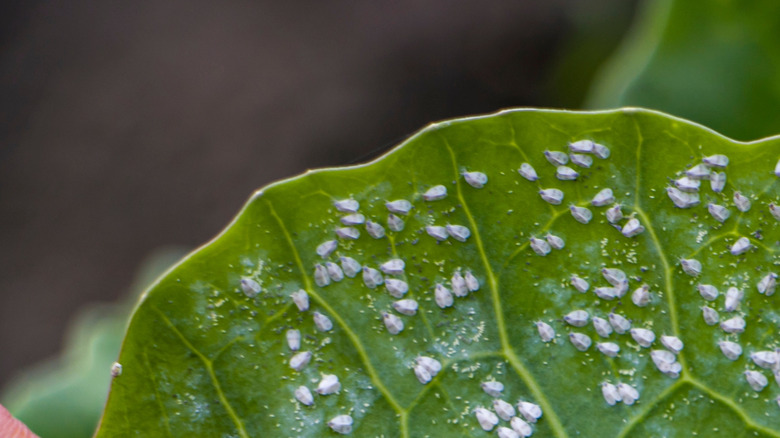
There are various types of aphids that could be causing your favorite plants problems. Most of them appear from oval-shaped eggs up to 1 millimeter in size, and most of them spend the winter as eggs before emerging in the spring. When they do, they rarely mess around in reproducing; In fact, each female can produce up to 100 new nymphs within just 30 days of hatching. This makes assessing your patch for aphids before the winter key to avoiding a problem in the spring.
There is no one single way to get rid of aphids, just as there is no one single reason for their presence. Instead, a multi-pronged approach is required — ideally one that encourages both prevention and cure. Preventative measures include avoiding over-fertilizing your plants, and keeping on top of aphid-friendly weeds, like sowthistles (Sonchus oleraceus). As for cure, there are various ways, including pesticides and, depending on the extent of the infestation, selective pruning. You may also need to consider ways to remove ants from your yard. Unfortunately, if aphids are present — and the ants learn that they're there — they can quickly make your infestation worse. Ants essentially "farm" aphids in return for the honeydew that they secrete; not only will they physically herd the aphids to the juiciest parts of a plant, but they'll also defend them against predators like ladybugs.
Butterfly caterpillars are smoother than larval moths
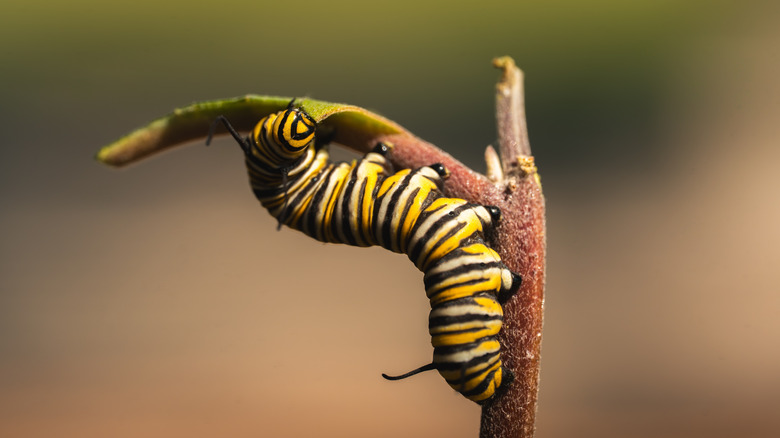
The presence of caterpillars is almost always a good sign in the garden. We'll admit that, having grown up on essential reads like The Very Hungry Caterpillar, it's hard not to worry that they'll chew holes through every last one of our leaves and lovingly-grown legumes. But the reality is that they're unlikely to kill any of your plants. What's more, if your goal with gardening is to welcome as many pollinators as possible into your yard, then spotting a caterpillar is a surefire sign that you're succeeding. But, how do you discern whether it's a butterfly or a moth?
Both butterflies and moths start out life as caterpillars, which makes things rather confusing. Most moth caterpillars are fuzzy and hairy, and while butterflies are neither of these, they may, instead, have spikes. It gets even trickier with caterpillars with smooth skin, as these could be either moths or butterflies. If all else fails, just wait for your caterpillar to undergo its transformation to adulthood. Moths wrap themselves in a cocoon of silk, and often bury themselves beneath the surface of your garden's soil. Butterflies, meanwhile, form chrysalises — smooth, hard, shell-like structures which can usually be found hanging from plants.
Stink bugs lay tidy clutches of eggs on the undersides of leaves
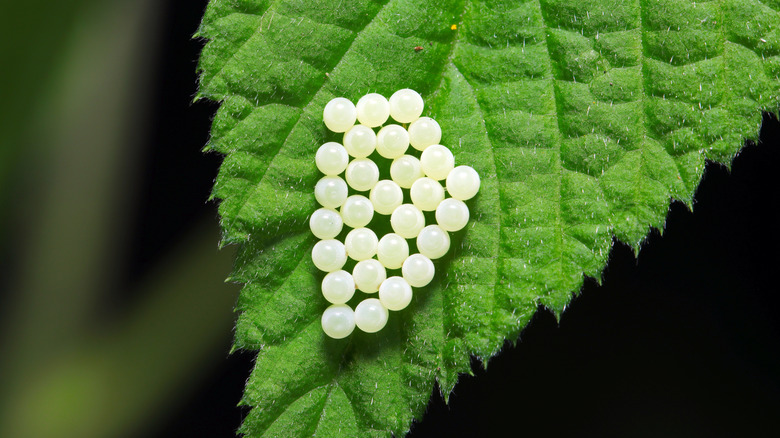
Ranging from white to pale green in color, and usually with 20 to 30 eggs per clutch (up to 60 for certain species, like the brown stink bug), stink bug eggs are a sign of a problem that you definitely want to get on top of. For starters, they can cause untold damage to an array of fruits and vegetables if allowed to go unchecked. They're also rather prolific breeders, and can lay and hatch twice in a single year.
For the most effective control, Jim Walgenbach, professor and extension entomology specialist at North Carolina State University tells Southern Living to try a multi-pronged approach. "First, look for clusters of light green eggs, often laid in a triangle shape like billiard balls, on the undersides of leaves, and crush them." He also suggests spraying neem oil to suppress nymph-stage hatchlings. As for the adults, as tempting as it might be, don't squish them – they absolutely stink! Instead, hand-pick them from your plants and submerse them in soapy water.