

Keep Your Living Room Organized And Decluttered The Japanese Way

While there are hundreds of organizational methods you could employ to keep your living room tidy and decluttered, not all of them will fit your needs. Some people prefer organization guru Marie Kondo's fascinating approach to tidying up, where you keep only the items that spark joy. Others like the Core 4 Declutter Method, which promises to revolutionize your organization in just four steps: clear out, categorize, cut out, and contain. One practice that is garnering attention online is Mottainai. Arguably one of the most exciting parts of de-cluttering is thinking about the new items you want to buy once you've gotten rid of your old stuff. This Japanese philosophy helps curb the temptation to shop. If you have yet to find a cleaning and decluttering style that works for you, you may want to give this method a try.
Mottainai, which roughly translates to "don't be wasteful" or "what a waste," is an active expression of regret about waste. The term was popularized by Kenyan political activist Wangari Maathai, who learned about the idea during a 2005 visit to Japan. At its core, this Japanese decluttering philosophy frames objects and nature as valuable in their own right. You're likely familiar with this trio of environmental directives: reduce, reuse, and recycle. When she learned about Mottainai, Maathai was inspired to add a fourth directive: respect. When you treat all the objects in your home with respect, you are less likely to part with them and more likely to repurpose them. Mottainai helps people recognize that all the items they own have a use — and, often, serve more than one purpose. We are encouraged to preserve items rather than throw them away, leave them unused in a closet, or replace them. You could transform an old step stool into an entryway shoe organizer or a wood pallet into a herb garden for your balcony. Of course, it's still important to remove items that no longer serve you, but this method makes you pause and reconsider their value before discarding them.
The principles of mottainai and how to implement them to your living room
Your living room serves as one of the central parts to your home, hosting friends and family for all of life's moments, both special and mundane. With these frequent uses in mind, the living room can become a high-traffic space that can easily collect clutter and be difficult to keep organized. Items like books, blankets, toys, crafts, tech accessories, and even clothing can make their way into the living room without permanent or designated homes. The living room can also become a catch-all for various furniture items that might not be frequently used, like extra chairs, shelves, and decor. Thus, the practice of Mottainai can really come in handy when focused on this particular room in your home. To ensure this space stays as clutter-free as possible, try to schedule a de-clutter session at least once a month.
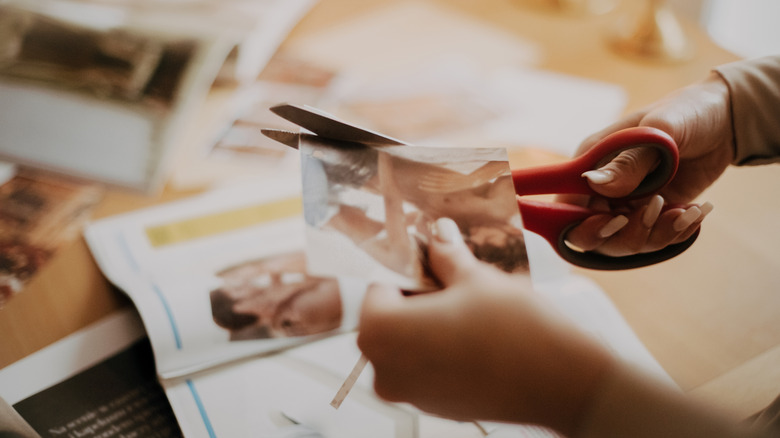
To implement the Mottainai method in your living room, walk through the room and take note of each item you no longer use or that is taking up space unnecessarily. Before you toss those items into the trash can or a bag destined for your local thrift store, pause. Take a moment to examine each item and consider how it could be of use in your home, perhaps in another, completely different way. Could those old books and magazines become a collage to hang on your gallery wall? Could you repurpose an old pair of curtains into a beautiful dining room mainstay? Obviously, there are some items you'll need to get rid of — those that serve no other purpose, are beyond repair despite creative reuse, or are single-use products. In these cases, you can throw those items away without guilt.