

The Cute Yellow Flower You Don't Want To See Growing In Your Yard
It's a darn shame when a brightly colored, pretty flower turns out to be problematic. One yellow-flowered plant native to South Africa was innocently introduced as a garden ornamental in the San Francisco Bay Area. In the 1960s, this plant got a little too enthusiastic about being there and began to spread further afield. This plant, Bermuda buttercup (Oxalis pes-caprae), has deceptively cheery yellow flowers that bloom from November to April on a long, leafless stalk. Bermuda buttercup is often confused with the similar-looking creeping wood sorrel (Oxalis corniculata), but the former has larger, more succulent leaves, while the latter is overall less showy.
Bermuda buttercup, also known as buttercup oxalis, is considered invasive in some areas, primarily in California, but not everywhere in the U.S. For example, the ecological damage it causes has prompted the California Invasive Plant Council (Cal-IPC) to characterize it as moderately invasive. The success of Bermuda buttercup in some areas is a telltale sign you might have an invasive plant in your yard — that is, a plant that's thriving even in harsh conditions. Happy in virtually any soil type and environment, this too-successful plant forms a dense mat that can crowd out or smother native greenery. Today, Bermuda buttercup is so prolific along the California coastline that trying to pull it all out isn't realistic. It's definitely a fast-spreading invasive ground cover to steer clear of, no matter where you garden.
Bermuda buttercup spreads by rhizomes, bulbs, and bulblets
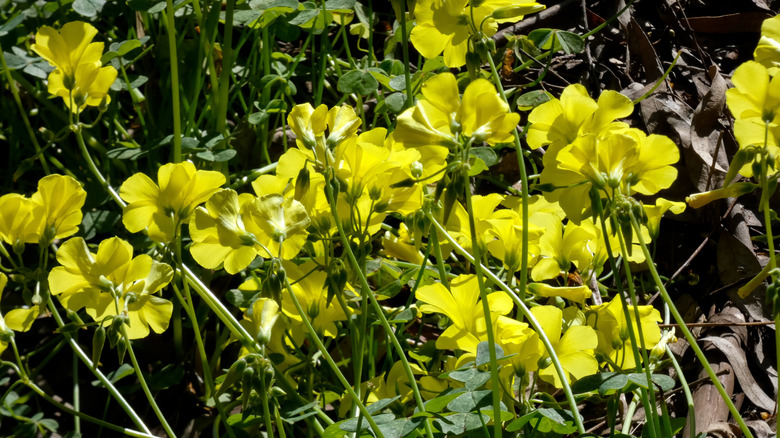
Once you understand how Bermuda buttercup spreads, you'll realize how hard it is to control. Unlike many invasive plants, Bermuda buttercup does not spread by seed. In fact, the flowers are sterile and therefore do not produce seeds. Instead, these plants spread through underground rhizomes, bulbs, and bulblets, often forming a monoculture. Moving infested garden soil that contains bulbs contributes to the spread, so avoid relocating it to uncontaminated areas.
Unfortunately, some animals, such as gophers, voles, and birds, find Bermuda buttercup bulbs tasty. They contribute to the plant's spread when they collect, transport, or store the bulbs. You might feel hope when you see the plant's foliage dying back in winter, but it will just grow back from the bulbs when the weather warms. As if the invasiveness of Bermuda buttercup isn't already enough, the plant is mildly toxic. It's in the Oxalis genus, and all parts of the plant contain oxalic acid. If humans or livestock consume Oxalis species in large quantities, they can suffer from oxalate poisoning.
Prevention is the best way to control Bermuda buttercup
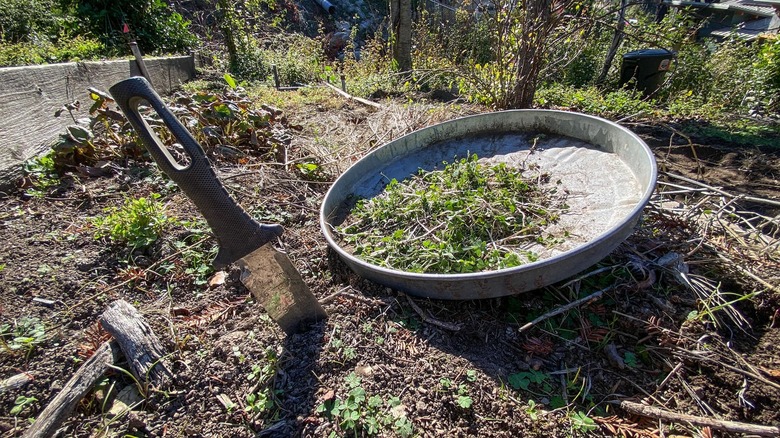
Bermuda buttercup is among the invasive plants along the West Coast you'll want to think twice about growing. How do you remove it if it's already in your garden? Unfortunately, the best control method for this aggressive plant is prevention. You need to keep the plants you want in your garden healthy so they can compete with Bermuda buttercup. You also need to vigilantly watch for this invader so you can tackle it when it's small. If you come into contact with Bermuda buttercup outside your home, thoroughly clean clothing, tools, and even vehicles. If it's too late for prevention, hand-pulling Bermuda buttercup may be effective — as long as you are persistent and remove all the rhizomes and bulbs. You may see new plants emerging from underground remains that you missed. Use a weed knife, and sift through the soil diligently to ensure you've left nothing behind.
You also only have a small window of time to act: when the plants are large and thriving, but not yet blooming, and the bulbs are immature. If you're up for a likely years-long garden project, try beating the plants into submission and starving the bulbs by consistently pulling them up and cutting them down with a lawn mower. Suppression techniques, such as solarization, heavy mulching, or laying down landscape fabric, may also be worth trying. Herbicides, applied according to the manufacturer's instructions, may work on Bermuda buttercup. A research paper prepared by the San Francisco Public Utilities Commission in 2017 showed positive results with imazapyr, with or without triclopyr and glyphosate, for both above- and below-ground plant parts.