

What Everyone Gets Wrong About Styling An Entryway
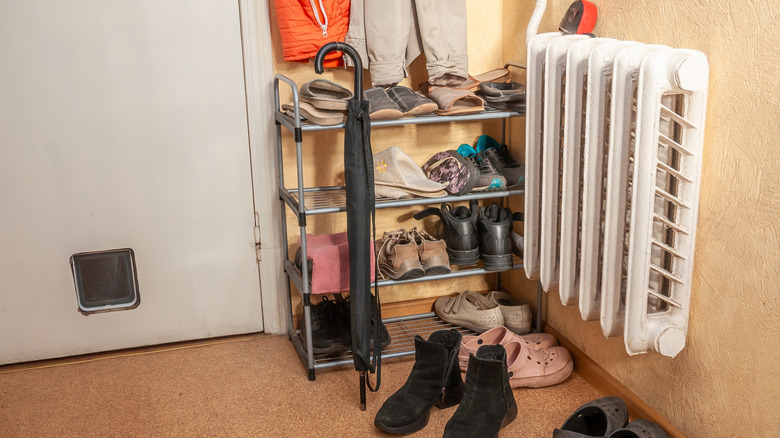
There are multiple tips you can follow for making your entryway more functional. However, treating it as a mere storage area or a dedicated drop zone can set the wrong tone, and leave a bad impression on your guests. Cheryl Eisen, the CEO of IMG NYC, agrees with this sentiment in her exclusive chat with House Digest. Relating what everyone gets wrong about styling an entryway, she tells us, "The biggest mistake I see people make when styling their entryway is allowing it to become purely functional — a cluttered catchall for shoes, bags, keys, mail, and coats — rather than designing it as a curated, intentional introduction to the home." And you might fall into this trap if you value practicality more than aesthetics, she feels. Ultimately, you're left with a space that looks chaotic and is visually overwhelming.
Even if you think your hallway works as is, try avoiding this faux pas of under-styling your entryway because its appearance will influence your visitors' and potential buyers' first impression of your home. "If the space feels chaotic, cramped, or visually heavy, it subconsciously signals that the rest of the home may feel the same — even if it doesn't," warns Eisen. Offering examples of where you might be going wrong with your design choices, she elaborates, "Clutter shrinks a space visually. Too many small decorative objects create noise. Oversized furniture blocks flow. Poor lighting flattens everything. The result is a space that feels stressful instead of welcoming." She explains the importance of not overlooking this part of your home. "There's also a misconception that small spaces can't make a big design impact," our expert says. "In reality, they're the most powerful spaces to design well because they frame everything that follows."
Ways you can avoid treating your entryway as a glorified storage unit
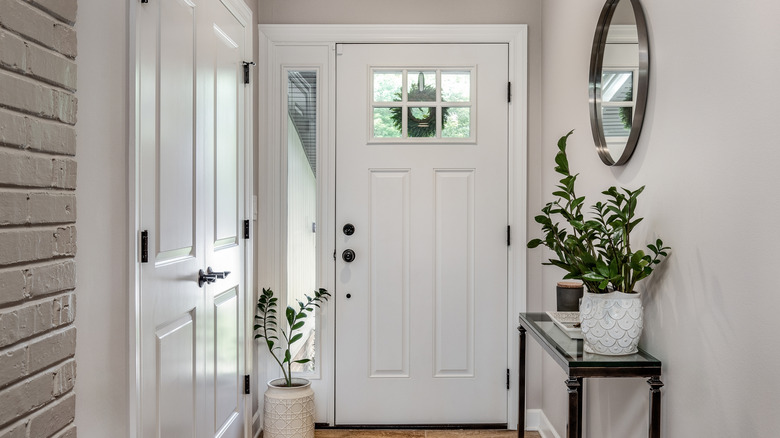
According to Cheryl Eisen, the best way you can avoid treating your entryway as a storage unit is by determining its vibe. Explaining how you can do this in a House Digest exclusive, she recommends asking yourself a few simple questions. "What do I want people to feel when they walk in? Calm? Sophistication? Warmth? Energy? Then design intentionally around that emotion," she offers. And to avoid any styling mistakes along the way, she suggests you start by decluttering this area in your house. "Remove everything that doesn't serve a purpose or elevate the aesthetic. You don't need five decorative objects. You need two strong ones. Negative space is powerful — it creates visual calm and makes the space feel larger," she shares.
Then, you want to decide on the visual anchor for your entryway, recommends our interior design expert. "That could be a slim console table or a sculptural bench," she says. "Choose one strong foundational piece scaled appropriately to the wall and ceiling height." Moreover, don't forget about the empty walls on either side. "Add a large-scale mirror or bold artwork to create height, light reflection, and intention. Undersized art is one of the most common styling errors I see," she reveals. As for storage? "Opt for closed cabinetry, tailored baskets, or a sleek drawer console," she advises. You also want to nestle in a bowl to serve as your catch-all dish. Finally, look for ways to improve natural light in your home or add some lighting features. "Add a table lamp or sconce to create warmth and dimension," suggests Eisen.
Top three entryway styling tips to help you design a functional and beautiful space
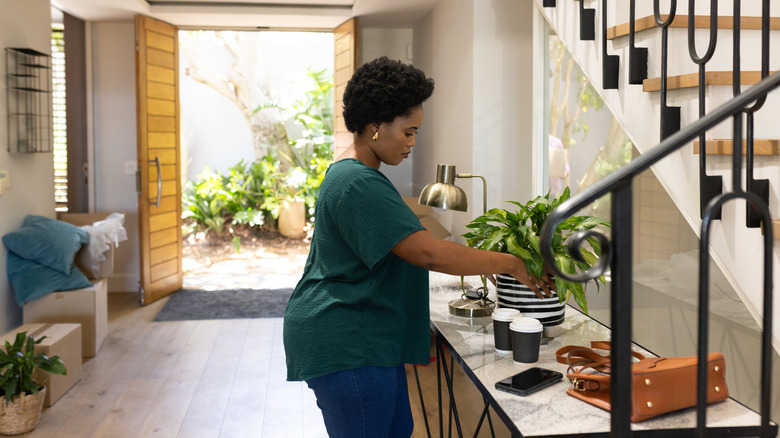
Unsurprisingly, a beautiful entryway design will make a stunning first impression on your visitors. But that doesn't mean you should compromise on your hallway's functionality. Not sure how to style an entryway that's the best of both worlds? Cheryl Eisen shares her top three tips in an exclusive interview with House Digest. She proposes you start by thinking of the space like a boutique hotel instead of reducing it to an inconsequential hallway. "Luxury boutique hotels understand that arrival is an experience. Even in compact spaces, they create symmetry, intentional lighting, and a focal point. Apply that mindset at home," she says.
Moreover, you should focus on single items that make an impact, rather than packing too much in. "One large mirror is more impactful than three small frames," she states. "One sculptural vase is stronger than five small accessories. Strong scale reads as confident and sophisticated." She has one final recommendation: "Design for emotion first, storage second." This is applicable regardless of how impractical it may feel. Commenting on how this tip will help you curate a balanced hallway, she states, "Yes, it needs to function — but function should be seamlessly integrated into a beautiful composition. When a space feels calm and intentional, it automatically feels more organized."
Changing your mindset about what an entryway truly is will have a significant impact on your home's overall look and feel. Accordingly, you can view your home as more than a way to access the rest of the house. "It's a psychological threshold. When styled correctly, it signals that the rest of the home has been thoughtfully curated — and that changes everything," she concludes.