

The Self-Seeding Flower You May Want To Avoid In Your Warm Climate Garden
The U.S. Department of Agriculture divides the country into 13 Hardiness Zones that determine which plants should be grown where. If you're in a warmer climate around USDA Hardiness Zones 8 through 10 — largely encompassing the rim of southern states from California to Florida — some of the best options you can grow include drought-tolerant, silver foliage plants that can beat the heat like lamb's ear, as well as crops including basil or sweet potato. However, you'll want to avoid four o'clocks (Mirabilis jalapa), a deciduous perennial named for its tendency to bloom later in the afternoon. Four o'clocks also thrive in USDA Hardiness Zones 9 and 10, but they're mildly poisonous to humans and are considered an invasive species.
Four o'clocks are native to Mexico and Central America, but can still be grown as perennials in states like Florida. In other parts of the country you may see them being sold as annuals, likely as a draw for pollinator gardens given that they attract hummingbirds and butterflies. However, you want to be careful about four o'clocks spreading wildly, as they can reseed themselves. These plants will grow out of tubers that become particularly heavy roots, which are hard to clear entirely out of a garden. This can create a potentially relentless cycle of self-seeding plants that embed themselves in the soil, and as climate change raises ambient temperatures across the world, it creates more opportunities for invasive plants like four o'clocks that thrive in warm conditions.
Self-seeding four o'clocks can attract pests to your garden
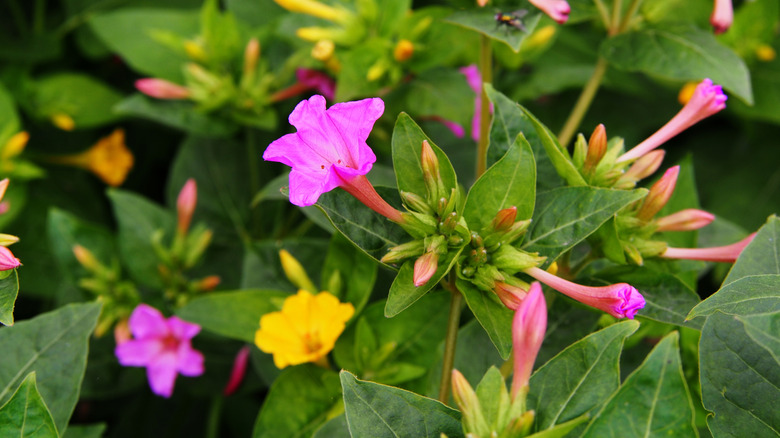
Letting a self-seeding flower like four o'clocks grow in your garden is potentially dangerous for more than just their overgrowing tendencies. Japanese beetles, an invasive pest species, are conventionally believed to be drawn in and killed by four o'clocks' toxic elements. It is true that four o'clocks will attract Japanese beetles, much in the same way hibiscus is a Japanese beetle-attracting flower, but The Old Farmer's Almanac explains that four o'clocks are just "decoys" that don't kill the bugs themselves. As a result, planting four o'clocks puts the rest of your garden in active danger from invasive pests, and as mentioned, it is hard to get rid of these flowers once they're growing.
If you're looking for a dazzling, self-seeding flower that will attract hummingbirds to your yard, it's better to stick with more native species like bleeding hearts than the invasive four o'clocks. If you do find yourself with a tuber takeover, you can dig the flowers up, but it will be hard to clean up all of its large, black seeds if the four o'clocks become self-sufficient. Make sure the soil is wet through before hand-removing a plant by the roots, otherwise a harder medium may break pieces off in the process. If you can't get everything by hand, this is a rare case where it might be worth trying to use a broadleaf weed killer, so long as you're able to keep the spray out of reach from other plants in your garden.