

Christina Haack Says This Trendy Backsplash Makes The Room Look Bigger

The backsplash is one of the most prominent features in the kitchen, alongside the countertop and cabinetry. Its primary purpose is to provide a solid barrier for the wall against splatters, spills, steam, and grease, all while enhancing the aesthetic of the busiest area in the kitchen space. Speaking of aesthetics, the backsplash also plays a role in the visual depth of the kitchen, as some designs and materials allow the room to appear larger. Sure, there are many ways, such as painting hacks, that can make any area in the house seem larger, but for HGTV star Christina Haick, one simple backsplash trick everyone should consider if their goal is to create the illusion of a larger kitchen space is to extend the material from the countertop to high up the wall.
"Running the backsplash up the wall the way we did not only draws your eye up, making the room feel bigger, it also showcases the beautiful veining in the slab," Haack says while showcasing a nifty kitchen remodel on "Christina on the Coast" Season 3 Episode 3. Over the years, Haack has tried numerous options to achieve some of the most stunning backsplash designs in made-for-TV home makeover history. However, compared to her earlier works that combined different materials for the countertop and the walls, Haack has embraced the unified, single-material trend for the adjoining surfaces. Furthermore, she's strategically expanded the length of the slab to make for a seamless wall-sized backsplash.
Why Christina Haack's trendy backsplash trick creates the illusion of expanded space
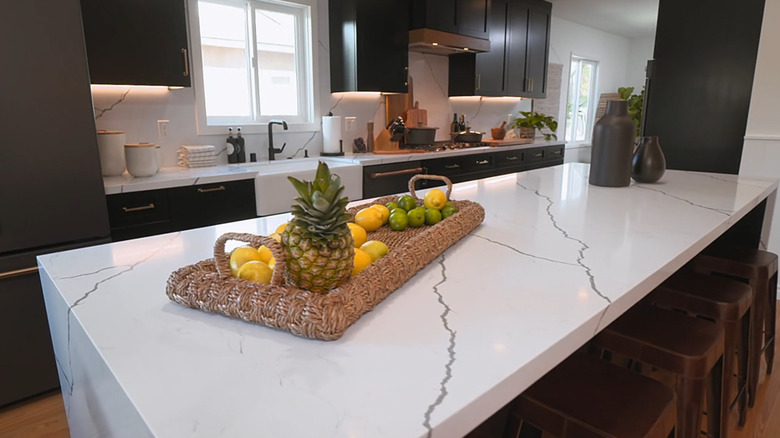
For the longest time, many American homes seemed stuck with short tile backsplashes. Christina Haack's new kitchen styling choice encourages homeowners to leave one of the most outdated home trends behind and instead opt for an alternative that eats up as much wall space as possible behind the sink and stovetop. In the "Christina on the Coast" episode where she showcases this style, she used white quartz with gray veining for the countertop and the wall, covering every inch of the latter that is not concealed by the wooden cabinets and obstructed by the window over the sink. She also used the same material for the waterfall kitchen island across. Such deliberate continuity in material solidified the design cohesion, while the size of the backsplash really gave the impression that the galley is far bigger than its actual size.
You don't need to invest in quartz if you intend to follow Haack's tip, especially since this material does not come cheap. You can pull off her trendy kitchen backsplash design by going for cheaper alternatives like granite and stone. Because, apparently, this trick will work for most options out there, considering that its main purpose is to draw the eyes up and make them believe that the space is bigger than it seems. Do note, however, that if you don't want grout lines to disrupt the visual continuity of the backsplash, the material should be a slab and not tile.