

The Fruit Tree Martha Stewart Loved So Much She Moved It From House To House

If there's one non-negotiable feature in all the homes Martha Stewart owns, it's a lush and expansive garden. Beyond being a superstar homemaker, the media personality has proven herself to be a brilliant gardener. She constantly shares gardening tips on her website, such as when Stewart shared her tips for stronger, healthier tomato plants. Interestingly for someone who can afford to build gardens from scratch every time she moves to a newly purchased property, Stewart has apparently opted to make an exception for some of her fruit trees. When she had her home in Katonah, New York, refurbished, she chose to move her quince trees from another property as part of the project.
"This tree I actually brought from my old house at Turkey Hill Road, and I had a small garden of quince trees," Stewart told People (via YouTube) during a tour of her Cantitoe Corners estate. She lived on her Connecticut farmstead from 1971 to 2007. In 2000, she expressed her desire to leave the area due to the "increasingly unfriendly neighborhood atmosphere" (via New York Times). In the same year, she purchased the 153-acre Katonah property. During the transition from her former home, among Stewart's priorities was bringing her quince trees to her new primary residence.
Quince trees are dormant during winter and sprout leaves in early spring. They bloom pale pink flowers in mid to late spring before bearing fruit. Quince fruits are similar to other fall-ripening fruits in Stewart's garden, like apples and pears; however, they are rarely eaten raw. They are roasted, baked, or poached to unlock their mellow, sweet taste. This, of course, is not a problem for someone as skilled in the kitchen as Martha Stewart.
Martha Stewart can't seem to get enough of quince trees
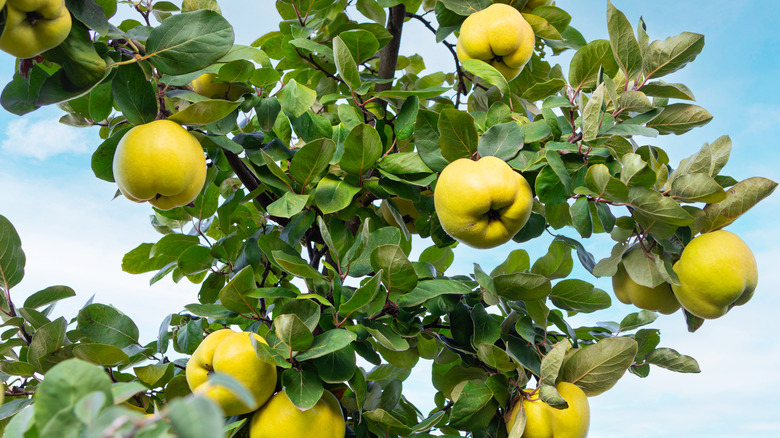
As a seasoned gardener, Martha Stewart is begging you to avoid this beginner gardening mistake: starting too big when building a garden. If anything, she's already a master of horticulture, given the massive scale of her farmland properties. So it's not surprising that she doesn't play when it comes to her quince trees. She has them scattered all over her New York plot, some standing along one side of a cutting garden while others are situated by her flower garden and orchard. Two quince trees that she holds dear are found next to a soccer lawn and an old corn crib. What makes these two special is the fact that they were trees she originally planted at her Turkey Hill estate.
It's unclear how many quince trees Stewart has on her property, although she did indicate in an October 2020 post that her staff pruned 16 Chinese quince trees (Pseudocydonia sinensis) near her flower cutting garden. In the same post, she revealed that she also has European quince (Cydonia bologna) as part of her farm's collection of over 200 fruit-bearing trees. Comparing the two variants, Stewart said the Chinese quince fruit tends to be larger and rounder and have a smoother exterior. Another point of difference between the two is their leaves. The Chinese quince has jagged leaves, while the European one typically has smooth leaves.