

Keep Squirrels Out Of Your Bird Feeder With These 11 Genius Tricks
We may receive a commission on purchases made from links.
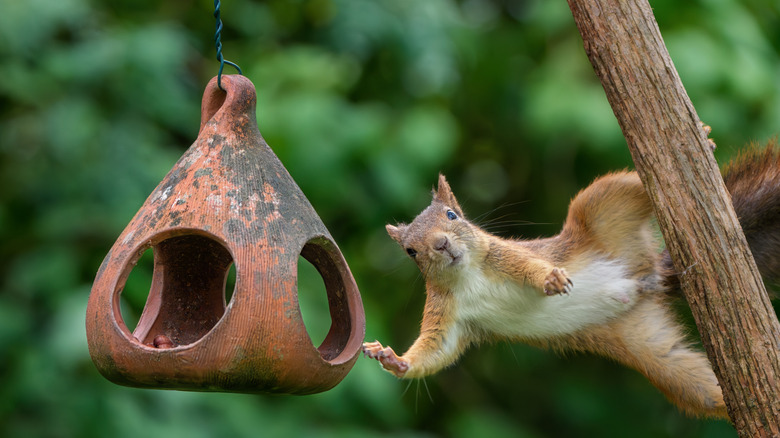
You've spent a small fortune on bird food, dedicated a weekend to DIYing your own backyard bird feeder, and finally settled down on your patio on a sunny Sunday with a glass of your favorite grape. Then a squirrel arrives. Not the American goldfinch you had high hopes of attracting, or the chorus of cardinals or song sparrows, but a squirrel. Does this sound familiar at all?
If so, then you're not alone. Squirrels have long been the bane of backyard birders. Not only do they have voracious appetites and a tendency to steal and stockpile bird food, but they're highly intelligent and, quite frankly, unbelievably athletic. They're also relentless, and once they get wind that getting into your garden is easy, they'll go to extraordinary lengths in order to pick up whatever it is that you're putting down for the birds.
Fortunately, there are several ways you can scupper the plans of your neighborhood squirrels. Some methods, such as using a baffle, prevent squirrels from climbing your feeder pole to reach the tasty morsels at the top. Others, like cleaning the area underneath your feeder and keeping your vegetable patch sealed off, help to keep your yard off the radar of any squirrels who've yet to find your feeders. Whether you're dealing with a lone scout or a seasoned syndicate of local squirrels, as you'll see below, it's entirely possible to outsmart these wily wanderers. With just a few tweaks to your setup and by ensuring you maintain a tidy yard, you can easily ensure that the early bird, and not the squirrel, continues to get the proverbial worm.
Buy and mount a dedicated squirrel baffle
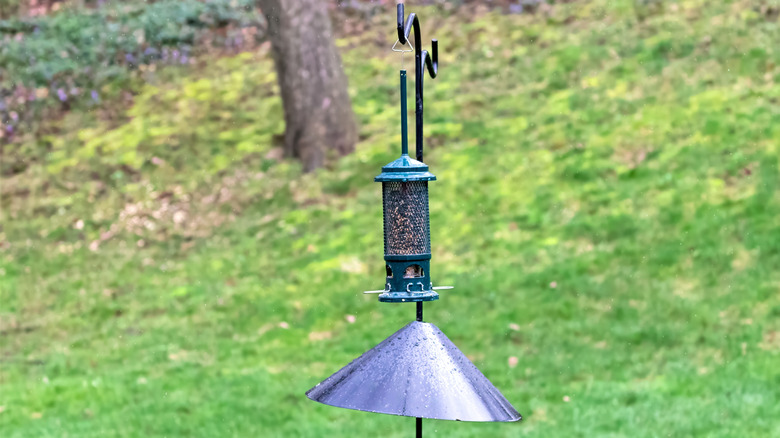
When you think of squirrels and bird feeders, one of the first lines of defence that likely springs to mind is a baffle. That's because using one is perhaps the best way to keep squirrels off your feeders. At least, it is for those that are mounted on a pole. They're designed in a cone shape and should be hung so that the widest part faces the ground. Now, they won't work in tree-hung feeders — they require a whole other type of squirrel deterrence. But if you have a feeder or two hung from a shepherd's crook, a baffle is sure to keep pesky squirrels from poking their snouts in your seed mix.
It's entirely possible to make your own, and we'll cover how to do that in more detail later. But if you want a quick fix and don't have time to DIY your own (or don't trust your craft skills), then this Pole Mounted Squirrel-Proof Baffle from Lezcufer is likely to fix your squirrel problem. It comes in two sizes and includes everything you need to attach it to your feeder pole. Alternatively, if you've yet to set up your feeder for fear of the squirrels you've seen intently watching from the trees, this Bird Feeding Station Kit has everything you need — baffle and all — to keep the birds fed and the squirrels out.
DIY a baffle on a budget with a plant pot or pie tray
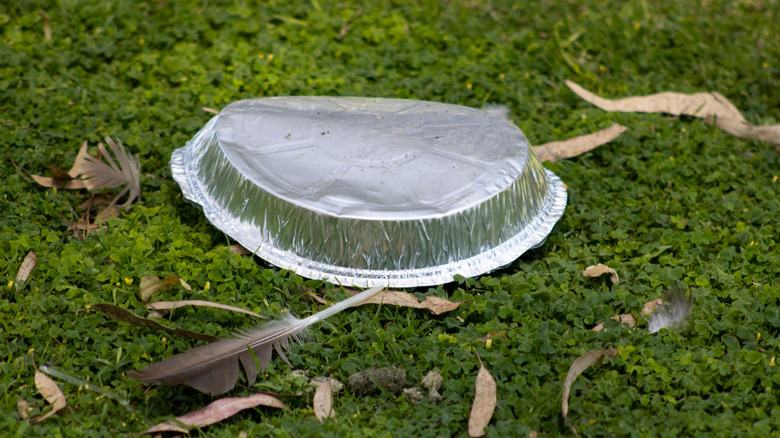
If you read the previous section on baffles and thought to yourself, "Why buy one, I could make one of those, no problem?" then we agree! In fact, there are lots of ways to DIY a squirrel-proof feeder. You could, for example, reuse an old plastic nursery pot to create a squirrel-proof bird feeder baffle, which is perhaps the easiest way for those who've just finished transplanting their spring annuals and now have several pots to play with. Alternatively, you could use an old foil pie tray to keep squirrels away from your feeder.
If you're using a plant pot, ensure you place the widest part of it on the ground. This provides the best defense against squirrels who might try to climb their way around the narrower part. If you're using a pie tray, then it should be wide enough, top or bottom, to keep them from scaling your feeding station. You could also use the pie tray as an unnavigable "roof" for your feeder, which is likely to be useful for those with trees growing nearby. Either way, just remember that a baffle is only effective if there are no other nearby structures that squirrels can climb and jump over from. Squirrels are known for their acrobatic abilities, and will leap surprising heights (sometimes up to 9 feet!) in order to feed on your seed.
Keep your bird feeder, and the area around it, clean
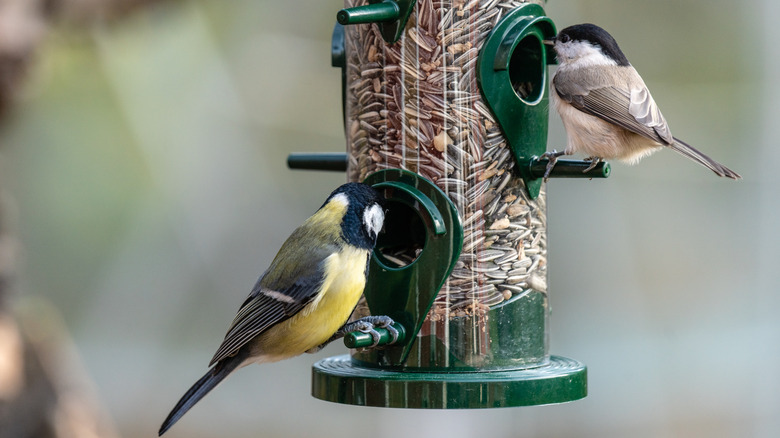
As cute as they may be from afar (or, you know, when they're not attempting to ransack your feeder), it's important to remember that squirrels are rodents. And like other rodents, they're much more likely to come sniffing around your home and garden if there's a chance of snagging some tasty treats. If you have a feeder, the ground underneath can quickly get messy with food items. Birds can be messy eaters, after all, and if you happen to be feeding them nuts and seeds — foods that squirrels love — then they won't take long to realize that the getting's good.
With that in mind, keep your bird feeder and the area around it clean. Sweep away any seeds, nuts, and husks that collect below it, and do so as regularly as you can. Not only is keeping a clean yard one of the best ways to keep squirrels from raiding your bird feeders, but it'll also help to ensure you don't get raided by rats and other rodent ne'er-do-wells.
Consider a squirrel-proof feeder
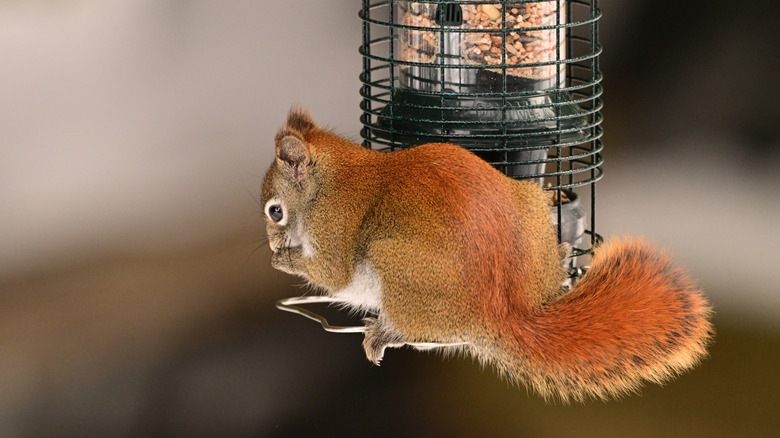
If you have a pole-mounted bird feeder, then a squirrel baffle is a useful way to keep these rapacious rodents from raiding your bird food. But if you're not convinced that it'll keep them away — perhaps because you have structures or trees growing nearby from which they could easily jump and bypass your baffle — then a dedicated squirrel-proof feeder may be your best solution. Luckily, there are various types of bird feeders that you can use without the risk of encouraging your local squirrels.
Some feature caged designs that help to keep squirrels out but allow birds of most sizes to easily gain access. You can also buy feeders built with weight-sensitive perches. When birds land on these perches, they do nothing. But when a squirrel puts its weight on one, it forces the perch downwards, which in turn pulls a shutter over the feeding station, thus forcing the squirrel to go without.
Sprinkle some chili powder around your feeder to ward off squirrels
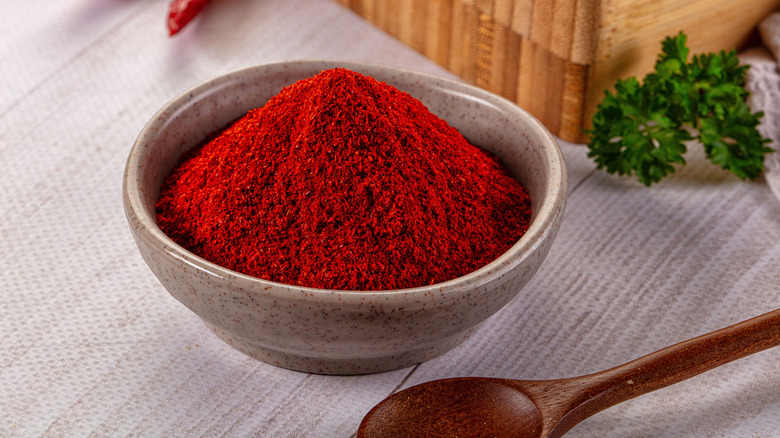
If you tried to eat something new, only to discover that it seared your taste buds and left you needing a seriously large glass of milk, would you be likely to eat it again? This is the logic behind deterring squirrels with chili powder, and according to those who've tried it, it's surprisingly effective. And why wouldn't it be? The active ingredient in chilis, capsaicin — the one that makes us fan our tongues and reach for the dairy — is just as effective on squirrels as it is on humans. In fact, some have reported reductions in squirrel seed theft of up to 80% on feeders coated with the hot stuff.
It's easy to give this tip a try. You can actually buy bird seeds that have been pre-treated with chili powder, although you should know that this is usually more expensive than regular, garden-variety bird food. Depending on how much food you need to put out, you may find it more cost-effective to use chili powder from your spice cupboard to keep the local squirrels away from your bird feeder.
Switch out a regular shepherd's crook for a PVC pipe
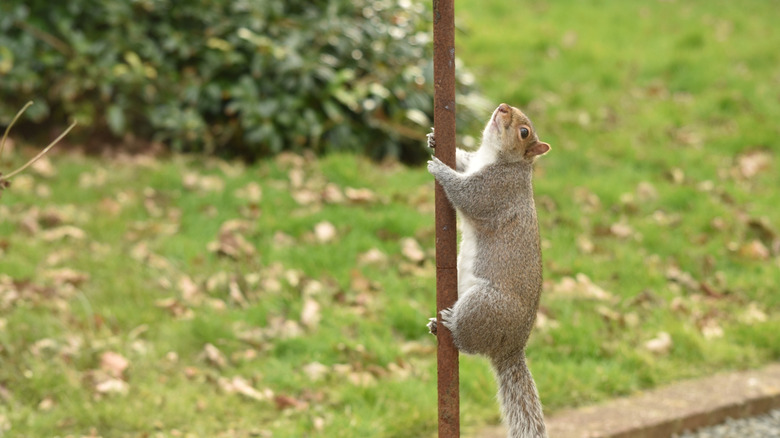
The thing that makes it so tricky to keep squirrels from raiding your bird feeders is that they're excellent climbers. Like many other rodents, they need surprisingly little grip on the surface they're scaling to find purchase and clamber their way up. But they do need some, and if you can ensure the surface of your feeder pole is truly smooth, you can prevent them from scampering skywards. One way to do this is to replace a traditional shepherd's crook or wooden frame with a chunkier piece of plastic pipe, which is much harder to grip and climb.
To do this, you'll first need to visit your local DIY store. You can use copper or PVC pipe to keep squirrels off your feeder; the key is to ensure it has a large enough diameter to prevent them from wrapping around it and shimmying up. You'll also need to drill some holes through the top of your pipe to fit either hooks or wire, which you'll use to hang your feeder.
Make your wooden feeder pole impassable with metal wrapping
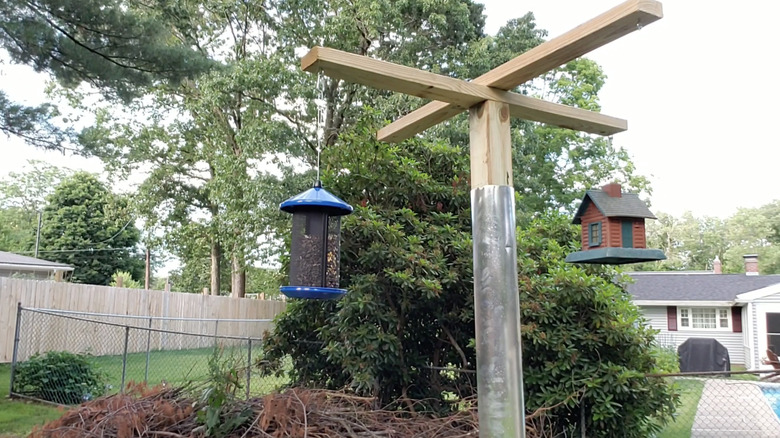
As the old saying goes, if you want something done properly, then it's often best to do it yourself. That's certainly the case with this DIY squirrel-proof bird feeder pole. You'll need some lengths of timber to create the upright section, the supports, and the crook at the top. You'll also need some strips of sheet metal.
The goal is simple: build your bird feeder hanger as you would without the metal sheets, and then wrap them around the middle of the upright section. Just like building the entire pole out of PVC or copper pipe, this makes it virtually impossible for squirrels to scale your pole, thus safeguarding your feeders from unwanted rodent raids. Now, as with any other feeder, you'll want to make sure that you position your finished creation suitably far away from other structures and trees. Don't forget that squirrels can jump a surprising distance — up to 10 feet between structures. If given the chance to do so, they won't hesitate to hop their way across to your feeder and bypass your handiwork entirely.
Fasten a band of sheet metal around the the trunk of your feeder tree
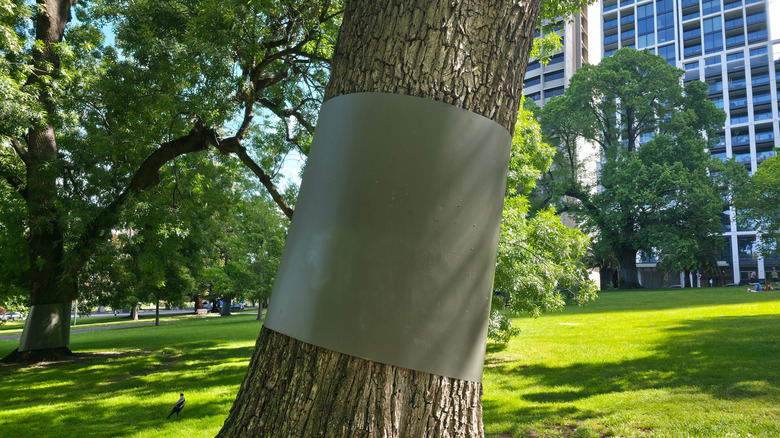
In gardens blessed with lots of trees, creating a squirrel-proof bird feeder with a pole is unlikely to work. It depends on the proximity, but if your pole feeder stands within 10 feet of your trees, then squirrels are likely to merely jump across. What's more, many birds may actually prefer to visit your feeder if it's concealed beneath the natural canopy of a tree. Fortunately, just like your feeder pole, you can make your tree considerably harder to climb for any squirrels in your neighborhood. All you need is a strip of sheet metal.
In terms of size, the Cornell Cooperative Extension recommends using a 2-foot-wide metal band and wrapping it around your tree between 6 and 8 feet above the ground. This should make it tough for squirrels to continue their ascent, thus protecting your feeders in the branches above. You should also try to maintain a minimum clearance of between 8 and 10 feet between the branches of your garden's trees, and indeed any other structures that squirrels may climb in your yard. This will prevent them from jumping across and bypassing your metal guards.
Suspend your feeder from a modern pulley clothes line
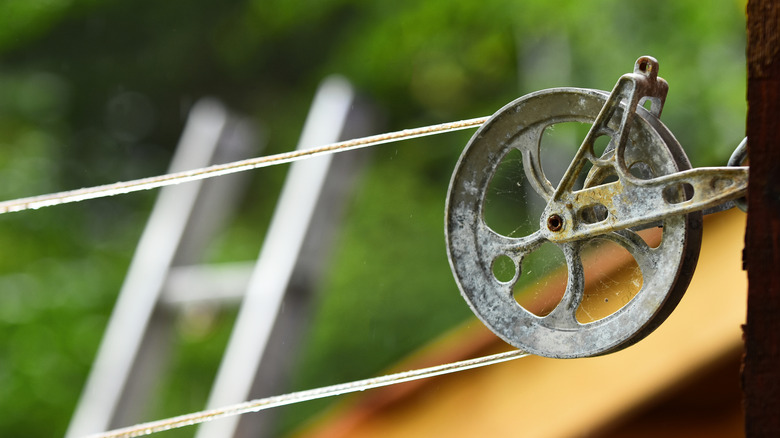
Another way to make sure that squirrels don't empty your feeders is to make absolutely sure that they can't gain access. And yes, we know, this is much easier said than done. However, it's not impossible, and if you have two buildings, you can suspend a clothesline between them; it's surprisingly easy.
This idea, offered by Cornell Cooperative Extension's guide to managing tree squirrels, uses a pulley-style clothesline. Instead of clothes, you use it to hang a bird feeder, and while it's a little more involved than staking a feeder pole in the grass, once installed, it's super straightforward to use. You can wheel it in whenever you need to clean and top up the feeder, and, provided you suspend the feeder at a suitable height, no squirrel is likely to raid it. On that note, since squirrels can jump fairly high (some up to 9 feet, in the case of the fox squirrel!), you'll want to make sure your feeder can be suspended out of reach. You'll also need to ensure you suspend your feeder far enough away from both structures that squirrels can't simply climb them and jump across.
Avoid encouraging them further by protecting your vegetable patch
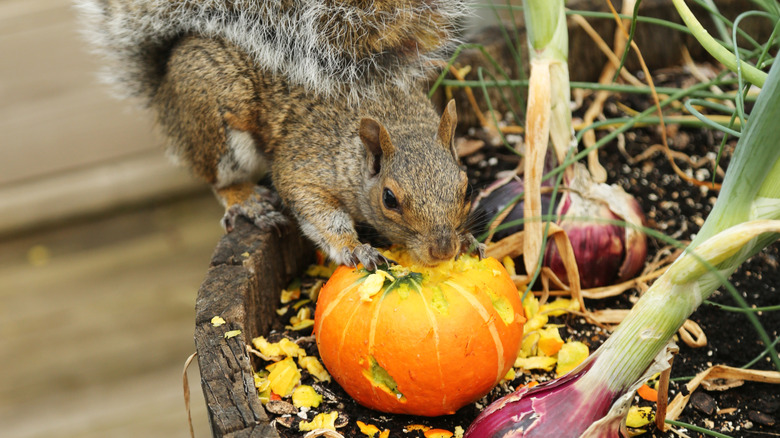
It doesn't matter how squirrel-proof you make your garden and bird feeders; if your garden is full of things that attract squirrels, then they'll continue sniffing around your yard until they're able to find a way in. One of the main attractants, as with any pest, is food, and even if you already keep a tight ship around the rest of your yard (like sweeping up spilled bird food), they may still come knocking at your garden gate for dinner. For example, if you have a vegetable patch, then they're unlikely to turn down the chance to raid your hard-grown gourmet goodies. Likewise, if you have fruit trees or berry bushes, those are similarly sure to pique their interest.
We're not suggesting that you stop growing fruit and vegetables in your yard. However, if you're having trouble with squirrels, then the best course of action is to keep them away from your produce and force them to find food elsewhere. Wire mesh can help keep them out, although this may be impractical for large patches with lots of plants. Another solution is to fence around your growing area and install squirrel-proof toppers on the fence panels. These could be slippery covers that make it hard to grip, metal spikes that make it impossible to climb over the top, or roller bars that make it tricky for squirrels to balance.
Embrace squirrels and provide them with their own food
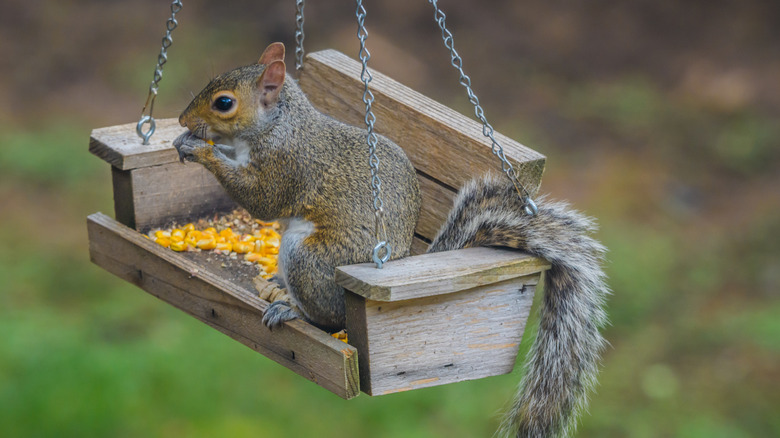
In a perfect world, squirrels would be unable to access your garden via your neighbors' trees, your fences would be proofed against their incursions, and your birds would be able to feed as they please without squirrels stealing their supper. Reality is rarely so ideal. In fact, anybody who has experience with squirrels will know how hard they can be to oust from the garden once they've found a reason to come visiting.
One way to alleviate the stress of squirrel-proofing is to adopt a pragmatic approach. In other words, accept that they're likely to keep coming, and embrace them. That doesn't mean allowing them to keep ransacking your bird feeders. What it means is putting out a dedicated feeder for your squirrels. You never know, it might just distract them from stealing your bird food, and if they're going to continue entering your yard for food anyway, you may as well take control over the things they do and don't eat.
To have the best chance of preoccupying squirrels, hang them where squirrels are most likely to spend their time, like in trees. Make sure you add baffles to any pole-mounted feeders (just to be safe), and if you're putting feed out for birds in your trees, you may still wish to sprinkle your offerings with chili powder. The more you can do to make squirrels stick to their own feeder, the better!