

Window Blinds Won't Budge? Here's How To Quickly Fix The Issue

As helpful as window blinds can be for limiting and shutting out sunlight or curious passersby, they can often prove difficult to fully raise or lower, especially if they get stuck. You may find yourself tangled in a mess of uneven cords, struggling to twist the shade adjuster, or shoving slats in the wrong direction. Whether you have slat, vertical, cellular, roller, Roman, or Venetian, you may need to try a few different tactics to fully un-stick your blinds without damaging them further. There's a few potential reasons for why your window covers may be stuck, such as damaged slats, frayed cords, or broken mechanics. While most are easy to fix in just a few minutes, others, like broken mechanisms inside the blinds, may require more repairs or total replacement.
You may also want to try to incorporate some preventive measures into your daily life to ensure the problems don't repeat. One way to make sure your blinds stay clean and usable is by consistently wiping them down to remove any dust or grime buildup. It's recommended to use a vacuum attachment or a microfiber cloth as well as a mild cleaner and warm damp rag. If you want to try the DIY route, you can clean dust from your window blinds by using a spin mop, or use lemon juice to easily clean rust or mildew off blinds. You can also keep it simple by replacing your current blinds with a cordless version.
Re-setting improperly lowered, raised, or tangled cords

Sometimes, the solution is as simple as re-setting the cords to their proper positions, particularly if they were raised or lowered incorrectly in the first place. While the method may vary based on the type of blind that you have, in general, the rule of thumb for a corded blind is to pull the cord at a 45-degree angle. (If you have slatted blinds, ensure they are fully open first before raising or lowering them to your desired positions.)
Thanks to high household traffic, kids, pets, breezes, and moving furniture, blind cords, also known as lift cords, can get all tangled up and out of sorts pretty quickly if you don't keep track of them. If you tend to yank on these cords or leave them hanging out, the more likely it is that they'll form knots or start fraying, both of which can affect how your blinds move. When lift cords are frayed, knotted, or damaged, they are much more likely to get caught in the guides or blind mechanisms, like the cord lock, and prevent blinds from functioning as intended.
Obstructions caused by jammed cord locks or damaged slats
One of the most common culprits behind broken or faulty window blinds is a jammed cord lock. This tiny yet important mechanism resides on the top corner of your blinds and is responsible for holding and locking them into place. However, sometimes it can lock when you don't want it to and be difficult to undo. If you think this could be your issue, inspect the mechanism for anything that might be causing it to be stuck, like the lift cords or fabric from a curtain. You can try to dust the lock in case dirt and debris are keeping it from moving. You can also pull at both ends of the cord to see if it will come loose, but make sure to not pull too hard and risk breaking the lock entirely. If you still can't get the cords to move, they may have slipped out of the lock or the lock is broken.
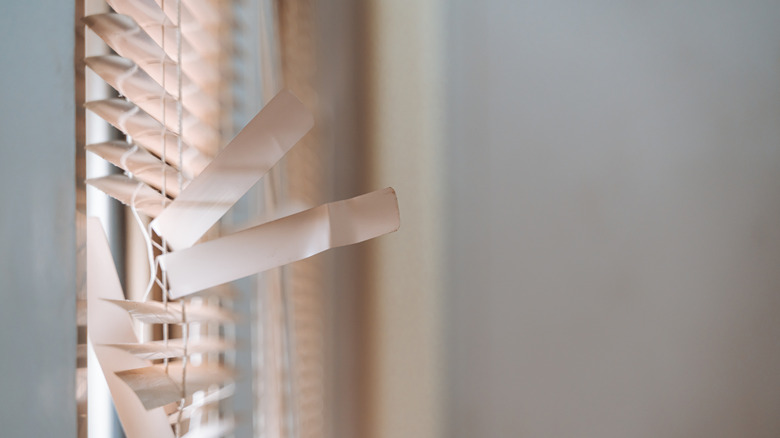
Another reason your blinds may not be moving at their usual rate could be due to damaged slats. Just one broken or crooked slat can cause the rest of the blinds to be obstructed and unable to move. If the slats are misaligned or falling out of place, first lower the blinds down to the bottom. Gently pull on the cord to lift the bottom slat up, allowing each slat to fall into place one at a time. If any of the slats are broken or bent, you may need to replace them. One quick way to fix your broken window blinds is to swap out unused bottom slats, which end up sitting on your window sill, for the higher, broken ones.