

Be Careful Using This Floral Foam Alternative In Your Favorite Glass Vase
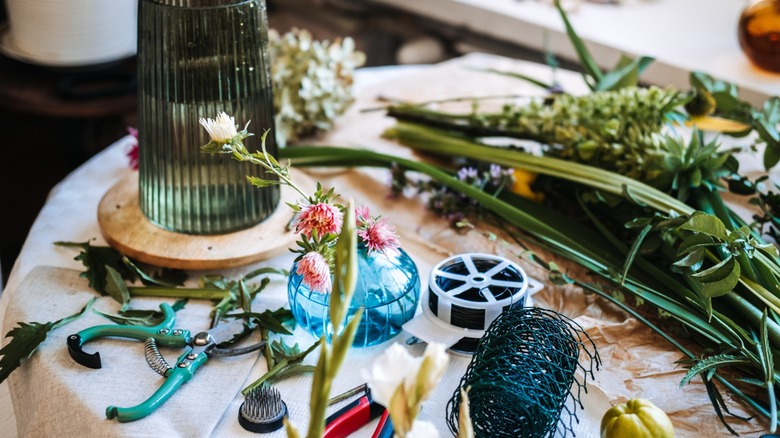
Floral foams have become one of those things to stay away from if you're trying to run a more sustainable home. Experts have found that they contain a great deal of toxins, which are really bad for our health and the environment. Now, since floral foams are no longer ideal, substitutes like chicken wire have become increasingly popular. It's reusable, relatively inexpensive, and compared to a foam block, keeps flowers far more hydrated.
For everyday arrangements in an opaque container, let's say plastic or ceramic, chicken wire works well. However, more people are finding out that it may not be the best choice for a glass vase, especially one that costs you a pretty penny or just has some sentimental value. On one hand, the wire itself is sharp. Sharp enough that if you're not careful, you could cut or scrape yourself. Even if you wear gloves and handle the wire carefully, there's also the risk of scratching the insides of the glass vase.
On the other hand, chicken wire, which is really just thin strands of metal, rusts. When it does, from all that interaction with water and flower food powder, it can leave stains that are notoriously difficult to get rid of, no matter how hard you scrub. And there's only so much force you can apply without breaking the vase. On top of that, the rust itself isn't great for the flowers either. Metal particles released into the water are toxic to flower stems and can shorten how long your arrangement lasts.
What you can use instead

There are more alternatives to chicken wire than you might expect, and some are already in your kitchen. Those mesh bags your citrus fruits come in, for instance, can be repurposed for stunning arrangements. And that's just one of the brilliant ways to reuse mesh produce bags. Another material you should be repurposing instead of throwing out is wood wool. That's the shredded fiber that often comes in wine packaging and gift boxes. Since it's spongy and porous, it holds flower stems in place and retains moisture much like floral foam does. It's also fully biodegradable, so you can toss it in the compost when you're done.
If your goal is to work with more eco-friendly materials, moss is another material worth considering. Pebbles and small rocks also work, especially in clear glass, where they can add some character to the overall arrangement.
However, if you'd prefer a more elegant finish, there are a handful of newer bio floral foams you can look into. They give you the utility of traditional floral foam in terms of the shape, the water retention, and support (but it can still be dangerous to the environment). TerraBrick, made by Smithers Oasis (the same company that invented traditional floral foam), and OshunPouch, from New Age Floral, are both plant-based products that work just like a standard foam.