

What To Do If You Find A Baby Bird Lying In Your Yard
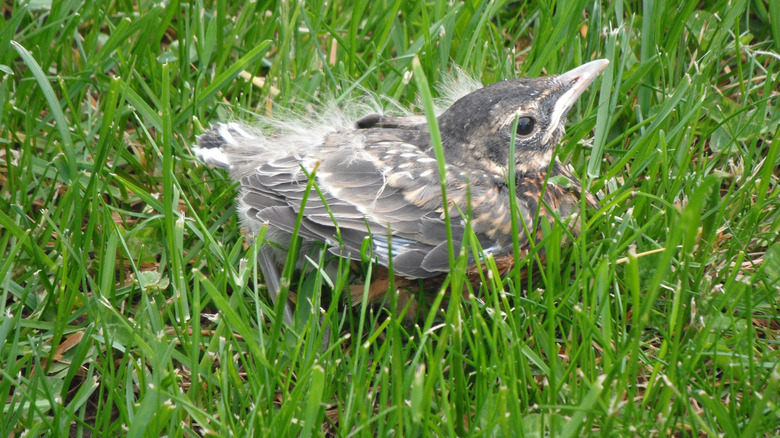
Spring is the time of year when many of us spend more time outdoors. This is also when you're more likely to come across wildlife in your yard, including baby animals. So, what exactly do you do if you find a baby bird in your yard? It actually depends on whether or not it's naked. Before panicking, check whether the bird has developed plumage. Because this will determine whether or not you should intervene. Similar to what you would do if you find a bird's egg in your yard, if the bird has feathers, you might not want to do anything at all.
The two types of birds you might find in your yard are a fledgling or a nestling. If you happen to spot a baby bird in your yard and it barely has any feathers, its eyes look slightly bulging and are mostly closed, that bird most likely fell from its nest and is considered a nestling. If you find a nestling, you will actually want to help it. Contrary to popular belief, birds will not reject their young if you touch them. Birds actually have a rather poor sense of smell and likely won't even know you touched their baby. If the bird you've discovered on your lawn has all of its feathers and has normal-looking eyes, that is a fledgling and most likely doesn't need your help. In fact, its parents are probably close by, making sure it's ok. The only time you might want to assist a fledgling is if it appears injured. Once you've identified what type of baby you have, the next step is knowing what to do.
Steps to take if you find a baby bird in your yard
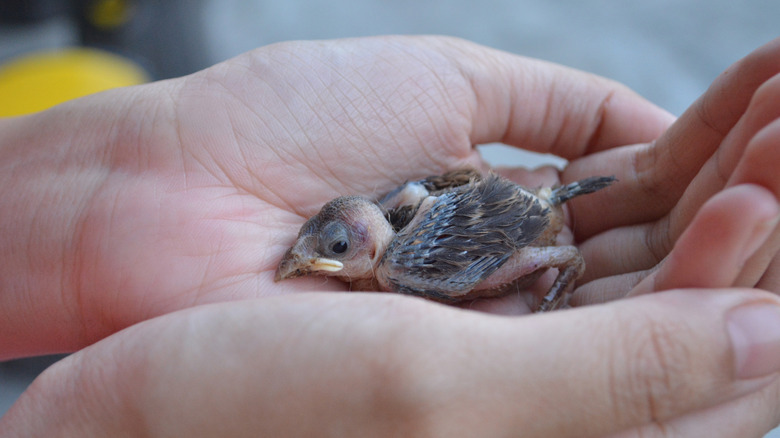
After determining which type of baby bird you've found, you need to check for injuries. If you have discovered that it's injured, you should immediately take it to a wildlife center or vet. If the bird is not injured, what you do next is determined by what stage the bird is in. With a fledgling, you won't want to do anything unless you feel the bird is in danger from predators. If this is the case, you can relocate it to a nearby bush. It's always a good idea to wear gloves when handling the bird for your own protection, especially when handling an injured bird.
For a nestling that is uninjured, your first step is to locate its nest. With any luck, the bird's nest is nearby, and then all you need to do is carefully place the bird back into its nest. If you can't find a nest nearby, you can make a small, improvised nest and place it nearby, keeping it out of reach of predators.
The one thing you shouldn't try in either situation is to feed or care for the bird. The most you will want to do if you have to take the bird to get care is make sure it stays warm. Trying to feed a baby bird might actually do more harm than good and is better left to trained wildlife professionals.