

The Pretty Purple Flowering Plant That Turns Your Retaining Wall Into A Work Of Art
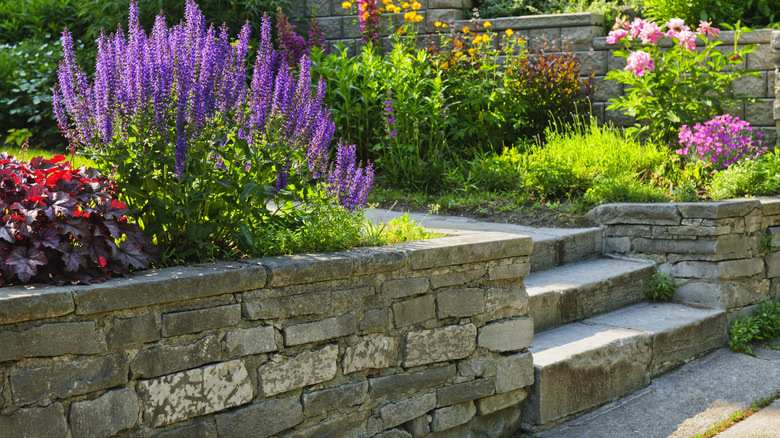
Retaining walls are an important part of a sloped landscape design, performing essential functions such as improving drainage or creating flat areas in your yard. But whether it's a natural-looking retaining wall that you don't even see or one made from concrete landscape blocks that makes a statement all on its own, it's the plants you choose that can turn any retaining wall into a work of art. If you're looking to add a brilliant splash of color to your yard, purple rock cress (Aubrieta deltoidea) is the pretty flowering plant that you often see tumbling in cascades of color from retaining walls, hanging baskets, and balcony planters.
Purple rock cress is a hardy alpine plant that can be grown as a perennial in Zones 4 to 7. It has good drought tolerance and likes a sunny location, which is why it does so well on top of a retaining wall. With its trailing habit, the soft green foliage turns into a vivid display of blooms from April to June, or mid-spring to early summer. After it blooms, it can be trimmed, and the evergreen foliage will keep its shape to provide visual interest throughout the year. Once established, purple rock cress is one of the deer-resistant plants that will bring color to your yard. At the same time, you can use this plant to attract bees, butterflies, and hummingbirds with red, violet, lilac, and deep purple blooms.
Discover where and how to grow purple rock cress in your yard
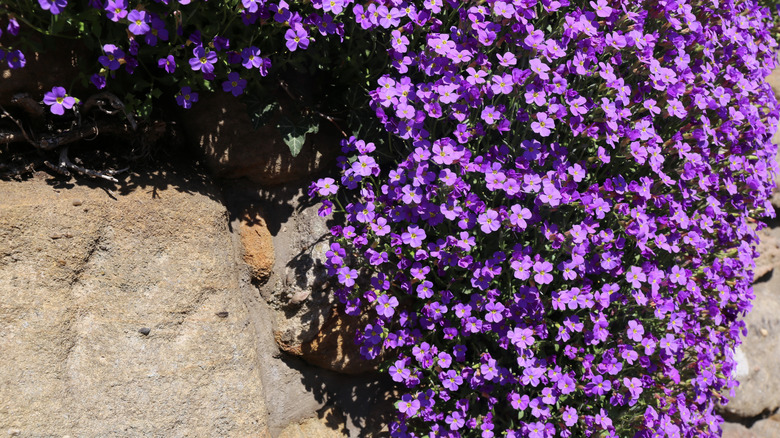
Planting purple rock cress is a great way to take a stone retaining wall that already looks amazing and turn it into a showstopper. But you don't need to have a retaining wall to grow it. Purple rock cress makes a showy container plant, whether that's in a hanging basket, tall patio planter, or wall-mounted planter for your wood fence. Because it is an alpine plant, purple rock cress is one of the best choices for crevice gardening, which adds interest to your landscape while helping conserve water at the same time. At about 6 inches tall, it makes a good choice for borders with its mounding and trailing habit.
Purple rock cress can be grown from seeds started indoors about 6 to 8 weeks before the last frost, but it's most easily propagated from cuttings taken at the end of May. It thrives in gravelly soil and sunny locations, and when it's finished blooming in May or June, you can trim it back by half to encourage growth the following season. With a variety of interesting cultivars to choose from, try Aubrieta x cultorum 'Hürth' for repeat blooms in September or 'Barker's Double' for fuller bluish-purple flowers. While the foliage is evergreen, it doesn't always look great in the early spring after being covered in snow, so pairing it with succulents like hens and chicks or sedums is a good choice for the top of your retaining wall.