

What To Know Before Planting Star Jasmine: Common Problems And How To Fix Them
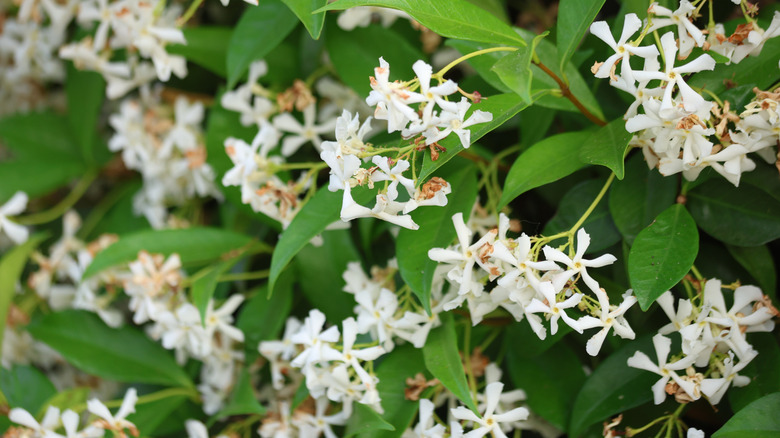
If you are looking for a flowering evergreen perennial that adds both beauty and fragrance to your garden, star jasmine (Trachelospermum jasminoides) is definitely worth a look. It blooms heavily in spring and summer with tiny white flowers that look like stars. The flowers smell wonderfully sweet, too, and interestingly, they become more fragrant at night. However, despite its many charms, star jasmine has a few problems. For one, it only grows as a perennial in warmer climates and doesn't do well in the cold. Secondly, it also has a vigorous and vining growth habit.
Left uncontrolled, star jasmine can quickly become problematic by climbing over other plants and even choking out trees. Even so, many people still want it in their gardens. After all, it has a reputation for being reliable and drought-tolerant once established. It's also pretty easy to grow. So, the real question is, how can you deal with these problems when growing star jasmine in your yard?
Protect star jasmine from the cold and prune it on time
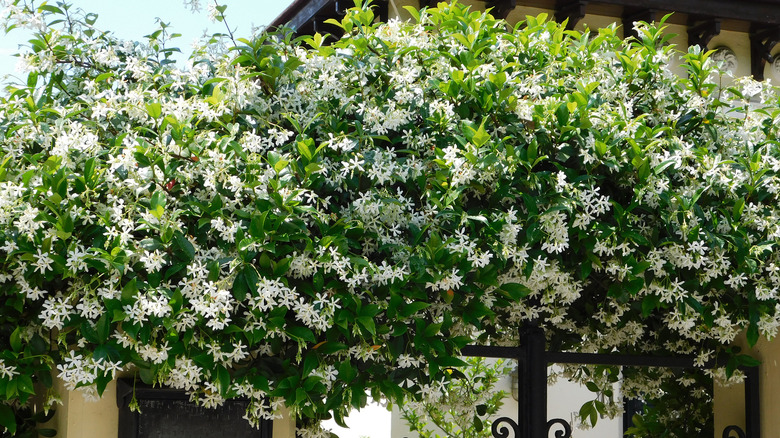
If you live outside USDA plant Hardiness Zones 8 through 10, where star jasmine grows as a perennial, try growing it as an annual instead. Or you can also grow it in containers and then bring the star jasmine indoors during the winter. Just make sure that you choose the right container if you are planning to keep it as an indoor plant. Secondly, since it has a vigorous and vining growth habit, take care when planting it near other plants. Pinch its tips to discourage vertical growth and instead encourage lateral branching and fuller plants. If you don't mind the vining habit, star jasmine still makes a great climbing plant to add shade and beauty to your pergola if you want that look.
You can also use star jasmine as a ground cover if you have the space in your yard. Just make sure to keep the plants 5 feet apart. Keep in mind that even when you are using star jasmine away from other plants, or in containers and pots, you might still need to prune or trim it at times to rein in growth and maintain a tidy look. The best time to do it is usually after the vine has stopped flowering. However, you can also prune it a bit at other times as well to keep its aggressive growth under check.
Watch for sooty mold and insects on star jasmine as well
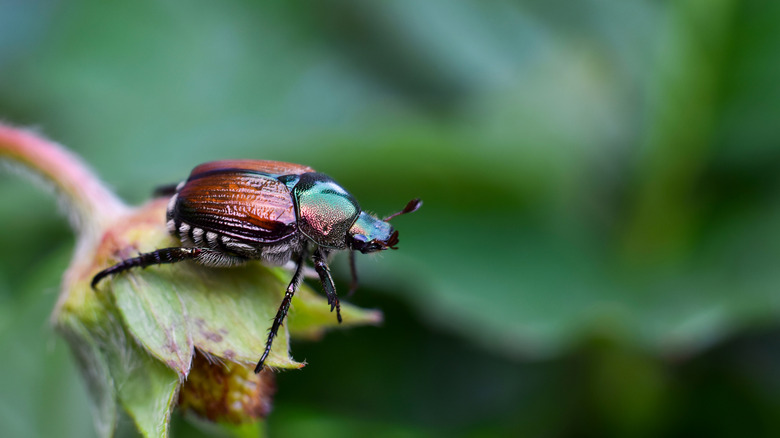
Luckily, the star jasmine plant does not have any serious pest or disease problems. However, you should still keep an eye out for scales, sooty mold, and Japanese beetles if you have planted it in your garden or yard. Thankfully, these issues are easy to control. For instance, sooty mold can be managed by controlling the populations of sap-sucking insects on plants such as scales. You can do this by spraying the plant with an insecticidal soap or horticultural oil if you notice problems.Just make sure that you spray all parts of the plant, including the undersides of leaves, always following instructions on the product label.
Get rid of Japanese beetles on your plant by hand-picking from leaves them and dropping them in a bucket of soapy water. These pests are known for quickly eating holes through leaves and flowers of your star jasmine plants, killing them, so be sure to stay on top of this problem.