

The Best Type Of Fertilizer For New Grass Seed
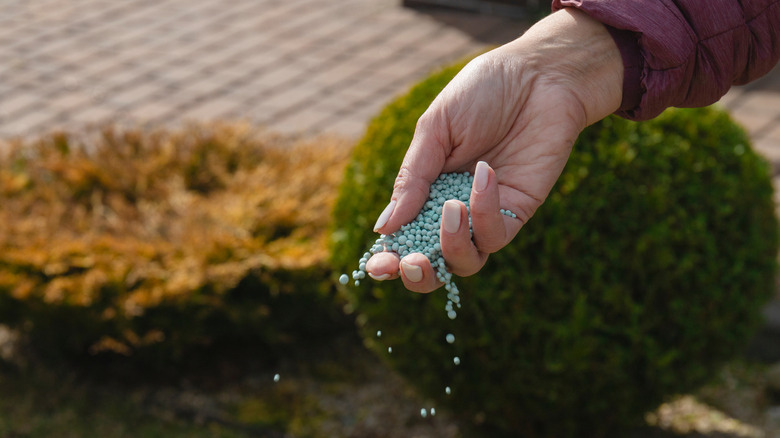
Getting grass seed to grow is one thing. Getting it to fill in evenly is another. Newly seeded lawns have a habit of starting out strong but ending up thin or inconsistent within a few weeks. Water and sunlight are usually the top focuses for people growing fresh grass, but the condition of the soil actually plays a major role in the survival of a new lawn. The best type of fertilizer for new grass is a starter fertilizer, which is specifically formulated to support early-stage growth.
Germination can take between five and 30 days depending on the type of grass, but that time span is a very important period. In the earlier days, seedlings are sensitive to their environment — weather changes, chemicals, and even foot traffic can challenge them. There are many additional factors that can cause inconsistent growth in grass, including compact soil, uneven irrigation, too much shade in the lawn, and soil pH imbalances. Once those inconsistencies in growth appear, correcting them can become an even bigger battle than starting seeds in the first place. One common misstep that leads to growth issues is treating fresh seed the same way as an established lawn. Standard fertilizer is great for grass that's already taken hold, but new lawns have different nutrient needs, and too many nutrients from fertilizer can burn grass or stall growth. To give new grass the best chance at properly filling in, it helps to use a fertilizer that's designed for early-stage growth.
How starter fertilizer is designed to support new grass
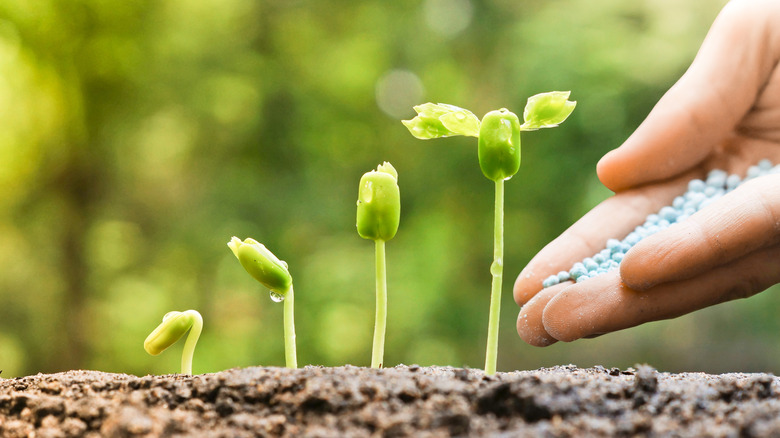
Starter fertilizer is different from standard lawn fertilizer in terms of nutrient levels. The key distinction is that starter fertilizer has higher levels of phosphorus, which aids majorly in root growth. Though phosphorus exists naturally in soil, seedlings have a hard time accessing it because it is not easily mobile in the ground. Starter fertilizer takes care of this issue by providing a phosphorus boost with easy access. This support for root development is key not only for the early days of grass seed but throughout the plant's life, as deeper rooted grass is far healthier and more resilient. Phosphorus is also key for germination — or sprouting — of the grass seeds, as well as energy transfer and storage within the plant, which is key to photosynthesis and other functions.
On the contrary, regular fertilizers contain little phosphorus and far more nitrogen and potassium than starter fertilizer. Too much nitrogen can cause grass to grow too quickly for its root system to be able to support, or even chemically burn the grass. Starter fertilizers are made specifically to avoid that imbalance, with gentler ratios that young grass can withstand. For best results, these nutrients also depend highly on proper soil conditions. Grass usually performs best in soil with a pH between about 6.0 and 7.0, where nutrients remain easy to absorb.
How to apply starter fertilizer for the best results
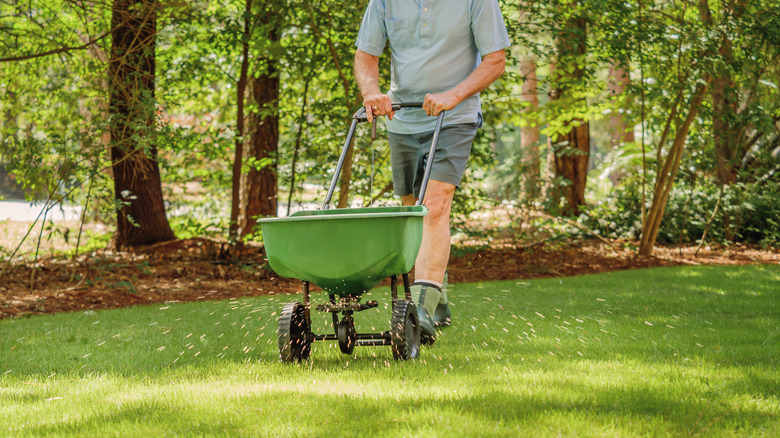
Timing and application have a huge impact on how effective starter fertilizer will be. It's best to apply the fertilizer immediately before seeding so that the nutrients from the mixture can be absorbed as soon as germination begins. If introduced too late, fertilizer won't be able to boost germination and seeds may fail to sprout.
Achieving even coverage of the starter fertilizer across the lawn is essential. Careful application or the use of spreader tools (so long as it's the right type of spreader tool for your lawn) can help distribute fertilizer and reduce the risk of uneven growth, which can result directly from uneven application. It's also important to follow the recommended rate of the fertilizer, since applying more than necessary does not improve results, and can even interfere with healthy development.
The final key is simple: watering. Without water, plants can't absorb nutrients from the soil, which can hinder their ability to take in the extra nutrients introduced by even the best fertilizers, so it's always important to make sure you know how often you should be watering plants. As the lawn begins to fill in, watering consistently can encourage deeper, more stable growth patterns. Once grass matures, starter fertilizer should be set aside as it can actually overload established grass.