

Turn An Orange Peel Into A Cottagecore Bird Feeder With This Easy DIY
Gardeners are naturally attuned to their local ecosystem, supporting their environment while growing food or their favorite flowers. Even if they don't intend to, their backyard will often draw in a host of pollinators and feathered friends. Why not embrace this magic even more by giving the birds a food source while adding whimsy to your backyard? With a few simple supplies, you can create an eco-friendly mushroom-shaped feeder suited for a dreamy cottagecore garden.
For this budget-friendly DIY feeder, you'll need dried orange peels, tree branches, twine, chalk, and a power drill. You can also use a pine sprig or berries for decorative flair. In order to attract a diverse variety of birds to your yard, you'll need a well-rounded feed with all the best ingredients. Select your ingredients based on your local bird population and preference for who you hope visits your yard. To cast the broadest net, use a mix of one part sunflower seeds, one part millet, and one part medium sunflower chips. However, you can further customize this recipe to attract specific birds too. For instance, goldfinches are drawn to thistle seed while cardinals enjoy safflower seed.
Before you start this DIY, you'll need to prep your oranges. You can also use grapefruits if you prefer. Start by cutting your citrus fruit in half. Spoon out the meat of the fruit completely. You should be left with hollowed-out rind cups. While you can allow them to air dry naturally, this can take some time. For a faster turnaround, bake them at 250 degrees Fahrenheit in 15-minute intervals until they're completely dry.
How to make a whimsical mushroom-shaped feeder
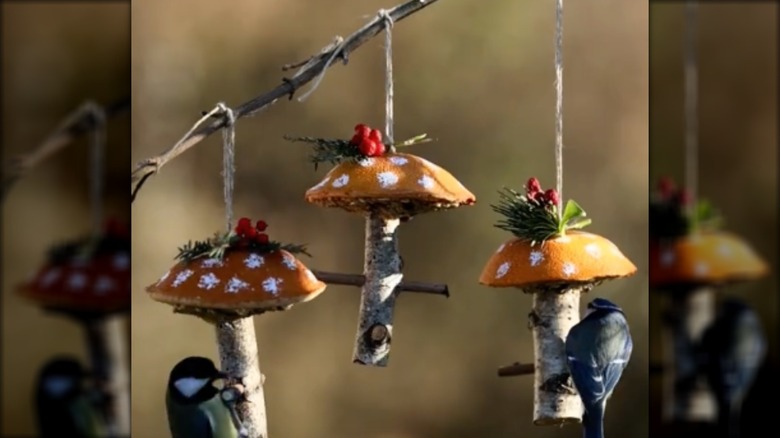
Once your citrus rinds are dry, create a hole at the top big enough to fit twine through. Next, drill a hole at the top and in the middle of a thicker, roughly 4-inch-long branch. Insert a thinner branch into the lower hole. The two branches should form a "t" shape. Feed a 6-inch length of twine through the hole at the top of the thicker branch, and join the two ends above the branch. Now, feed the twine through the hole in the dried orange rind. It should form a mushroom-like shape.
@kindwaldundwiese V O G E L – G L Ü C K ┈┈┈┈┈┈┈┈┈┈┈┈┈┈┈┈┈┈ ┈┈┈ Kleine, süsse Glückspilze für Vögel, gefüllt mit allerlei Leckereien! Ihr braucht: Getrocknete Bio-Grapefruitschalen (Grapefruit halbieren, Fruchtfleisch auslöffeln, mit der Öffnung nach unten auf der Heizung trocknen lassen) Birkenäste Dünner Haselzweig Bio Kokosfett Haferflocken, gehackte Walnüsse, Sonnenblumenkerne, getrocknete Mehlwürmer, Rosinen, Hirse, wenn möglich in Bioqualität. Bohrer, Kastanienbohrer oder Ahle Kreide für die Tupfen Etwas Dekogrün und Beeren, die die Vögel mögen, oder zumindest nicht giftig sind. Vogelfutter herstellen: Kokosfett schmelzen, alle Zutaten dazugeben und gut umrühren. Dann alles abkühlen lassen, aber nicht zu lange, denn die Masse soll noch eine formbare Konsistenz haben. Ein Einfüllen in die Schalen immer alles gut anpressen! Viel Freude beim Basteln und Vögel beobachten! 🐦🪶🐦⬛💫 "A bird doesn't sing because it has an answer, it sings because it has a song." ~ Maya Angelou Auf ein wunderbares, wild-buntes 2026 voller schöner Lieder! Happy New Year! Alles Liebe, Gabi & die ganze Kindwaldundwiese-Bande 🫶 ┈┈┈┈┈┈┈┈┈┈┈┈┈┈┈┈┈┈┈┈┈ #vogelfutter #happynewyear #diy #tutorial #glückspilz
Next, melt organic coconut oil and add in the dry feed ingredients. Allow the mixture to solidify until it's malleable. Before it fully solidifies, press the feed into the bottom of the citrus rind. Finish your feeder off by drawing white spots on the rind with chalk to mimic the look of a mushroom, and attach your decorative sprigs at the top of the rind if you choose to.
To add even more whimsy to your cottagecore backyard, you can create a garland of mini mushroom feeders too. Start by drying clementine peels and drilling a small hole at the top. You'll use a peanut for the "stem" of the mushroom. Drill a small hole at the top of the peanut. Use a needle to thread twine through the peanut and then the clementine. It should form a mushroom. Fill the rind with feed and string your mini mushrooms on a longer length of twine. Hang your DIY mushroom feeders throughout your yard, and watch as your feathered friends flitter to your yard to eat!