

The Stunning Design Tip That Takes A Peace Lily From Simple To Sculptural
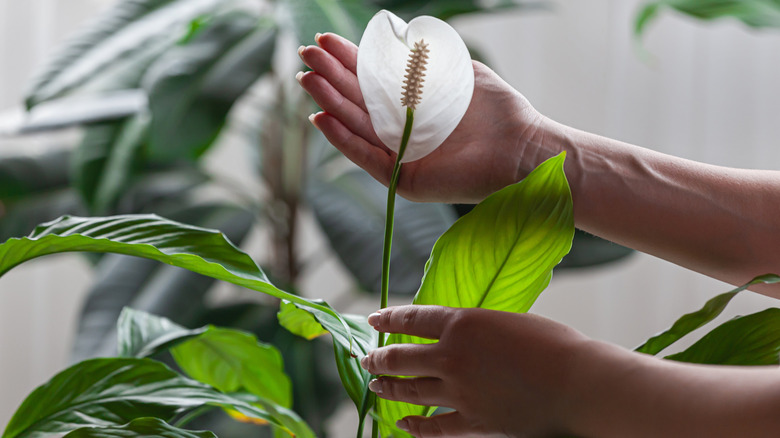
Plant enthusiasts love the peace lily (Spathiphyllum) for its graceful beauty. These increasingly popular tropical houseplants seem to cry out for a treatment that celebrates their tall, slender stems; delicate white spathes (leaves that look like flowers), and vibrant green leaves. Why not showcase peace lilies while you also explore your creative side with the basics of Japanese flower arranging, known as ikebana? Incorporating peace lilies into the centuries-old practice of ikebana will enable you to highlight their sculptural qualities and elegant stature.
Ikebana practitioners use peace lily even though it's not typically listed among the plants and flowers traditionally used in the practice. Lilies are part of that tradition, though peace lily is not the flower you think it is — it's not a true lily. These beloved houseplants seem especially well-suited for the ikebana style called "shoka," which celebrates a plant's inner beauty and upward growth. In shoka style, flowers are often displayed in tall, slender vases that are perfect for peace lilies' verticality. You can style this calming houseplant alone or with one or two additional plants.
Showcase your peace lily in an ikebana arrangement
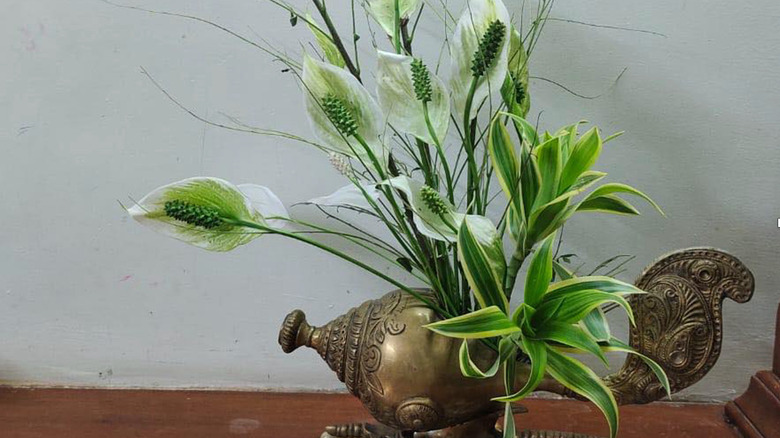
To try ikebana with a peace lily, you'll need the fascinating tool that will give you a truly unique flower arrangement — a kenzan, which has spikes to hold plants in place and gets inserted into the vase for your ikebana creation. You'll also need sharp, clean scissors or small pruners, a vase or other vessel with water, and of course, a peace lily plant.
Since ikebana is considered a form of meditation, you may want to put yourself into a quiet, meditative headspace as you create your flower arrangement. Classical ikebana is much more formal than other types of flower arranging and dictates precise ratios of plant stems to containers (for example, a ratio of one and a half to three times the combined height and width of the container typically determines how long the longest stem should be). Consider a simpler approach without these calculations for your first project.
Instead, choose three elements of graduated lengths from your peace lily — perhaps two stems with spathes and a stem with leaves. The three stems symbolize heaven, earth, and humanity. Selecting the longest stem first, place it in the kenzan. Then add the second and third stems. The stems don't need to be completely upright; in fact, many ikebana arrangements show sculptural curves in plants, with peace lilies excelling at graceful curviness.