

12 Backyard Problems That Are Caused By Tree Roots (& How To Solve Them)
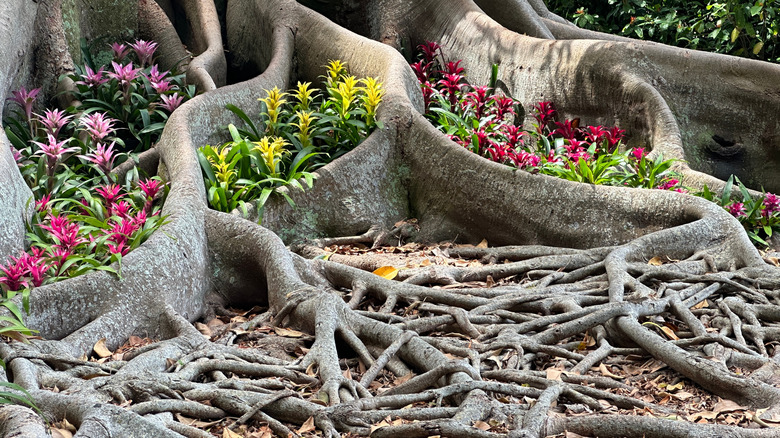
You often inherit trees with a property. My current home has an abundance of ornamental and edible trees on it. Or, if your yard is bare, you may add trees for shade, wildlife habitat, color, biodiversity, or because you just love trees and nature. But when planting trees, most people don't consider the size at maturity or realize just how big and strong the roots can be.
Lots of people only think about the eventual size of the canopy and tell themselves it'll be fine because they can have the canopy cut back or reduced. But, as a master gardener and permaculture specialist who has worked with dozens of established gardens and their incumbent tree problems, I can tell you that the underground reality is usually far messier than the beautiful thing happening above ground. Tree roots generally grow to at least the same diameter as the canopy and can spread much further if conditions are favorable and competition is minimal. This opportunistic and shallow spreading habit is why tree roots cause so many issues.
Lifted sidewalks and garden paths
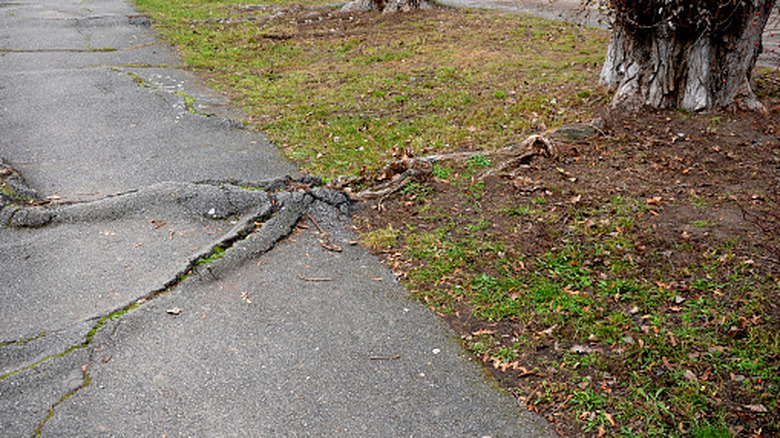
Concrete, asphalt, compacted or bound gravel, and other similar pathway materials simply have no give in them. So, if a tree is planted too close to a pathway, the root flare quickly lifts the edge of the path. A tree's root flare is the bottom portion of the trunk that flares outward just above the soil surface, where it starts to branch out from trunk to roots. The root flare will get closer to the path year after year, as the tree trunk continues to expand. Nature is a force to be reckoned with. Even a well-laid path is no match for a patient but inexorable root flare. The tree will just keep growing, pushing the path up and over, out of its way. Larger questing roots also do the same over time as they thicken, and pathways can end up lifting and splitting at random points, making a significant trip hazard.
I don't recommend cutting the offending root if you can avoid it, though. Cutting through the root doesn't stop it growing but can invite decay and disease. Plus, cutting close to the root flare will destabilize the tree and likely kill it eventually. If you want to keep the tree and you're committed to the pathway material you've already got, then reroute the path well away from the tree. If you don't mind changing things up, go for a more forgiving pathway material. Gravel, for example, has many benefits as a pathway material. It's permeable, so helps with drainage and limiting runoff, and it isn't rigid, so can move freely to accommodate growing tree roots. You could even go for stepping stones set in gravel, which are a great compromise. Woodchip paths are a genuine permaculture favorite of mine because they absorb root movement, allow water infiltration, and break down to feed the soil.
Heaved patios and shifting pavers
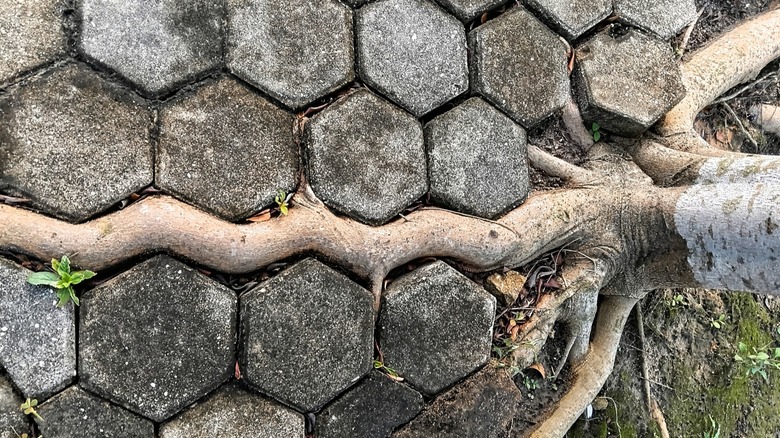
Like pathways, rigid patios and pavers are at risk of questing tree roots. Root flare is less of an issue as people don't tend to plant trees too close to a patio. But you will find that trees will put out long, lateral roots that thicken as they mature and continue their journey. They tend to stay fairly close to the surface. Therefore, as they thicken up, they can fairly easily dislodge pavers, even if they were cemented in place. You'll end up with wobbly patio slabs that can be a real trip hazard. And if you just reset them, they'll quickly get displaced again.
If you need a hard surface patio, root barriers made from high-density polyethylene can guide roots downward so they don't conflict with structures above, but these really do need to be installed by someone who knows what they're doing. Patios are expensive and labor-intensive to install properly, so having to reset them regularly is far from ideal. If root barriers aren't working, the better option is to build a deck on joists that can be adjusted without rebuilding, or to pull the patio well back from the root zone. You can also switch to a gravel area with slabs or pavers reserved only for seating and a table area.
Cracked or lifted driveways
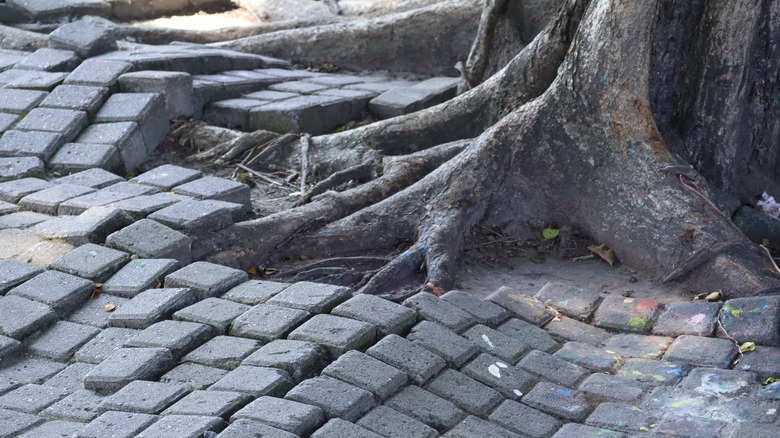
Driveways take more punishment than any other hard surface in the garden, and they're usually made of materials with no tolerance for movement. Asphalt and concrete both crack under root pressure. This is far more problematic on a driveway than it is with pathways or pavers because driveways do take more pressure and wear. Plus, once a driveway surface is broken, water gets in and causes more problems and faster deterioration that gets worse with use and with every hot spell, wet spell, or cold spell. It's a very common problem, too, as often trees are planted alongside driveways as a feature to boost curb appeal or as a screen, without any thought to how they'll behave as they grow.
As with patios, but even more so, there's not much point spending all that money just to have a driveway repaired, resurfaced, or replaced if you don't address the underlying issue. If you just have another asphalt driveway installed, you'll get the same issue within a few years. You can switch to a more flexible material, like gravel, as this will shift to accommodate the growing roots. Alternatively, you can call an experienced arborist to come and assess the root structure and tell you if root barriers or root cutting is suitable. However, if a driveway runs close to a large tree, cutting major structural roots can destabilize the tree and make it a significant danger. You may need to decide between removing the tree and redesigning the driveway.
Slow drains and sewer backups
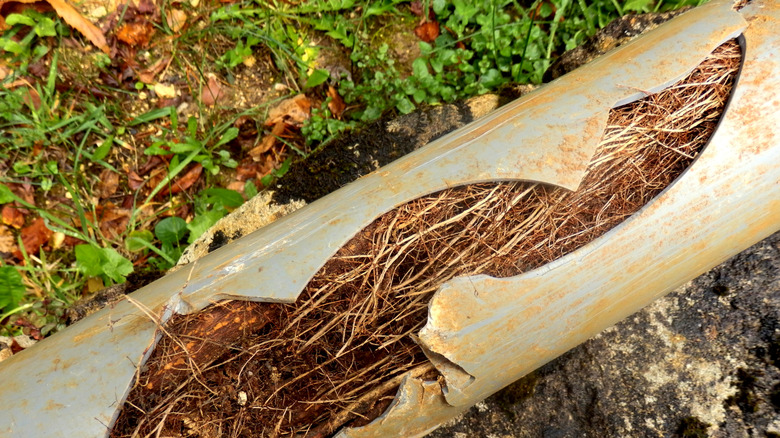
Many people think roots bore through a perfectly good pipe. But actually, this particularly expensive problem is caused by the pipe developing a hairline crack or a loose joint or another minor fault. The tree roots find the weakness and exploit it. Roots will go toward the moisture from a leaking pipe and quickly grow inside the fault. Once inside, the roots continue to grow and eventually they'll block the pipe entirely or they can crack or collapse it. Older clay pipes and cast iron are more at risk from root incursions than PVC ones.
A camera inspection is your first port of call. It's worth the expense, as it'll show you exactly where the problem is and how bad it is. Plus. it'll spot other minor problems that you are probably better off addressing at the same time as the root problem. Root cutting is only an interim solution, as without fixing the crack or entry point, the roots will be back inside within a couple of years. For minor to moderate damage, it may be possible to repair the pipe, but more extensive damage may require replacement.
Clogged footing drains, drain tile, and buried downspouts
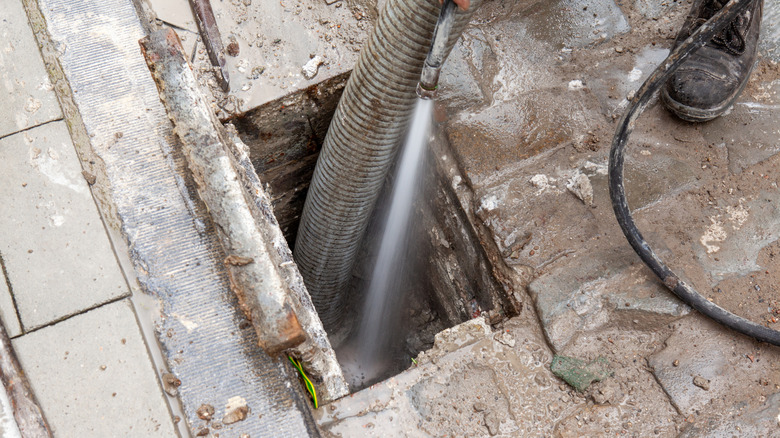
Any buried drainage line that stays damp is a target for roots. Footing drains around foundations, perforated drain tile used to manage waterlogged ground, and buried downspout extensions all carry or hold enough moisture to attract tree roots, and once a root finds a joint or a crack, it will work its way in, just as with pipes. With this kind of clog, symptoms can be slow to appear, or the cause may not be obvious. You may see new spots in the yard that stay wetter for longer than normal or standing water near a foundation. Or, if you've got a buried downspout extension, you might find the downspout no longer drains properly during heavy rain.
With less serious blockages, something like hydrojetting can clear them. However, this is only temporary if you don't seal the site of the incursion. For drain tile that's been compromised, you can replace it with a sealed pipe or reroute it away from the root zone. Buried downspout extenders can be cleared and extended farther away from growing tree roots.
Septic drain-field failures
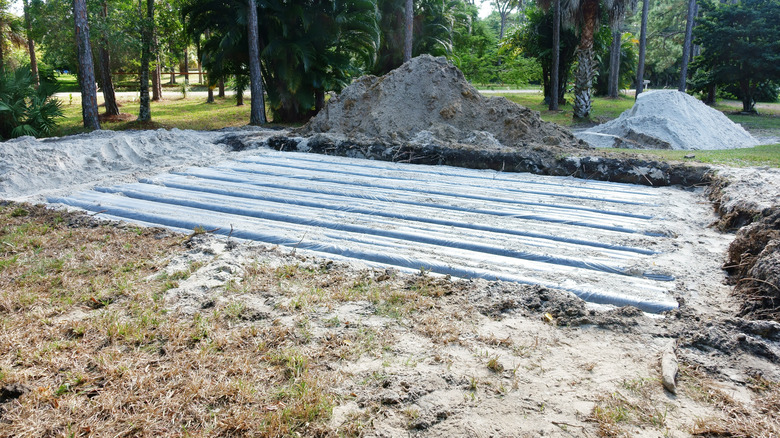
Root incursions in septic drain fields are serious and expensive. A septic drain field is where treated grey and black water percolates through the soil and safely away into the groundwater. To function properly, the drain field pipes and the surrounding gravel bed need to remain clear and open. The problem is that these drain fields are moist and full of nutrients, so are naturally attractive to tree roots and, once they clog the pipe or displace the gravel, the leech field stops working properly and sewage can back up into the house or pool on the surface of the drain field.
If you want to avoid a potentially $20,000 bill to replace a septic drain field, keep trees 50 feet away from the area, and, with aggressive species like willow and maple, give an even bigger buffer. If roots have already reached the field, you may be able to slow the progress with professional root barrier installation. But you are likely better off removing the tree to prevent further issues. It's a more reliable, longer-term fix than a root barrier. However, if the roots were already significantly impacting the drain field, just killing the tree won't necessarily fix the issue, and you will likely need to replace the pipes anyway.
Trip hazards from surface roots
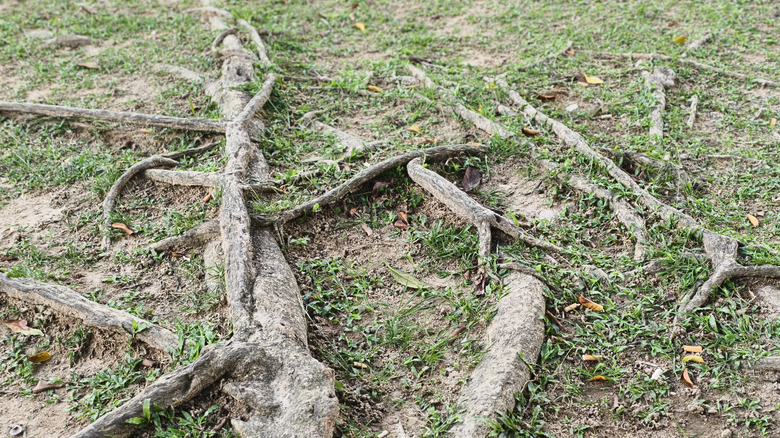
As trees age, their lateral roots thicken up, and some of them push up through the surface, particularly if the lawn soil is thin or compacted. Maples are notorious for it, but pretty much any tree will behave the same over time. And you end up with an uneven network of ridges, troughs, and humps crossing the lawn. It's a danger for playing kids and for you when you're carrying anything around the lawn.
If you've got trees close to the lawn, this is basically guaranteed to happen. But don't just hack the roots out, as you'll reduce the stability and health of the tree. Don't just try to bury them in soil and grass seed either. It won't really work, and the area will still be bumpy. My recommendation is always to turn the root zone, at least to the diameter of the canopy, into a mulched bed. Mulch benefits for trees in this situation include creating a feature of the tree, protecting the roots, removing trip hazards, and slowly feeding the tree as the mulch breaks down over time.
Scalped lawns and mower damage around the base of trees
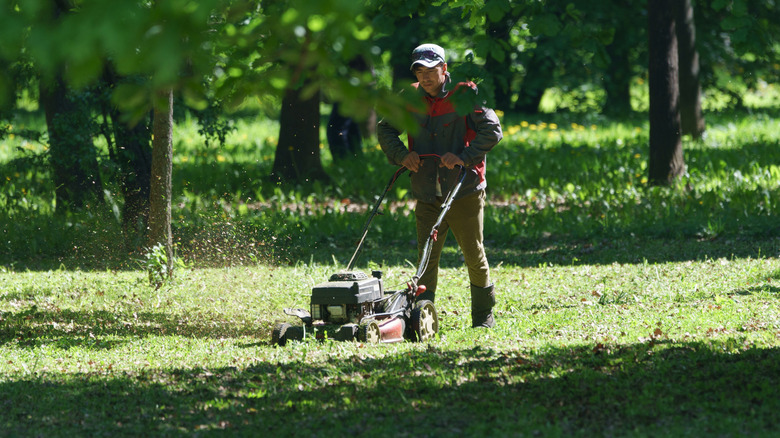
Another issue that occurs when you've got trees in the lawn is damage to the tree, the mower, and the lawn, whenever you mow or trim. While caring for the lawn around your tree base, there is a good chance you'll hit the root flare or the trunk, and every small bump produces an injury. This can invite disease, decay, fungus, or pests. You'll also damage the root structure eventually. Plus, you'll ruin your mower blades, go through loads of string trimmer line, and take chunks out of the lawn, too.
You can still landscape around exposed tree roots. Again, go with a mulched ring instead of trying to maintain a lawn right to the trunk of a tree. Be kinder to yourself, the tree, the lawn, and your garden tools. Just make sure you keep the mulch about 4 inches from the tree trunk, as piling mulch right up against the tree can cause additional problems. Go with compost or wood chips, and make sure you edge the outer edge of the bed so grass doesn't easily creep back in.
Thin, patchy grass under mature trees
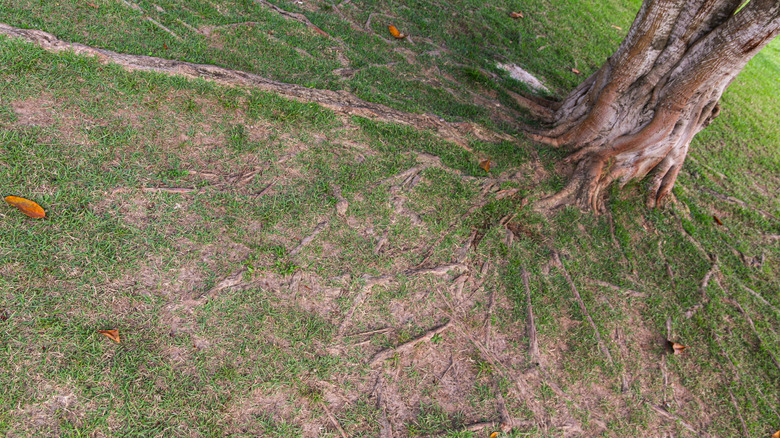
Most people assume that thin, patchy grass under their trees is the result of the lovely shady canopy. And it's partly true, but shade is only half the issue. The tree's root system is the other half. While the canopy blocks light, the roots gobble up all the water and nutrients from the same thin band of topsoil as where the grass is trying to survive. Grass and trees directly compete with each other for nutrients. And, as you may have guessed, the tree wins every single time. Trees have a massive advantage in terms of root volume, spread, and depth. They are also hungry and thirsty, so leave the top layer of soil depleted and nutrient-poor. Trees can also compact the uppermost soil layers just with root pressure. The area beneath the canopy can get so thoroughly occupied with top-level feeder roots that grass just can't get established.
Turf grass under large established trees is really a waste of effort. You'll put a huge amount of time into reseeding, fertilizing, and trying to encourage the grass to take hold. Give up on the grass. Instead, convert the root zone to a mulch bed. It's not difficult, it's an easy job that makes your yard look landscaped, and it costs very little. If you still want something growing there, go for a shallow-rooted ground cover planted in the mulch layer. Choose shade-loving ground covers. These plants stabilize the soil, can tolerate poor conditions, and, if you go with something like sweet woodruff (Galium odoratum) or green-and-gold (Chrysogonum virginianum), you'll get loads of flowers that support pollinators, too.
Flower beds that never really establish under trees
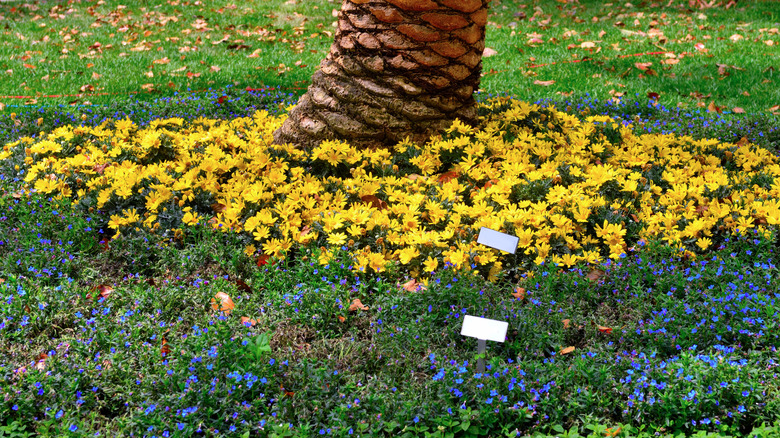
Flower beds planted right in the root zone struggle for the same combined reason as grass. And again, most homeowners misdiagnose the issue as a shade problem. So they go out and buy shade-loving flowering plants. Then those plants still struggle, or they die after a season or two, and people start to think there's something wrong and that nothing will grow there. The actual problem is that shade-tolerant doesn't necessarily mean root- or drought-tolerant. Nor does it mean that the plant can cope in thin, depleted soil where a large tree is taking up huge amounts of water and nutrients. Hostas, for example, love shade, but they also need plenty of moisture, so a dry, rough spot under the canopy of a big old tree is not right for them.
There are plants that grow under even trees even with the thickest roots. They evolved to thrive in these conditions — namely, woodland plants. I'd mulch the area, then plant fox gloves for height and color, as these fabulous plants are renowned for their woodland-loving nature. Clustered bellflower (Campanula glomerata), hardy cranesbill 'Rozanne' (Geranium 'Rozanne'), and dog tooth violet (Erythronium americanum) are all excellent choices, too. You can create a beautiful, colorful flowerbed right in the root zone if you select plants that can cope with the conditions. And these plants are mostly pretty hardy and self–sustaining, too, so there shouldn't be much required from you in terms of maintenance.
Plants failing near black walnut roots
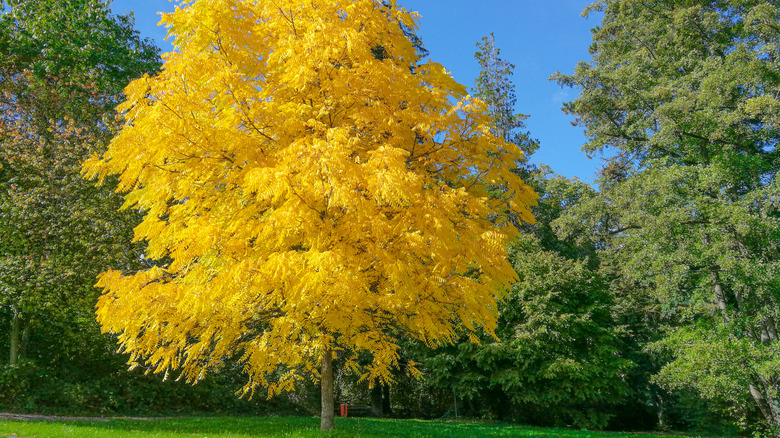
Black walnut is a really beautiful native hardwood tree, and it supports a lot of wildlife. But it is also incredibly challenging in the yard. It produces a chemical called juglone, which is present in all parts of the tree. Unfortunately, juglone acts as a natural herbicide, interfering with the growth and respiration ability of many other plants. Not all plants are sensitive, but those that are will yellow, wither, and die if planted within about 80 feet of a black walnut.
To get a flourishing yard near a black walnut, you need juglone-tolerant plants near the tree's root zone. Ferns (Polypodiophyta), asters (Symphyotrichum spp.), hostas (Hosta spp.), lobelia (Lobelia spp.), geraniums (Geranium spp.), and sedges (Cyperaceae spp.) can all cope with black walnut. And for edible plants, raspberries (Rubus idaeus) and blackberries (Rubus fruticosus) generally cope well with close proximity to juglone. You'll also need to choose juglone-tolerant trees, like Canadian hemlock (Tsuga canadensis), red maple (Acer rubrum), peach (Prunus persica), plum (Prunus domestica), or oak (Quercus spp.). Although I'm a big fan of using leaf litter, don't ever use black walnut leaves, hulls, or trimmings as mulch or try to compost them.
Root suckers taking over beds and lawn
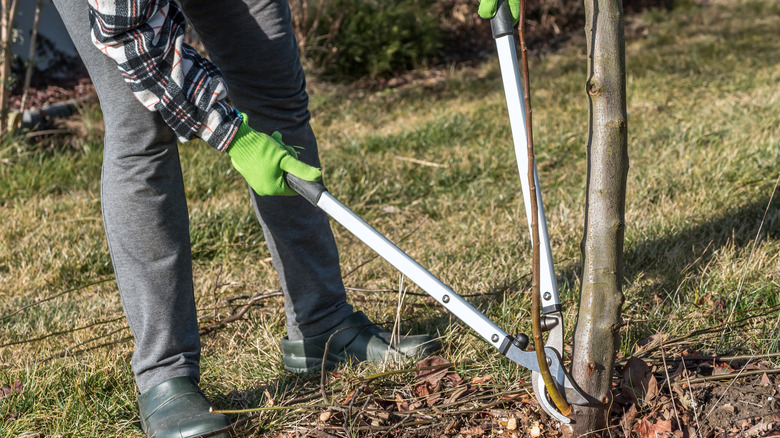
Root suckers are shoots that emerge from the root system of a tree, sometimes very close to the trunk and sometimes many feet away, toward the outer reaches of the root zone. They pop up in the lawn, sometimes looking like little flower seedlings, but they are vigorous growers and will soon produce leafy, upright stems. You can't always judge by the leaves, either as they don't always look like the actual tree. It depends on if your tree is a grafted specimen or not. A grafted tree is one where the root stock is different from the actual trunk and canopy. For example, it's common for apples and pears to be grafted onto the rootstock of hawthorns, because the hawthorn is tougher, more vigorous, and more reliable. Often, suckers appear in response to injury or stress. For example, if you damaged the trunk or the root flare with your mower, the tree will try to put off new growth in the form of suckers in case the main trunk dies.
Really, there are only a couple of things you can do here. Firstly, try not to damage the tree. But even with the best care accidents happen. Plus, some, like all fruit trees, as well as black locust, linden, and several other species will put off suckers even without injury. The other thing you need to do is to cut the suckers off as close to their base as possible. Make a single, clean cut to minimize damage and stress, and leave the wound to heal naturally. Do not use herbicides on suckers. I understand that it's tempting, but please don't. Herbicides are systemic, so they'll kill the sucker, but they'll also get taken up by the tree's roots and over time, even in small quantities, they'll have a cumulative effect that will eventually kill the tree.