

The Flower Hummingbirds Can't Resist That Adds Fiery Color To Your Summer Garden
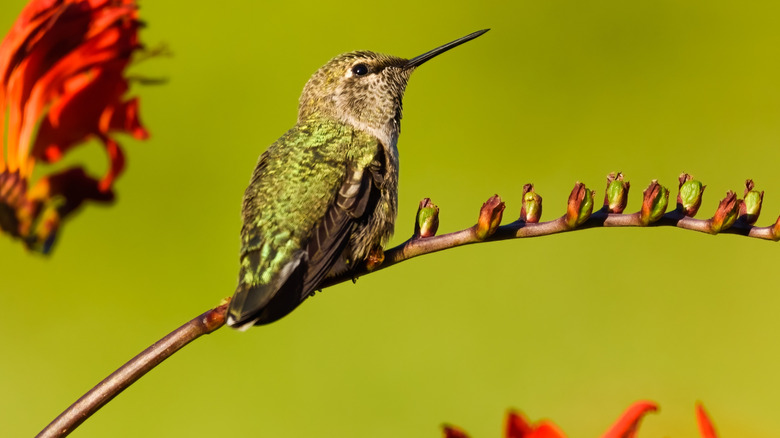
Crocosmia is a genus of summer-blooming perennials that grows from a bulb. Also known as coppertips, montbretia, or falling stars, these members of the iris family resemble a row of tubular blooms on sturdy curving stems. In my work designing gardens for clients, I love to include these easy-care, sun-loving plants. They come in range of bright, fiery colors and are known to attract pollinators, including butterflies and hummingbirds.
Hummingbirds are drawn to crocosmias for several reasons: their bright colors, their sweet and abundant nectar, and their trumpet-shaped flowers, which make sipping nectar easier for them. Planting these easy-care perennials in your garden will very likely bring hummingbirds, if you have them in your area. They're a great addition to your pollinator garden, and blooms appear in summer, usually from early July through early September.
Crocosmia come in shades of red, orange, and yellow, and look beautiful planted with other bright colors, especially blues and purples for contrast. Try them planted near blue or purple asters (like 'Woods Blue' or 'Bluebird' or 'Purple Dome') for spectacular late season color. They also make excellent long-lasting cut flowers, and add real drama to arrangements with their curving stems full of blooms. Depending on the variety, they may not be cold hardy in your USDA hardiness zone, so be sure to check the specifics. If your area is too cold for them, they can be lifted and stored for winter, much like dahlias, canna lilies, and other cold-sensitive flowers that can be saved for next season.
Varieties of crocosmia for bright blooms and hummingbirds
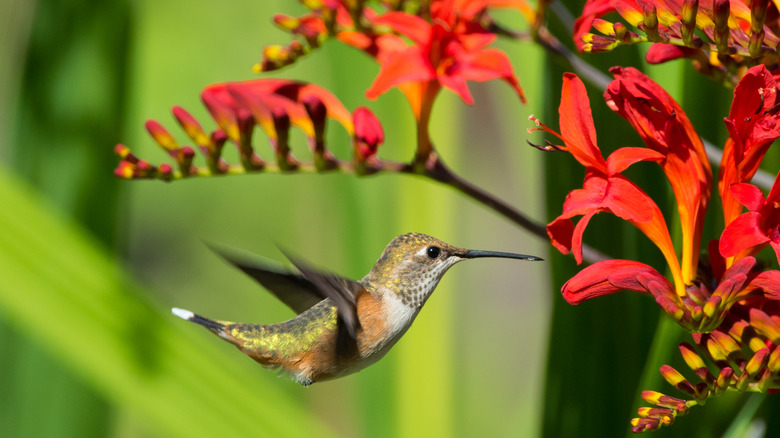
Crocosmia come in a range of sizes and colors, and some varieties have slightly different growing needs. The bright red variety 'Lucifer' is one of the most popular for its vigorous growth habit and cold hardiness. It will survive winters up to USDA zone 4! 'Lucifer' grows fairly tall (3 to 4 feet) and is a magnet for hummingbirds. The bulbs form clumps that increase in size each year. I've divided these in mid spring to replant where I want to have some bright red color, but they're also perennials you can divide in the fall. Another popular red variety is 'Fire King' which grows up to 24 inches tall and is only winter hardy in zones 7 to 9, so it has to be dug up during winter in colder zones.
While red flowers may be most attractive to hummingbirds, they'll flock to orange blooms, too. I love the bright orange and red variety called 'Emily McKenzie' which is hardy in Zones 5 to 9. This one is a shorter height (20-24 inches) and adds vivid color to the pollinator garden. 'Peach Melba' is another gorgeous orange variety, and grows up to 36 inches tall. This one is only hardy in USDA Zones 6-9, so it will have to be lifted for winter if you're in a colder zone.
There are also some lovely yellow varieties of crocosmia. 'George Davison' has large, gorgeous golden yellow flowers and grows up to 28 inches tall. It's cold hardy in Zones 6 through 9. 'Sunglow' is a more vigorous yellow variety, growing up to three feet tall and with cold hardiness in Zones 5 through 9.
How to grow crocosmia
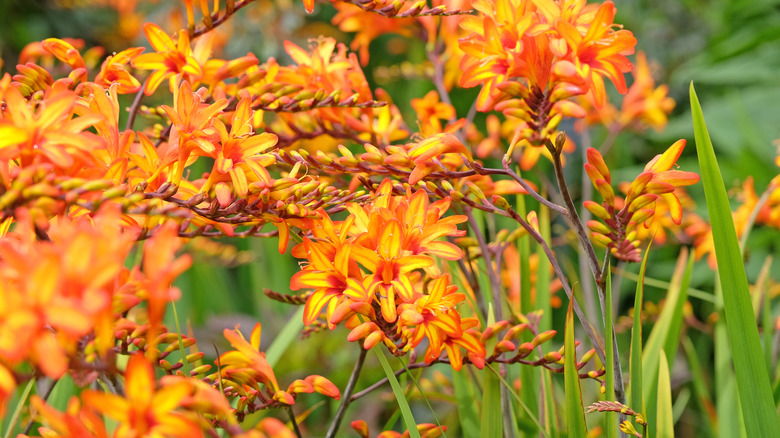
Crocosmia aren't too fussy about soil, though a well-drained soil is best to prevent the bulbs getting water-logged in spring if there's a lot of snow melt. They will bloom in partial to full sun, but the flowers tend to get bigger in full sun. Because the bulb clumps increase each year, it's best to divide them at least every other year. Autumn is the best time to divide and replant crocosmia for more beautiful blooms, but you should be sure to do it before the nights get too cold.
The main care aspect to be aware of for these flowers is their cold hardiness and the need to lift and store them for winter if they're not hardy in your growing zone. But some gardeners have success with heavily mulching them in the fall instead of digging them up. This is certainly worth a try if your crocosmias are hardy to USDA zone 6 and you live in zone 5, 5a or 5b, for example. If you do lift them, dig the bulbs up by October or before the first frost. Brush them off and store in sand or peat moss in a cool, dry place.
Crocosmia are resistant to deer and rabbits, and most other bulb-digging animals like squirrels also leave them alone. The only pests they might be bothered by are occasional spider mites, which are more of an issue in very hot and dry conditions. Keeping them watered regularly can help prevent an invasion. Speaking of watering, don't water crocosmia too much, as they are somewhat susceptible to fungal disease or bulb rot if the soil gets too soggy.