

Lawncare Pros Agree: This Trick Makes Mowing So Much Faster
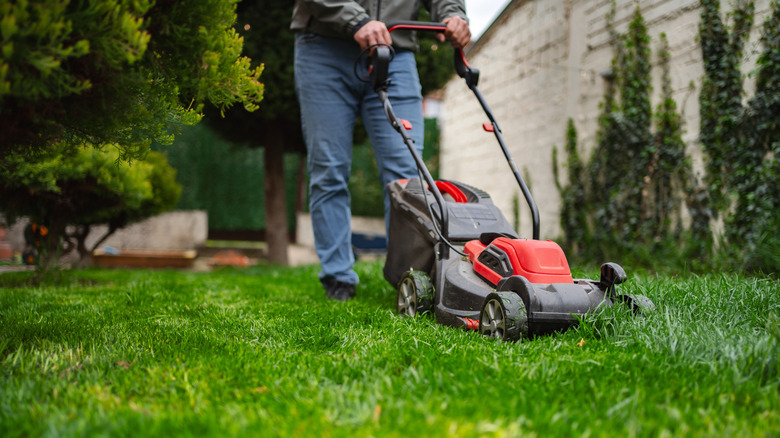
Everyone with a lawn wants it to look lush and manicured year-round. But getting it to that level often entails rigorous work, including countless afternoons spent mowing while braving the hot and humid weather. While it may all be worth it if you end up with the best lawn on the block, wouldn't it be wonderful if you could also save time in the process? By employing a nifty, expert-approved technique that involves incrementally lowering the deck on successive passes, you might be able to achieve just that.
GreenPal CEO Bryan Clayton advised House Digest's readers in an exclusive interview on how to shave off the time spent on yard work without sacrificing quality. He shared, "The best trick I know is to start high, then go lower on the second pass." Basically, you make the first pass in one direction with the mowing deck tuned at its highest setting. That way, you can cut the grass without worrying about the clippings choking up the equipment and making you stop to empty it. "Then drop the deck one or two clicks lower and mow again in the opposite direction," Clayton explained. As a result, rather than piling haphazardly, the clippings get mulched and evenly distributed across the lawn, saving you clean-up time. Leaving grass clippings on your lawn after mowing can be advantageous, too, as they release crucial nutrients like nitrogen and potassium into the soil as they decompose.
Why this mowing trick works so well
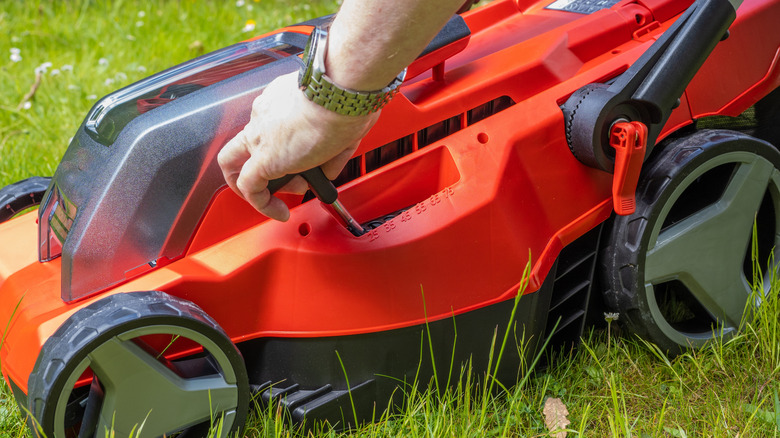
Explaining how using his trick can help you mow faster, Bryan Clayton clarified in his exclusive House Digest interview that it's all about managing the overall volume of grass clippings. Generally, you should follow the one-third rule to keep the lawn stress-free all year, or cut as much as one-third of the grass's height in each mowing session. Depending on how tall the grass is and how large your yard is, this can result in a ton of messy clippings. "If you raise the deck and then lower it gradually, it's kind of like you're incrementally dealing with the clippings you have to mulch up and the amount of grass you're cutting," Clayton said. He compared it to taking tiny bites of a salad, rather than stuffing it in your mouth all at once.
With this method, according to Clayton, you can halve the time spent on mowing. "Let's say your grass is over 6 inches tall ... taking it in incremental levels like this will save you at least 50% of the time [it's] going to take you to deal with all of the clippings," explained the lawncare pro. Stack up the saved hours over the season, and you'll have freed up plenty of time for other activities. Another advantage is that this trick simplifies the process enough that even if you work with a small push mower without much power, you can complete the session without getting frustrated and giving up mid-way, Clayton said.
Don'ts and do's while using the trick
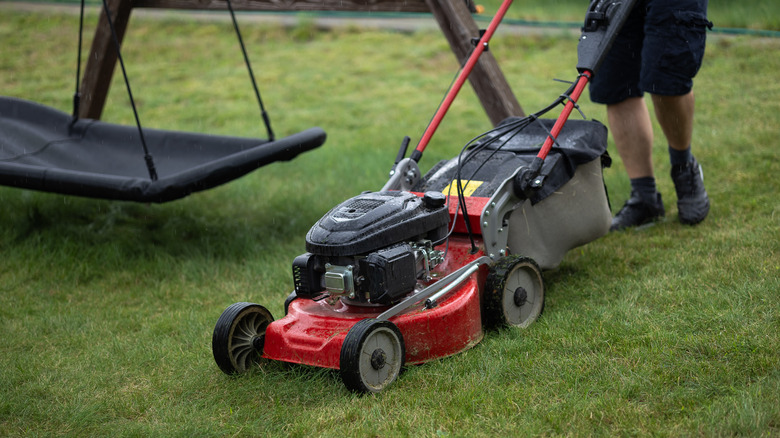
If you hope to keep your sunny lawn healthy and green, avoid using this mowing trick when the grass is wet. "Wet grass is a non-starter for any lawnmowing situation, even in the ideal circumstances," Clayton told House Digest exclusively. His rationale for it? "[When] you try to mow your yard after a rain shower, then you're going to have clumps of grass that are going to clog up your push mower or even your riding mower, and it's going to be a total nightmare."
Wet grass tends to bend, as opposed to standing straight, resulting in scalping and uneven mowing. According to Bryan, while you may still get away with this if you mow frequently — say every two or three days — you may not if you let a week or two pass between the sessions, resulting in too tall grass and an overgrown lawn. "So let the grass dry at least five or six hours after a rain or ideally the next day or two," he advised.
That being said, he clarified that you can use his mowing trick with all types of equipment, including personal and commercial. You can also use it while creating mowing patterns. Think: "Horizontal stripes on the first pass, then vertical, diagonal, or even a diamond pattern on the second," he added. But make sure the blades are sharp and the mowing deck is clean, so you get the cleanest cuts.