

Don't Confuse A Spider Plant For Something You'd Never Want In Your Home
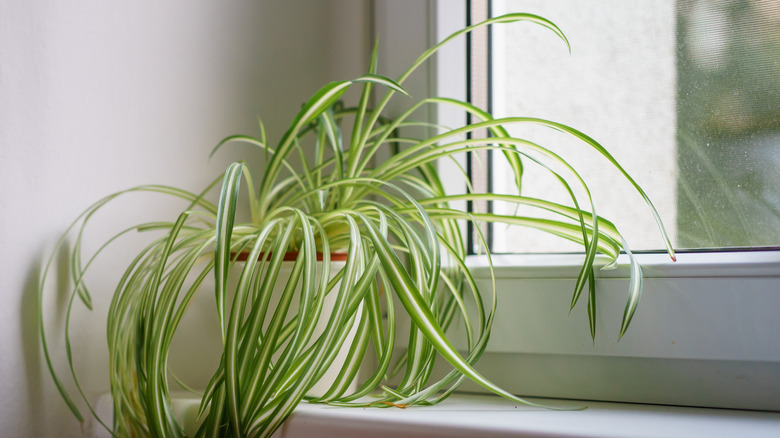
If you ask a gardening expert what beginner-friendly houseplant you should buy, chances are they will recommend a spider plant (Chlorophytum comosum). Popular, easy-to-grow, and overall low-maintenance, spider plants are the perfect indoor house plant and are quick to propagate into new, baby plants. However, whenever you bring a new plant home, especially if you're a gardening novice, you want to make sure you are not bringing an accidental pest into your home instead. It's not uncommon to mistake pesky and aggressive crabgrass (Digitaria sanguinalis) for a spider plant, especially if it manages to sprout up in the same pot. You may think it's a new shoot of a spider plant, but until you are certain, you want to avoid cultivating this growth at all costs. Crabgrass is not a plant you want inside of your home.
There are many ways crabgrass can make its way indoors. Beginner gardeners may mistake it for a houseplant, like a spider plant, and bring it inside. It can also be accidentally brought in by shoes, clothing, pets, or potted plants. If you're wondering what crabgrass is, it's an extremely invasive weed that can spread quickly through seed, usually forming identifiable patches. It is very adaptable, fast-growing, and able to withstand a wide range of conditions. In fact, just one crabgrass plant can produce more than 150,000 seeds. If you aren't sure whether or not your new plant is a weed or not, there are a few major ways to determine its species. If it is crabgrass, make sure to remove it from your home or kill it naturally with a kitchen essential, baking soda.
How to distinguish crabgrass from a spider plant
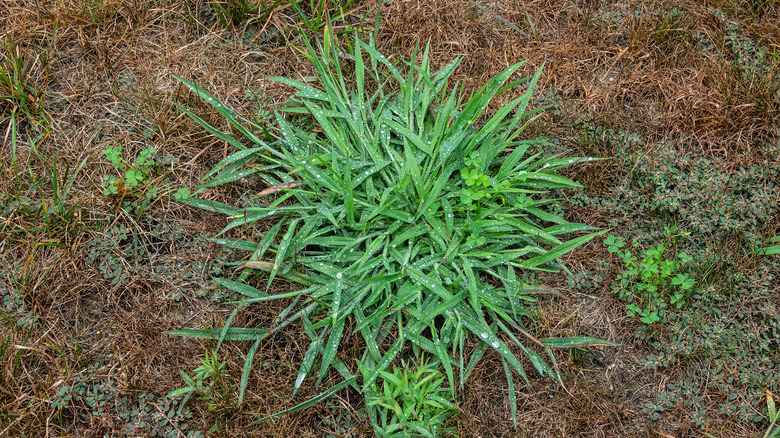
While crabgrass and spider plants are not identical, they share a few main characteristics which can often be confusing. Both plants tend to grow low to the ground with sprawling leaves that appear that to be folded down the center. They also both grow quickly. It may be hardest to tell these two apart when they are young and primarily green, before spider plants have formed their long, iconic leaves that often are striped with white or yellow.
There are some main identifiers to look out for when determining what type of plant you're dealing with and if you should bring it indoors. Crabgrass, both the smooth and large species, can typically be found growing in patches outside in your lawn, particularly in areas with full sun. Crabgrass can be found in regions all over the United States. Spider plants, on the other hand, aren't typically found living outdoors in your yard, unless you live in a tropical area. Native to West Africa and South Africa, the spider plant is primarily grown in the U.S. as a houseplant. If you think you see a spider plant sprouting naturally in your yard or a new shoot appears in your spider plant's pot soil that looks a little different, it could actually be another plant or grass like crabgrass. Always be cautious when bringing in a new plant to your home and make sure to confirm its identity before giving it care.