

The Ancient Technique That'll Make Gardening In Your Sloped Backyard A Breeze
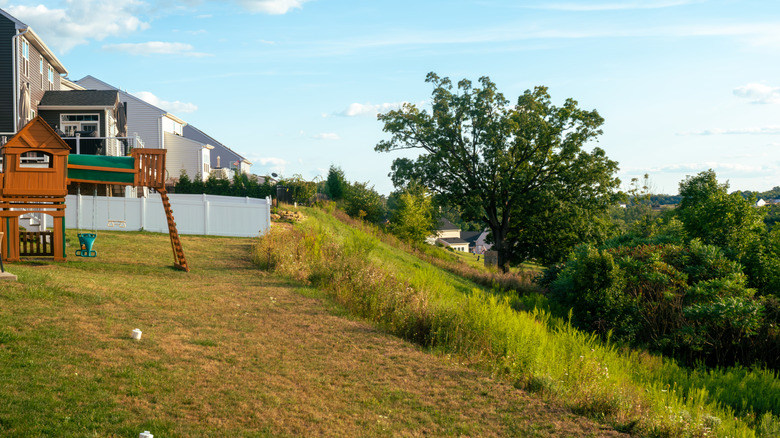
Sloping, uneven yards can make gardening a hassle or sometimes completely impossible. But having a sloped backyard does not mean that you can't maintain a successful garden. Instead, you may need to borrow a practice used by farming communities for centuries to make your difficult landscape easier to cultivate. There are many ancient techniques that deserve a place in your garden, such as crop rotation and no-till gardening. But terrace farming, or gardening, which uses earth embankments or ridges constructed on a slope, may provide a solution.
The practice dates back to the Incan Empire that stretched along the Andes Mountains in what is now modern Peru. These ancient farmers had to figure out a way to manage erosion and cultivate along steep mountainous terrain. Other cultures have also employed terrace techniques in challenging spaces, including in some Asian rice fields. Today, terrace farming methods are still utilized for a variety of crops. Just like the centuries-old planting technique that uses tree guilds to boost your fruit tree's health and harvest, terrace farming has proven effective. Terracing can also help conserve water and soil in a home garden, transforming difficult terrain into a usable space.
How to transform a slope backyard with a terrace garden
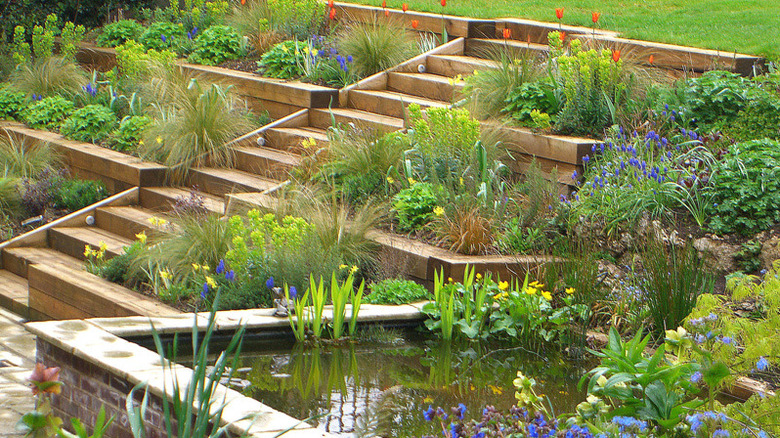
Terracing is possible in a backyard but be aware of the labor involved to start out. Well-made terraces require planning and sometimes heavy-duty equipment, such as a bulldozer, to move earth into place. For large-scale terraces, parts of the slope get removed to form step-like structures that offer enough flat surface to cultivate the soil and grow plants. Large-scale terrace building may not be the kind of DIY project that a home gardener wants to undertake. You may want to get a professional involved.
Simpler terraces, however, may be more manageable and can work well in a backyard space. The first step is to find the rise and run of your yard's slope. Run equals the distance between the top and bottom horizontally, while rise is the vertical distance from bottom to top. After that, begin to build the beds from the bottom, paying attention to the depth and width of the trench you dig. The size of your trench determines the overall size of the terrace. Wood beams added to the sides and fronts of the beds provide stability. After completing the first terrace, dig another trench into the slope for a second one.
Repeat this process until you have created all the flat beds in your sloped yard to allow for easy cultivation. When creating terraces for your garden, also look into more tips for gardening on a slope, including managing water runoff properly. Planting the right plants for erosion control can help prevent your backyard from sloping any further.