

14 Weird Things That Can Happen To Lawns
We may receive a commission on purchases made from links.
Even the most beautifully manicured, perfectly maintained lawn can suddenly throw homeowners a curveball. Weird foamy blobs appear from nowhere. Slimy patches might develop. Perhaps every morning the lawn looks like it's covered in spider webs, or gray, scaly patches start to grow at an alarming rate, like something out of a sci-fi movie.
Most of these weird lawn phenomena have a simple explanation. As a master gardener and permaculture specialist, I can tell you that the best way to prevent almost all of these is to focus on building good soil health and structure. This lets you reduce your reliance on watering systems and synthetic fertilizers over time, and helps you build a healthier, more resilient lawn that produces less weirdness. I should point out, though, that strangeness is just a part of nature, and you'll never eradicate it completely.
Fairy rings that form perfect circles or arcs
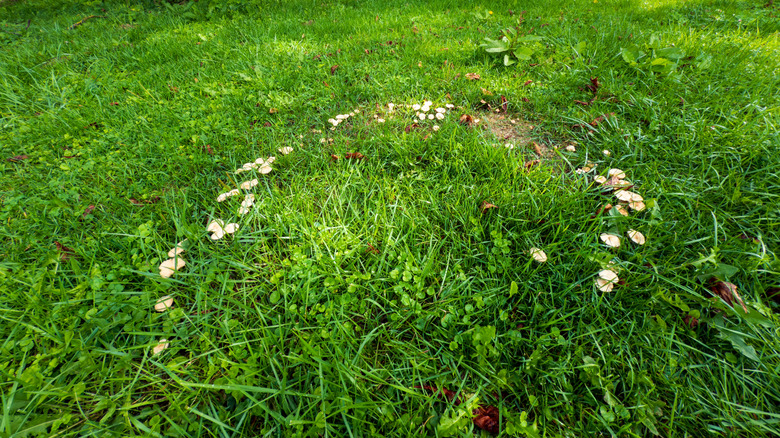
Fairy rings appear as mushroom or toadstool rings in lawns. They're often accompanied by a flush of very green grass on the outside. Sometimes the grass inside the ring looks tired and dry, and sometimes it appears to die off completely.
Fairy rings have a less mystical cause than their name implies. They're caused by fungi feeding on decaying organic matter beneath the surface. As the fungal network matures, it spreads outward in a circular pattern and produces fruiting bodies, which are the little mushrooms you see appear above the soil. Whichever type of fairy ring you have — whether your lawn has no symptoms beyond a little ring of mushrooms, or a mushroom band with a dead center — fungicide isn't really effective. Plus, the presence of the fungi is natural and normal and actually an indicator of a healthy, lively soil biome. So what should you do about a fairy ring? You can remove the fruiting bodies if you have pets that are prone to nibbling stuff they shouldn't. And, if you have a fairy ring with a dead, dry, or hydrophobic center, stick a garden fork in and wiggle it a little as a simple, no-cost way of aerating. Do it multiple times all over the inside of the ring, then water deeply and regularly to hydrate the grass in that area.
Frog-eye rings with a green center
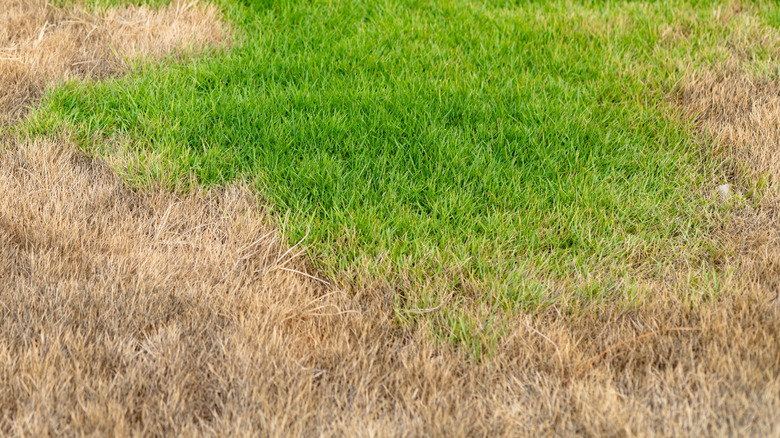
Frog-eye rings are odd. They suddenly appear as a ring of dry, dead grass with a perfectly healthy green center. While "frog-eye" is the common term for these types of lawn patches, one of the most common causes is necrotic ring spot (NRS). And it's caused by Ophiosphaerella korrae, a soil-borne fungus. It attacks the roots and then the crowns of the grass, but not the blades directly. As the fungus spreads outward, the center recovers or is recolonized by healthy grass, which is why you end up with the halo effect.
NRS occurs most often in cool, damp conditions, particularly in early to mid spring and in mid to late fall. But you usually notice the symptoms most severely in summer, when the root-damaged grass, which is already heavily stressed by the fungal disease, can't cope with the heat and dryness. Cool-season grasses, particularly Kentucky bluegrass, are most susceptible. While there are systemic fungicides labeled for NRS, as with many lawn fungal issues, cultural controls are more sustainable and effective. In the case of frog-eye, building a healthy lawn is super important as a preventive measure, as is watering deeply but infrequently to encourage deep, drought-tolerant roots. If you do get NRS despite all your best efforts, aerate the affected area to allow water to penetrate and prevent compaction. And don't over-fertilize. If you must add fertilizer, add a gentle, slow-release one, as a sudden influx of nitrogen will make the problem worse. Dethatching can also help grass recover from this disease.
Flat gray or brown scales creeping through the lawn
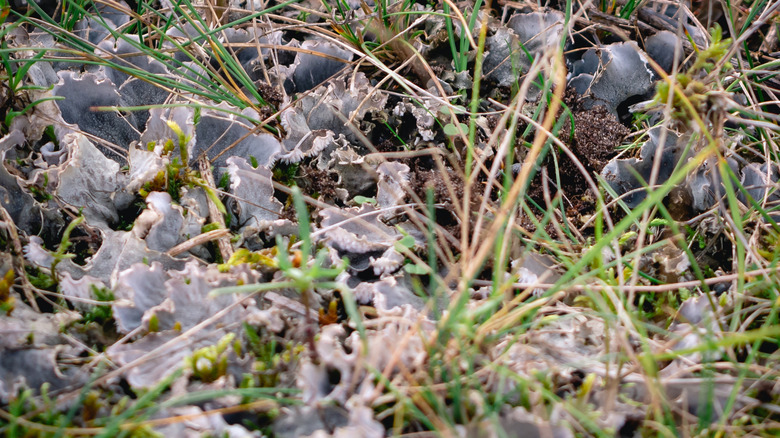
Gray-brown scales on the lawn sadly don't indicate you've attracted a little dragon to your yard. What you're looking at is dog lichen, or Peltigera. This isn't a disease, but is the most common lichen found in lawns. You'll see flat, lobed patches spreading across the lawn. In moist conditions, the scales are darker in color and pliable. In dry weather, they shrink to papery, crusty scales.
Dog lichen doesn't attack or harm your grass. But it's an indicator of poor health as it tends to colonize already thin or bare ground and appears where soil is compacted, weak, waterlogged, or heavily shaded. So rather than attacking the lichen, take note of it and work to improve the conditions in the area it's colonizing. You'll want to boost drainage, reduce shade where that's an issue, consider overseeding if the grass is thin, and generally bolster soil health by aerating and adding a top-dressing of nutrient-rich compost or shredded leaf litter which will slowly break down, release nutrients, and help ease compaction. As the soil improves and the grass thickens, the lichen will have less bare ground to colonize.
Foamy, dog-vomit-like blobs on the grass
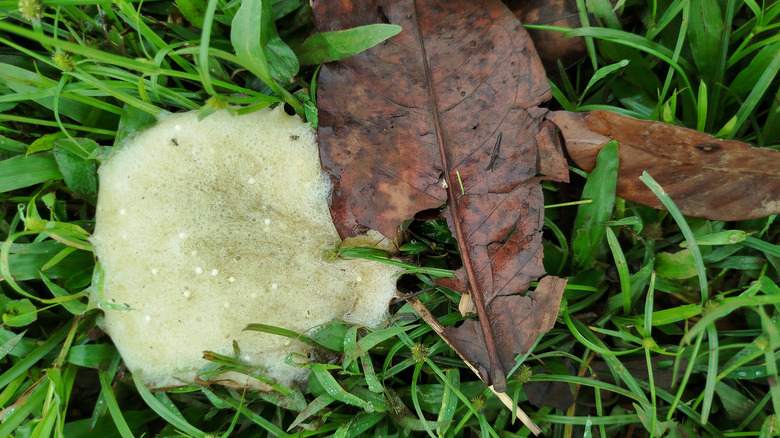
Piles of what looks like foamy dog vomit on your lawn — which pet parents would recognize as looking like "hunger pukes" — are really a slime mold. They tend to be yellowish, orange, or white and foamy. One of the most common of these slime molds is Fuligo septica, which produces weird, pillowy, yellow blobs.
These molds are generally harmless because they feed only on dead organic matter. They are not harming your grass, and most are considered non-toxic to dogs, cats, and humans. (Although I wouldn't personally let my dogs eat this stuff.) If there's a lot of it, you're worried about kids or pets, or it's just too unsightly, you can wash it away with a blast of the hose. No real treatment is needed. When I've had these foamy molds pop up, I generally leave them alone, as they dry up and vanish in just a couple of days.
Orange dust that coats your shoes and pets
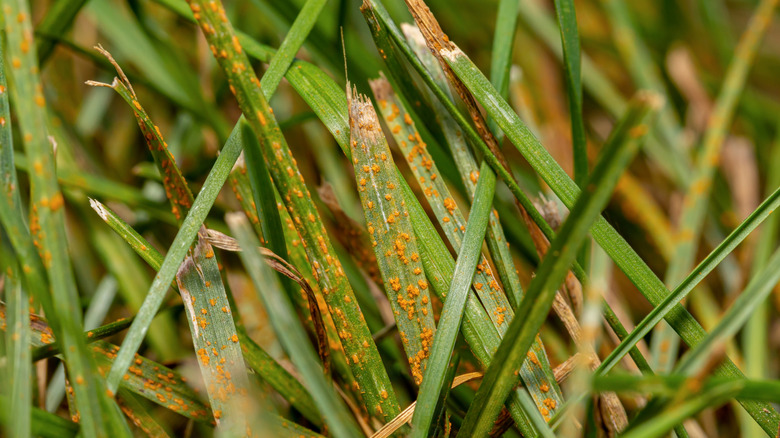
Lawn rust is an annoyance but not a death knell for your grass. The symptoms you'll notice are your shoes picking up an orange or rust-colored hue after walking on the grass. This is a fungal lawn disease, caused by either Puccinia or Uromyces fungi. It's most common in late summer and into fall, when your lawn is more likely to be stressed by heat and lack of water. The fungi produce countless tiny spore-filled pustules on the grass blades. When you or anything else brushes past them, the pustules break open, releasing powdery orange spores that coat whatever they touch.
Rust in your lawn isn't anything to be concerned about, and it doesn't need radical or chemical treatment. Over the long term, building soil health and optimizing the wellness of your grass, as I keep saying, are both so important. But in the immediate term, the easiest solution to get rid of lawn rust is to rectify any nutrient deficiencies that are affecting vigor (just avoid excessive nitrogen in the fall). I'd recommend blood meal or fish emulsion as a natural source of key nutrients. Consistent mowing and clipping removal can also help.
Pink or red fuzz on the tips of grass blades
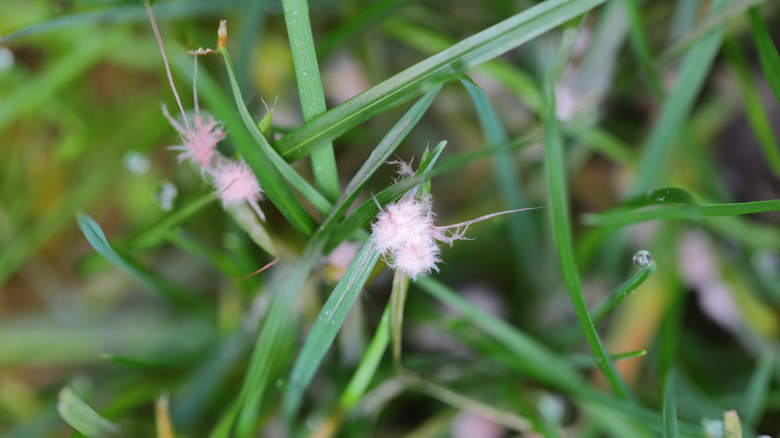
Red thread and pink patch diseases are another annoyance. These diseases don't kill your grass, but they can dramatically affect the appearance of your lawn. If you've got pale, raggedy patches of lawn and you can see pink or red threads clinging to the tips of the grass blades, you've unfortunately got red thread disease. Or pink patch. Or sometimes both together. The cause of red patch disease in lawns is a fungus called Laetisaria fuciformis. Pink patch is caused by Limonomyces roseipellis. These diseases most often attack underfed lawns in cool and wet conditions. Late summer and fall are the peak times for them to pop up, but they can appear and persist through mild, wet winters, too.
These fungal patch diseases don't attack the roots or crown, only the leaves. It can look a bit unsightly for a while, but it's not serious enough to warrant fungicidal treatment. Just like with rust, the best thing you can do to get rid of red thread or pink patch is to help it grow out. Adding a good nitrogen feed can help control the fungus. Then, as new growth starts, mow the lawn until the red thread disappears. Just be sure to dispose of the grass clippings, or compost them only if you know you won't be using the compost anywhere near your lawn. Then work on fixing the lawn's deficiencies. You may need to scarify or hollow-tine the turf to improve aeration, and make sure it receives deep watering and a gentle, slow-release fertilizer.
Greenish-black jelly blobs that swell after rain
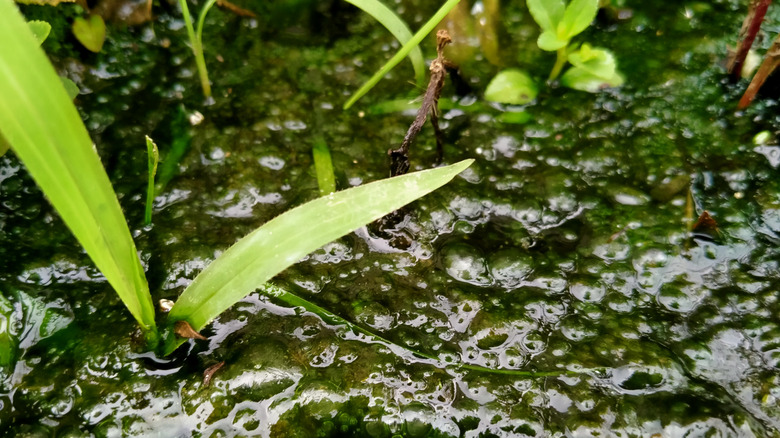
Green or black masses of rubbery or jellyish blobs are a type of cyanobacterium called Nostoc; they're not mold or fungus. When the Nostoc clusters are wet, they look like seaweed or algae thanks to their rubbery or jelly-like texture. However, once the weather and the turf dry out, so do the jelly blobs. They turn into a black crust until the next rainfall, when they morph back into the weird jelly blobs.
Nostoc doesn't grow on grass or attack grass leaves, crowns, or roots. It develops only in areas where there's no actively growing grass and the conditions are poor. So it essentially just takes advantage of and fills the space. There is no effective chemical intervention for this, and none is required. The only way to combat Nostoc is to wet-skim it with a shovel to remove as many of the clusters as you can. Then, work on fixing the poor conditions that caused the problem in the first place. Focus on easing compaction, improving drainage, and making sure the soil has sufficient, balanced nutrients. You may also want to overseed the affected area to grow new grass to fill the space so the cyanobacterium doesn't re-establish itself.
Tiny puffballs that smoke when you step on them
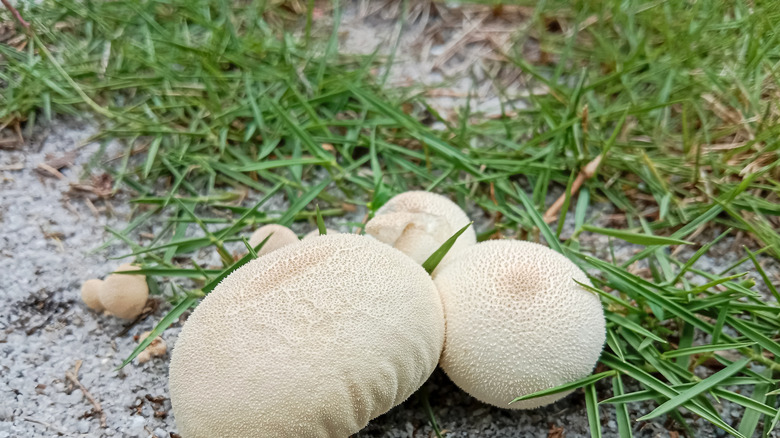
Little puffballs can appear overnight, releasing a billow of brown "smoke" when disturbed. They look pretty harmless and they are, even if their explosion of spores is fairly dramatic. Like other fungi, puffballs feed on decaying matter beneath the lawn, and the mushrooms you see are just their fruiting bodies. That brown "smoke" is simply spores being released.
Puffballs are nothing to be particularly concerned about. If you have pets and you don't want them inhaling or getting coated in the spores, you can pick off the mushrooms before they mature. Otherwise, just ignore them. They require no treatment and don't cause any actual damage to your lawn. They'll just look a little bit odd for a few days before they complete their lifecycle.
White, gray, or pink snow mold sticks grass together
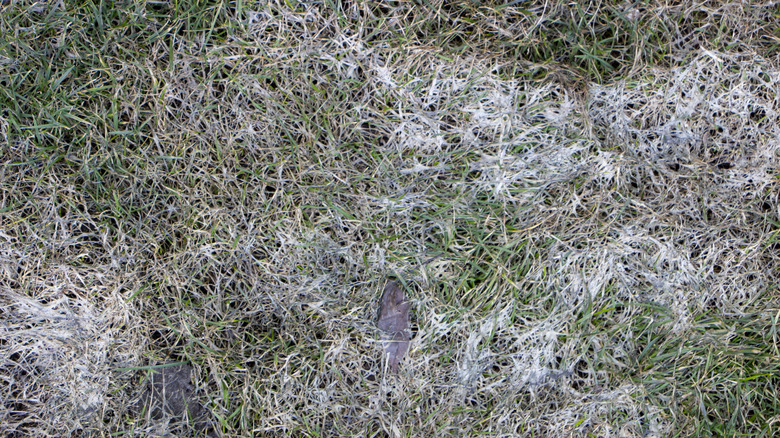
Snow mold is a weird one. It occurs when snow sits on the lawn for a prolonged period. When the snow melts, you'll find gray, white, or light pink matted patches. This is snow mold. It makes the grass blades stick together and turn brown. This is a cold-weather fungal disease that is confined to snowy areas. Interestingly, pink snow mold can actually occur without snow, in cool, wet weather.
Snow molds are usually caused by Typhula spp. and Microdochium nivale. Neither generally requires intensive treatment. To treat your lawn for snow mold disease, start by raking the affected areas so you lift and separate the matted, compacted grass blades. This lets the air circulate properly. Then just wait. You will likely see faster recovery in the spring, when the weather improves and the grass starts to actively grow. If you want to limit the risk of snow molds, avoid late-season nitrogen feeds that cause lots of leaf growth. It's also a good idea to mow your lawn fairly short until it stops growing, so you don't go into winter with overly long grass. If this becomes a persistent problem every year, consider dethatching the lawn, too.
A dark, smelly black layer hidden under the turf
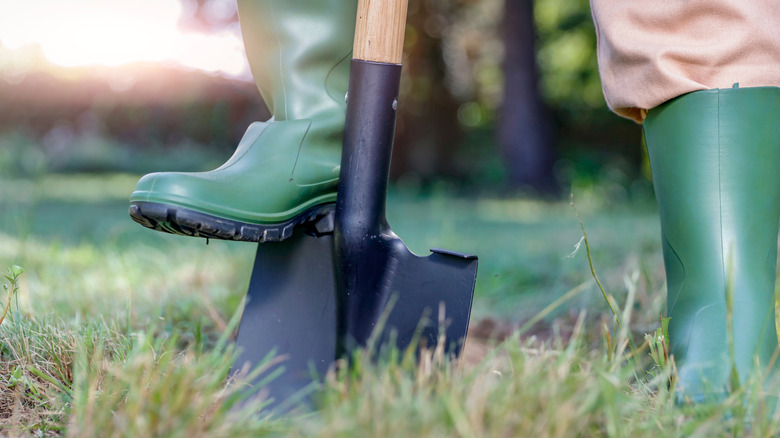
Black layer is a real problem, but it's not caused by disease or fungus. If part of your lawn keeps struggling for no clear reason, slice into it with a spade. When you lift it, you may find a near-black, slimy layer that smells like sulfur or rotten eggs. This is the result of constantly waterlogged soil with little to no oxygen. The soil becomes anaerobic, and the bacteria in this environment produce hydrogen sulphide gas — the source of the smell – as well as black iron sulphide compounds that make the soil inhospitable to grass roots.
There's no easy cure or chemical treatment for this stinky slime other than improving the soil quality. Stop excess watering to avoid worsening the problem. Then, aerate the area to improve drainage and airflow by either using a hollow-tine aerator or making deep holes with a fork. You can also improve drainage with an appropriate top dressing for your soil type, like sharp sand and compost, which can further help build better structure and move the slime layer back toward aerobic conditions.
Spider webs that disappear as the day warms
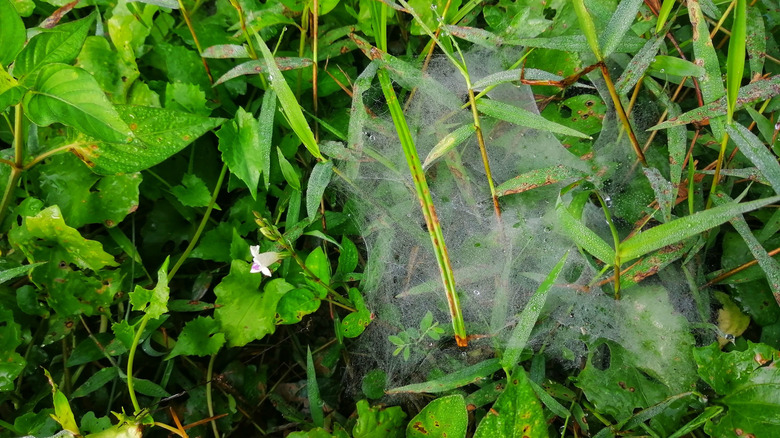
One common question I hear a lot is some variation of "why are there spider webs all over my lawn every morning?" And the answer is, most likely, "there aren't". If these "webs" disappear as the day warms, then they weren't spun by spiders, so there's no need to panic if you have a touch of arachnophobia. What you're looking at is mycelium. This specific strain of mycelium can show up as very fine, white threads when humidity levels are high or when grass blades stay wet for more than 10 hours.
If your lawn is otherwise healthy and you don't have any obvious issues like large dead spots, then visible mycelium showing up with the morning dew is nothing to worry about. But before you dismiss it as harmless, once the mycelium vanishes, go and take a close look at your lawn and check for dry, bleached, or brown spots. If you don't find anything nefarious, no action is required.
Big brown patches and mycelium
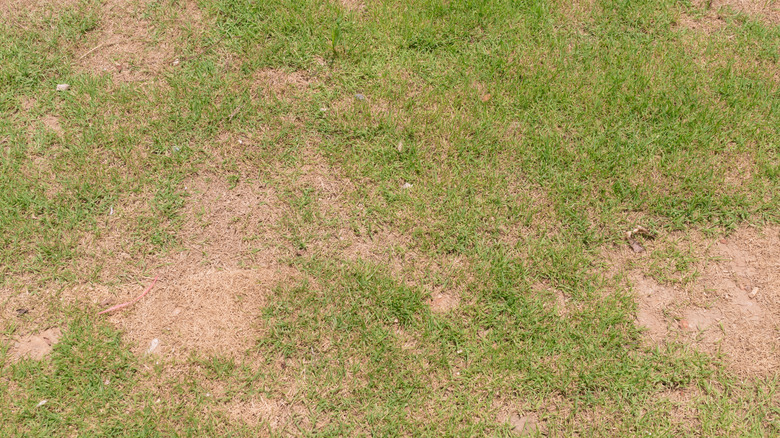
If the early morning mycelium I mentioned above is accompanied by large brown patches on the lawn, you've either got large patch or brown patch disease. These are both caused by a fungus called Rhizoctonia solani. Large patch occurs on warm-season grasses and results in brown patches up to 20 feet across. Brown patch appears on cool-season grasses and has brown spots up to 3 feet.
The fungus attacks grass that's overwatered and that's been overfertilized, especially with fast-release nitrogen. And Rhizoctonia solani occurs in warm, humid conditions. First, if you've been a little heavy-handed with the nitrogen, stop fertilizing. Don't apply any more fertilizer until the fungus is resolved. Make sure you're mowing at the right height for your grass type and climate. Change watering to early in the day so the leaves dry out as soon as possible. And, as with most of these fungal diseases, work on improving soil structure, getting rid of thatch, and reducing compaction.
Dry patches that are suddenly hydrophobic
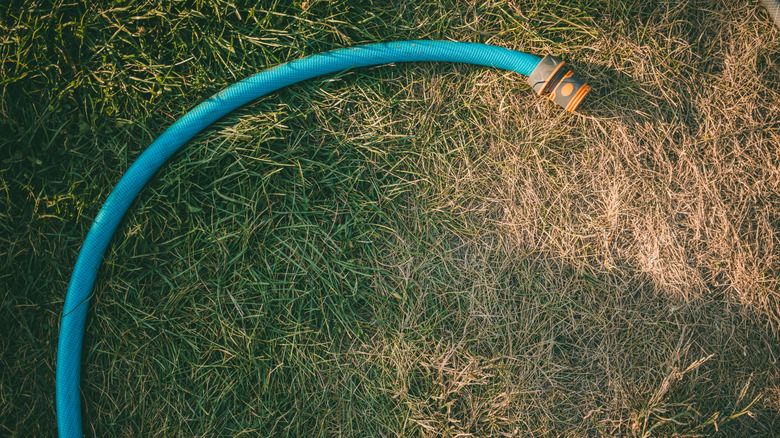
Sometimes, seemingly out of nowhere, you'll get a patch of lawn that just won't absorb water. That particular area may stay green at first and just be hydrophobic. Or it will very quickly go brown and dead-looking. Fairy ring fungi can cause this effect in the center of their rings, as can severe soil compaction. An excessive layer of thatch can also cause this issue, but that's usually over a huge portion of the lawn. Organic compounds can also build up over time and coat soil particles, causing the hydrophobic effect.
Start with figuring out whether you've got fairy rings or if you need to dethatch the lawn. If a dense thatch layer isn't the issue, then aerating is a good first step. Depending on how big the affected area is, you may be able to do this by just digging your fork into the soil all over the area. For larger lawns, you'll probably want to use an aerator. To add organic matter and help the area soak up water, you can top dress with compost after aerating. When watering, aim for deep soaking as this is the better method for watering your lawn anyway. But with hydrophobic patches, you may have to water lightly more frequently for a few weeks until water starts to penetrate properly. Start with a very light sprinkling of water, and continue to re-wet frequently and repeatedly. Slowly, the soil should start to rehydrate. In extreme cases, you may also need to apply a wetting agent. But, as a permaculture specialist, I'd recommend trying other chemical-free methods first.
Purple or blue-tinged grass in cold or hungry patches
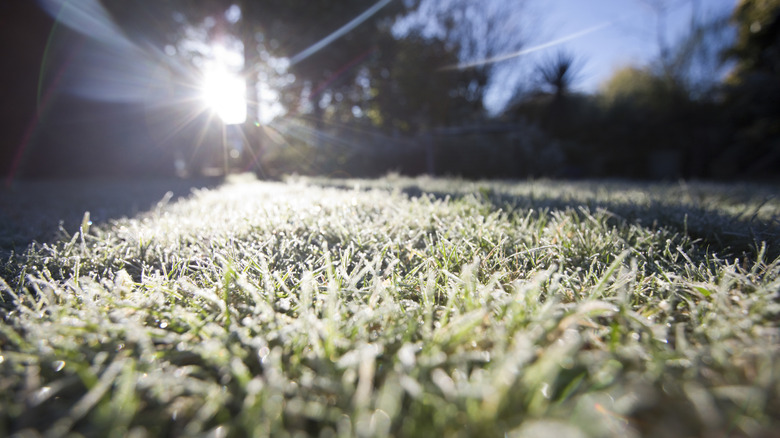
If your grass changes color to a smoky green or develops a purplish or bluish tinge, then it has suddenly started producing anthocyanin pigments. This is a strong indicator of stress. It occurs most often during cold snaps and in soil that is thin or nutrient-poor. As the temperature drops and sugars move more slowly through the plant, the stress pigment accumulates in plant tissues, causing the blades to change color. The other cause is nutrient deficiency, particularly phosphorus, as phosphorus uptake can be slowed in cold soils.
If the color change happens in an area of your lawn that you know has thin or poor soil or that is sitting in a cold pocket, then you're probably looking at a normal-ish response to environmental stress. And it should resolve once growth resumes again in spring. If, however, the problem is more widespread, I'd recommend you do a soil test to check for nutrient deficiencies so you know exactly what to add to correct the problem. I like the Luster Leaf Rapitest soil test kits as they're easy to use. Randomly fertilizing is never the answer.