

Why There's Simply No Need For More Than Four Kitchen Knives
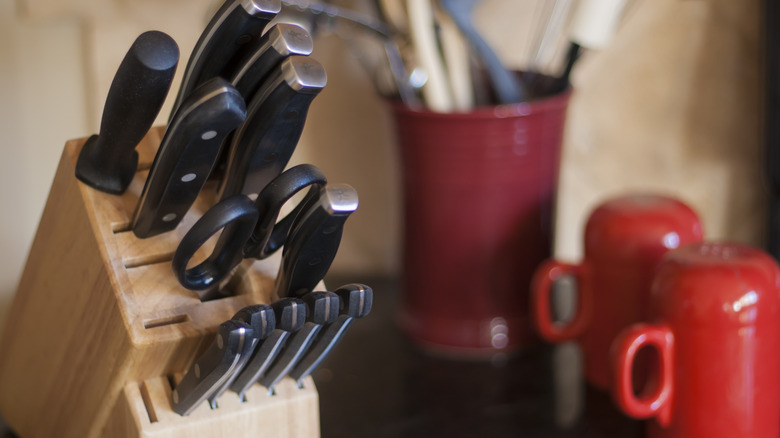
As someone who has moved around a lot in recent years, I have become interested in exactly how much a person actually needs in their day-to-day life — and how much is simply clutter. While this has led to me rifling through my linen closet and hall cupboard, it has also brought me into the kitchen. This room — often the practical and social center of the house — is a common culprit for clutter. From specialized gadgets that are just a waste of money to spare utensils, kitchens can end up harboring objects more likely to collect dust than be useful in daily life. For example, having spent years cooking and baking at home, I believe there is simply no need for more than four kitchen knives. The other eight or nine that come in a typical knife block are simply too specialized to be of frequent help.
If that statement has your hackles raised, then bear with me because there are sources which support this hypothesis. For example, popular knife company Klaus Meyer professes that many households complete 95% of their cooking tasks with the same three or four knives. This is because you don't actually need a different knife for every task you complete in the kitchen. A range of knife experts and sellers also agree with me, often citing these four as the cornerstones of food preparation: the chef's knife, the paring knife, the bread knife, and the carving knife. These are designed for specific tasks but are versatile enough to be used in a number of different ways. So, if you want a minimalist home or are sick of digging around for the same knife, it might be time to focus on the ones you really need.
Exploring the four key knife types
If you think of kitchen tasks as a sort of range, I have found that these four knives together cover pretty much every job along the line. As such, I often find myself reaching for those same four knives because of their familiarity, reliability, and versatility. For example, my chef's knife has a longish blade perfect for chopping larger items like onions and peppers. In addition, its wide blade prevents my knuckles from hitting the chopping board, a particularly useful quality when cutting lots of vegetables at once. My paring knife, on the other hand, has a thin, narrow blade which is ideal for precision tasks like peeling potatoes, trimming off unwanted sections, and chopping smaller items like garlic.
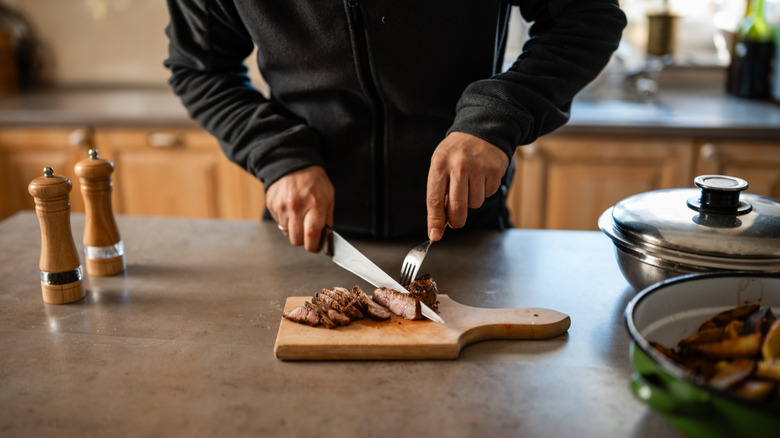
Even if you don't consider yourself a knife connoisseur, the value of a bread knife is pretty obvious. Its serrated blade makes it easy to cut through things with a thick outer layer, like sourdough bread, without crushing the inside. And finally, while a carving knife may sound like something that is only needed on Thanksgiving and Christmas, it is actually perfect a variety of daily tasks. It typically comes with a thin blade that allows you to cut through all kinds of meat without ripping it. Even if you don't eat meat, this knife is helpful for making careful cuts in cakes or desserts as well as fruits like pineapples which have a dense body. If it sounds to you like these knives pretty much cover any task that might arise in the kitchen, then you may want to consider ditching the bulky knife block like I did and paring down — pun very much intended — to these four styles.