

12 Popular House And Garden Plants That Thrive On Neglect
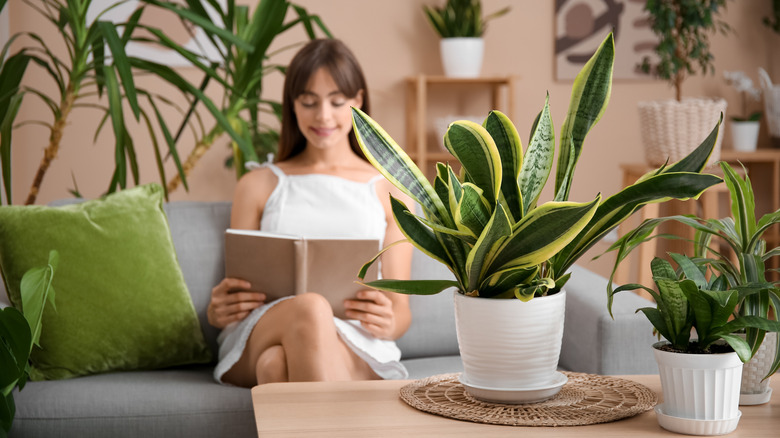
I've been a master gardener for the last 20 years, and while I am fine with being an attentive gardener when I need to be, I do love a plant that will take care of itself. I'm also a permaculture specialist, so seeing plants thrive in the right conditions without the need for constant maintenance is my aim. Nature knows what to do, and in the right conditions, a lot of plants can manage perfectly well (or even better) without too much fussing.
The most resilient house and garden plants are generally the ones that can cope with a wide variety of conditions, including inconsistent watering, thin soil, and varying light. These tough plants basically thrive on neglect. When I see them struggling, it's almost always because their caretakers give too much care and attention. They overfeed, overwater, and generally love their plants to death. Overwatering is usually the biggest killer. Dry out a snake plant completely because you forget to water for a month, and it'll carry on as if nothing happened. Leave it sitting in stagnant water or let the soil stay too wet for too long, and it'll rot and die pretty quickly. Below is a list of the species that tend do better with less helicopter plant parenting, and more of a laissez-faire approach. Set these plants up with the right soil and light conditions, leave them alone (apart from infrequent waterings and even less frequent feeds) and they'll thank you.
Snake plants are almost unkillable
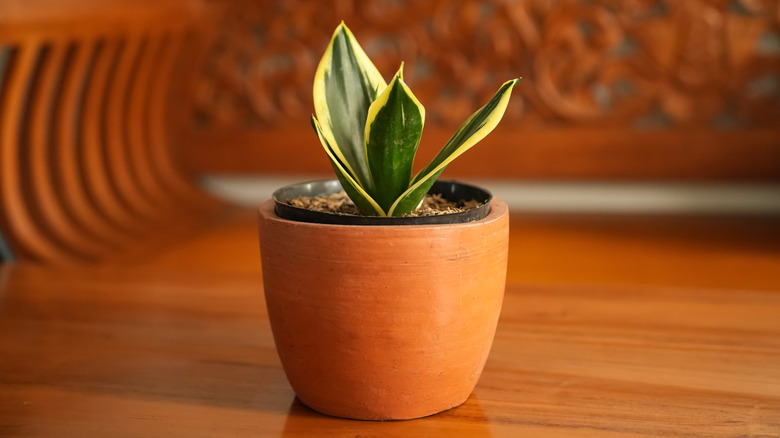
The snake plant (Dracaena trifasciata, formerly Sansevieria) is arguably one of the most forgiving houseplants you can get. It'll cope with pretty much anything apart from darkness and persistent wetness. Snake plants can handle low light, dry air, irregular watering, and genuine neglect that would kill many more fussier houseplants. If you want your snake plant to grow relatively quickly, it does need plentiful indirect sunlight, though.
Too much water is what kills a snake plant. Because it's a succulent, those thick, sword-shaped leaves store lots of water, so the plant has reserves to draw on between missed waterings. In general, it stores enough water to last about three weeks. It prefers drier soil and needs very little water compared to other houseplants. Whatever you do, do not leave the soil sodden around the roots, as you'll end up with root rot. And often by the time you see signs on the foliage, the plant is too far gone to save. Make sure you're using a light, fast-draining succulent potting mix, and the pot has adequate drainage. If you're using a decorative cachepot, make sure there's either a small riser inside, or you let the nursery pot drain on the draining board or in the bathtub so that stagnant water doesn't sit inside the cachepot and suffocate the plant roots. Let the snake plant dry out completely between waterings. When you lift the pot, it should feel super light. In winter, you might need to go six weeks between waterings. And, when you do give water, do so from the top down, water deeply and thoroughly, then leave it to drain.
ZZ plants store their water underground
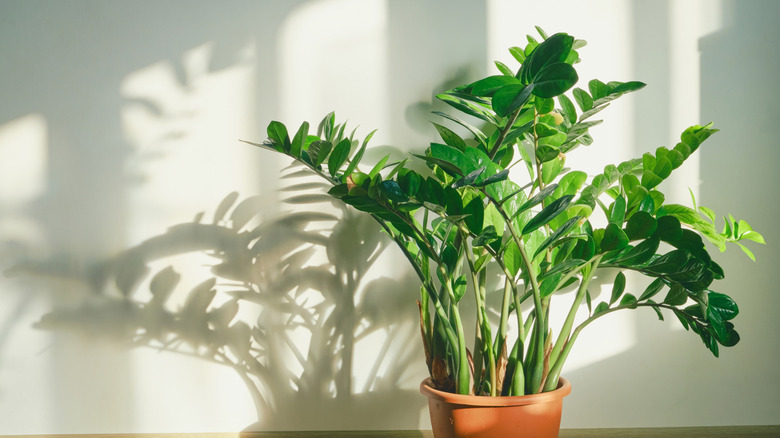
ZZ plants (Zamioculcas zamiifolia) store their water underground in their chubby, potato-like rhizomes that sit just below the soil surface. So this is another plant that can go for long periods without water. It's one of the reasons ZZ plants are so great for new plant parents or for those folks who notoriously lack a green thumb. It's a good choice for homes or offices without a lot of natural light, as it can cope with low light conditions, too.
As with snake plants, overwatering is enemy number one for the ZZ plant. If your ZZ plant leaves start yellowing, whatever you do, do not add more water, as it's likely that overwatering is the cause of the issue. Treat it like a snake plant, and let it get bone dry between waterings. ZZs also like to be fairly rootbound, so don't be tempted to pot them up until absolutely necessary. I leave mine until they are ready to burst out of their terracotta pots. If you use plastic pots, you'll see the rhizomes start to push against and distort the shape of the pot. Then you'll know it's time to go up a pot size or two. They are fairly slow growers and slow drinkers, so don't rush watering or repotting.
Pothos is a very forgiving climbing plant
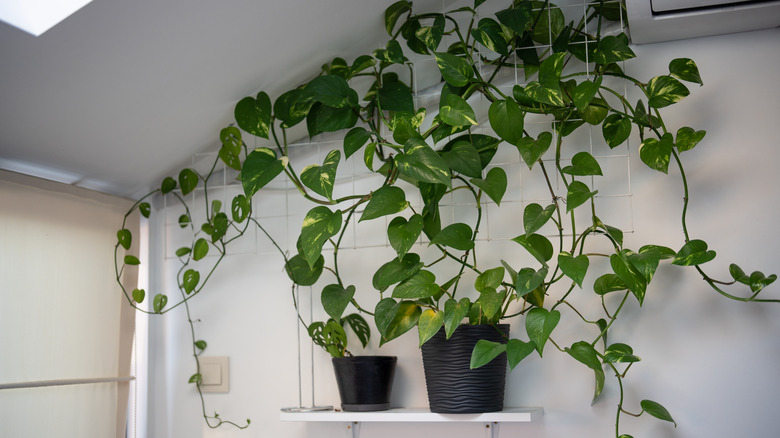
Pothos (Epipremnum aureum) is another exceptionally hardy plant that prefers neglect over constant helicopter plant parenting. Fluctuating indoor temperatures, low light, and periods of drought don't bother this tough, climbing plant. Its hardiness is what makes it such a popular first houseplant. Pothos is one of the first houseplants most people learn to keep alive because it's so forgiving of newbie errors. It'll even tolerate a variety of soils, as long as they're not overly heavy or wet. Pothos is beautiful and produces long, trailing, glossy-leafed vines, especially if you give it decent soil and modest light.
While pothos can withstand low light, its growth will slow significantly. Also, variegated forms, like 'Marble Queen' or 'Golden,' will lose their color variations and go back to monocolored dark green if they don't get enough light. One of the best tips for pothos is to remember that it wants to climb rather than trail, so give it a moss pole or wall anchors to climb on. And, as it matures, you'll want to curl long vines back into the pot so they root and help hide the bare, woody crown. If your pothos is struggling, it'll show yellowing lower leaves, minimal new growth, or leaves will fall, leaving gaps in the vine. Like other hardy plants on this list, let it dry between waterings and don't be tempted to overfeed, even if growth is slower than you'd like. If you have aged vines with gaps or you've accidentally knocked a leaf off, use keiki paste, or cloning paste, to stimulate new growth on the leaf node.
Cast iron plants survive almost anything
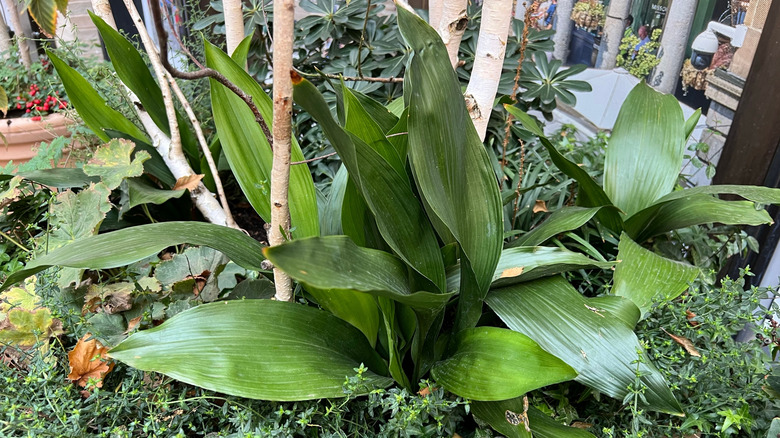
The cast iron plant (Aspidistra elatior) earns its name because it's super hard to kill. It can even handle deep shade, drafts, and poor soil, all without showing any signs of stress. It's a really remarkable plant. The deep green, strap-like leaves grow slowly but steadily. Admittedly, cast iron plants aren't flashy or impressively dramatic, but they are stubborn, steady, and supremely resilient. If you've got a dark hallway or a dim home office that gets barely any light, this is the plant that can breathe life into the space. Greenery is good for the soul, even if it's not flashy and ostentatious. And, in my opinion, it's even more important in a low-light space that's devoid of other natural touches.
Unlike most other plants, even those that cope with neglect, cast iron plants do more than just survive in low light. They persist and thrive without slowing down, stalling, or losing color and leaves like other "hard-to-kill" houseplants. Enjoy them for their steadfastness, and don't expect explosive growth. These plants take their sweet time, growing so slowly that you'll barely notice. Water them when the top few inches of soil are dry, and give them a very diluted succulent or houseplant fertilizer once or twice during the active growth season, but otherwise just leave it alone to do its slow thing. As an aside, another reason I love a cast iron plant is that they are non-toxic to cats and dogs, so if you've got ridiculous creatures like one of my cats who cannot resist munching on anything green, a cast iron plant is a sensible choice.
Chinese evergreens keep growing even in low light
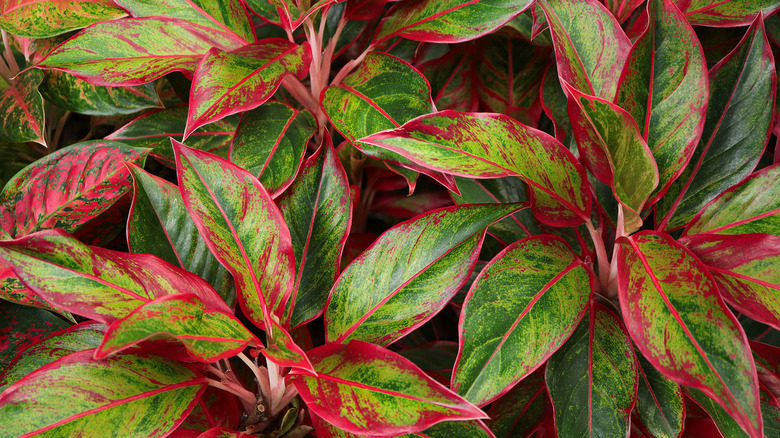
Chinese evergreens (Aglaonema) are super-easy to grow indoors. They need no special treatment in terms of light, humidity, air quality, soil, or watering. Chinese evergreens are a good choice for most new houseplant caretakers. Particularly, the plain green-leafed cultivars are the most tolerant of neglect and the most likely to continue to thrive with minimal fuss. Because they don't struggle too much in dim light, they're excellent hallway and office plants, even if they're not quite as robust as cast iron plants.
The pink, red, and variegated cultivars are genuinely beautiful, but they are somewhat fussier than their plainer cousins. These colorful varieties need bright, indirect light to maintain their coloring and variegation. Additionally, they are more sensitive to cold drafts and overwatering. So, if you want a Chinese evergreen that you can really neglect without worry, go for a plain dark green variety. Showier ones, like 'Big Roy,' 'Siam Pink,' 'Lady Valentine,' or 'White Kiwi,' are still comparatively low-maintenance; you just need to be aware that they can't quite tolerate the same level of neglect as the less fancy original greens.
Aloe vera is tough and useful
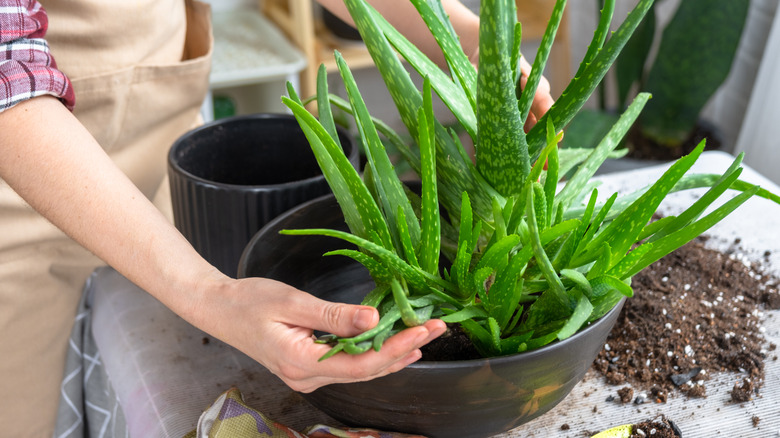
I'm a certified master herbalist as well as a master gardener, so I can't get enough aloe vera. I love this plant. It's got well-studied healing and soothing properties and reproduces easily. Aloe is easy to grow and care for if you don't overwater or over-harvest it, and it reproduces easily. During the growing season, aloe only needs watering every two to three weeks. It's a succulent, so it stores water in those wonderfully fat leaf spikes. As a result, the leaves are full of gel. In winter, it needs watering only once every four to six weeks. Like other succulents, aloe should dry out between waterings. If it gets too wet, it'll get crown or root rot that will kill the plant before you can save it.
My kitchen windowsill and conservatory are home to several large aloes and more than a few juveniles in various stages of growth. I pot up the pups when they're ready, and add them to my collection or gift them to friends once they get established. They do, however, need light. Aloes are not low-light plants. While they will forgive you for neglecting their water needs and not obsessing over their humidity or soil quality, they do need sunlight. Sit aloes in the sunniest spot you've got so they stay upright, compact, and fleshy. In poor light, aloe vera gets loose and floppy, and the plant eventually topples as it tries to grow toward the light.
Spider plants are tough, hardy, and pet-safe
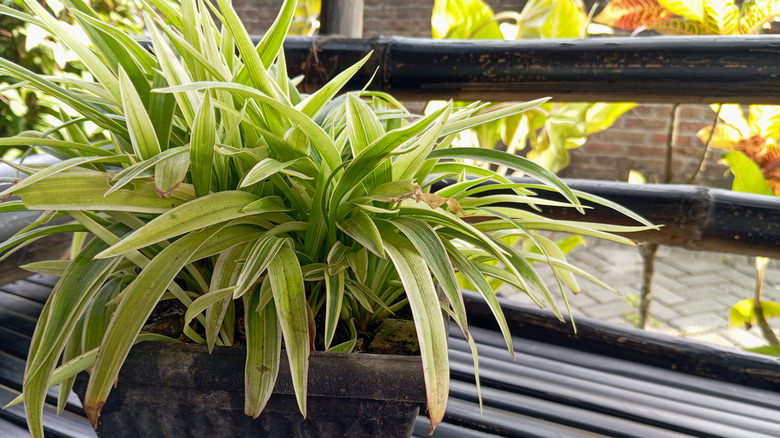
Who doesn't like spider plants? They're fabulous, chaotic-looking, low-maintenance houseplants that don't pose a risk to cats or dogs. My spider plant is a gigantic, gloriously messy beast of a plant that lives happily in my conservatory in a pretty lilac macrame pot hanger I made for it. It's rampant, a little bit sassy, and just wonderfully carefree and fun. It also produces what feels like a billion babies (spiderettes) that I gift or even sell at a local plant fair every June. Spider plants (Chlorophytum comosum) are adaptable to a wide range of light levels, they're okay with the occasional missed watering, and they are robust enough that they'll bounce back pretty quickly from periods of total neglect.
These plants prefer plenty of indirect light. My conservatory has shades, so the light is plentiful but diffuse. As with other plants on this list, they do not like too much water, but they perform best when they receive reasonably consistent moisture levels. And, once yours matures and starts throwing off those adorable little spiderettes, they are ridiculously easy to propagate.
Jade plants are long-lived, low-maintenance succulents
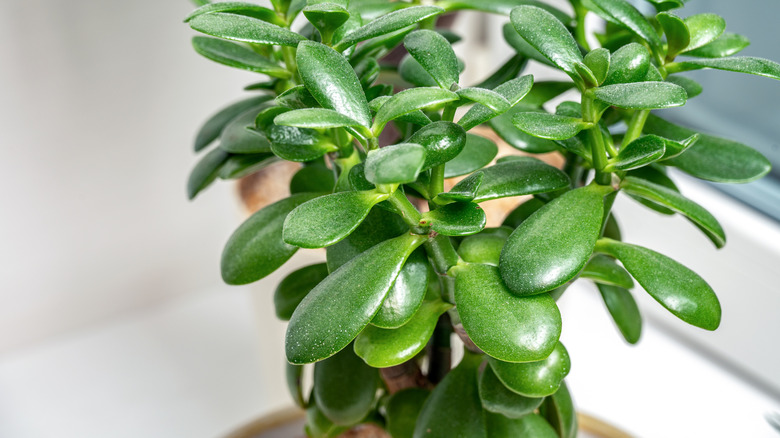
Jade plants (Crassula ovata) are slow-growing succulents that ask for very little. Over 20 years ago, I moved into a property and found two sad, bone-dry, withered jades in the musty, dim old garage behind a plywood board on a shelf. The property had been empty for at least eight months, and there were these two little plants, still shockingly clinging to life. I wasn't sure if I could save them, but I potted them into my own succulent potting mix, sized up their pots a little, and brought them indoors. I still have those plants in my kitchen. They remind me to persevere, no matter what, and they've given me numerous jade pups over the years. In short, jades really don't need much. They like to dry out fully between waterings, and the best place for your jade plant is a nice, sunny spot on a windowsill. That's basically it.
As with most succulents, jades do not appreciate having wet roots or soggy soil. Jade plants are notoriously difficult to save if they get root rot. Over winter, you'll find you barely need to water them at all. Don't be too quick to pot them up. Jade plants prefer to be snug in their pot, and repotting stresses them out and can cause them to drop leaves, so only upsize when you need to, and only go up one or two sizes. Jade plants also get better with age, and they end up having a very structural, tree-like form that's really pleasing to look at.
Lavender is very self-sufficient once established
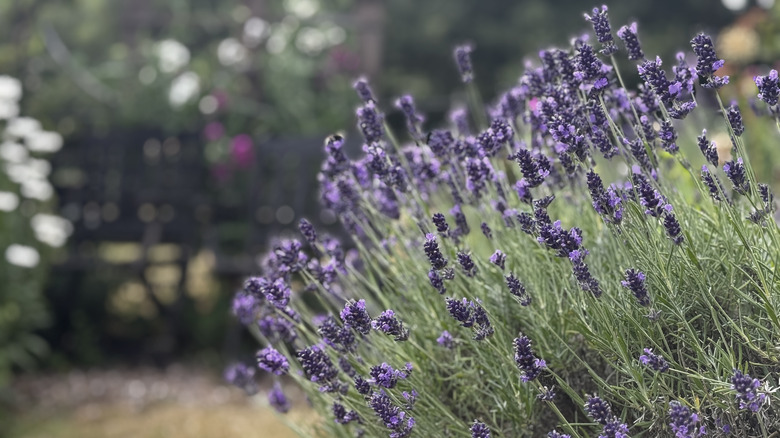
If you give lavender decent, free-draining soil, it requires basically no maintenance once its roots anchor in. Some people find lavender tricky, but that is almost always because the soil is too wet or heavy. Lavender thrives in all but wet soil conditions. It will tolerate sandy, dry, and even gravelly ground. It doesn't need feeding or mulching, and once it gets going, it doesn't need watering, either in all but the driest climates.
Lavender doesn't like having wet roots, and it doesn't do well in very humid environments either, as it doesn't like having a wet crown. Avoid common mistakes when growing lavender, like overfeeding and overwatering, to have a healthy, maintenance-free specimen. To get the most from your lavender, plant it in full sun and, after a year or two, start cutting back the woody stems by about a third every spring, as this will keep its growth habit neat and compact. Don't be tempted to feed the plant, as lavender prefers low-nutrient conditions, which makes it great for patches of thin soil.
Coneflowers are prairie flowers that don't need to be coddled
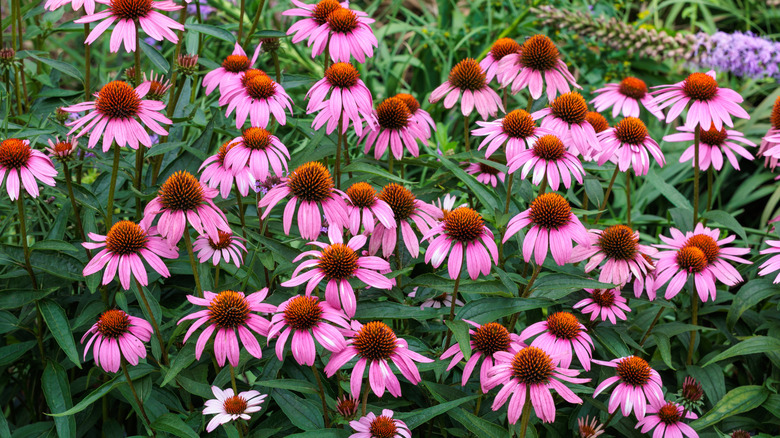
Coneflowers (Echinacea purpurea) are simply beautiful. I have them growing all over the place, interspersed with my edible crops and my ornamentals. Coneflowers are great for growing with herbs like lavender. They can cope with full sun and hot summers, and periods of drought. I love them because they are easy, produce glorious flowers every year with no encouragement from me, self-seed easily, and attract pollinators of all varieties. You don't even need to deadhead them. Just let them be.
I leave my seed heads right through the winter and into late spring, as they add visual interest to the winter landscape, the seed heads provide food for all manner of small creatures, and the stems make exceptionally valuable habitat for beneficial insects. Coneflowers prefer to be on the drier side, and can develop fungal problems in very wet, humid conditions, but as long as you don't crowd them or overwater, they'll thrive.
Black-eyed Susan is drought-tolerant and does fine in poor soils
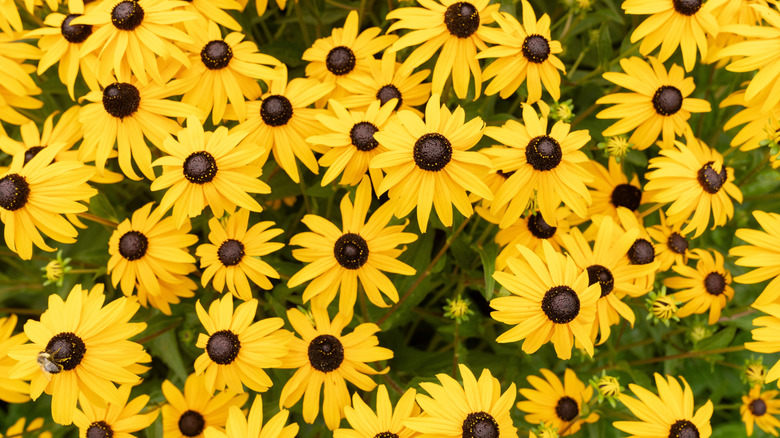
Black-eyed Susans grow right alongside my purple coneflowers. They produce beautiful, bright yellow flowers with dark centers from midsummer well into late fall. Black-eyed Susans (Rudbeckia hirta) are untroubled by browsing deer and rabbits; they cope with poor soil and self-seed freely, so you'll have fresh flowers every year. These cherry golden flowers are drought-tolerant and don't need any intervention from you (unless you want to pull some up once they start to self-seed), making them a great choice for a problem border or a bare patch you struggle to access regularly.
The self-seeding can be a problem in some gardens, though. As I'm a permaculture grower, my space is a very naturalistic cottage garden, and I rarely mind the plants spreading where they like. But in a tighter or more formal garden, this is something to be aware of, as you'll need to deadhead them before they run to seed to limit their spread. Black-eyed Susans grow as annuals in very cold climates, but work as short-lived perennials in zones 3 to 10.
Creeping thyme is an undemanding, but gorgeous groudcover
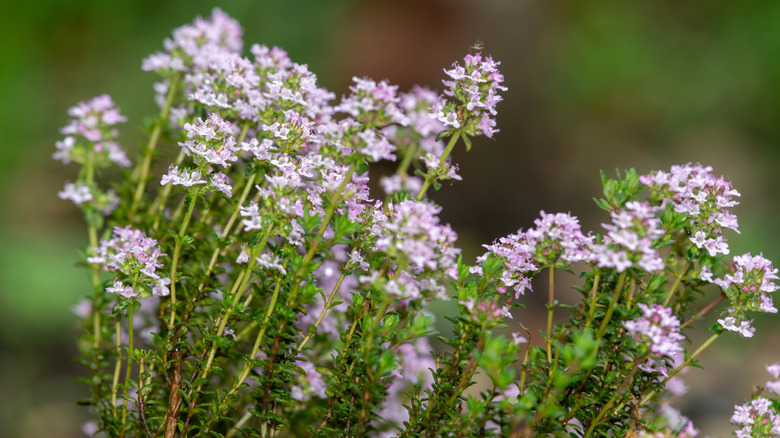
Creeping thyme is my favorite groundcover. It is so wonderfully fragrant and has huge drifts of tiny fragrant flowers that draw in pollinators. It forms dense, fragrant mats and tolerates foot traffic, even if you've got busy pets and kids running over it on a regular basis. It doesn't need any maintenance and copes with full sun, drought, and thin soil. It will also out-compete most weeds because it simply smothers them and stops new ones from growing through.
To successfully grow creeping thyme, it's best to plant it in thin, nutrient-poor problem spots, in narrow, sunny patches, along path edges, and in gaps between pavers. Let it replace problematic and weedy patches of lawn, and use it as a living mulch along bed edgers. Just avoid too much shade and planting in clay or heavy, persistently wet soils. And remember that it spreads. That's why you planted it. It's not particularly aggressive, but it will slowly creep, hence its name. So you may find you have to cut it back periodically.