

The Big Mistake You're Making While Mowing That Could Kill Your Trees
We may receive a commission on purchases made from links.
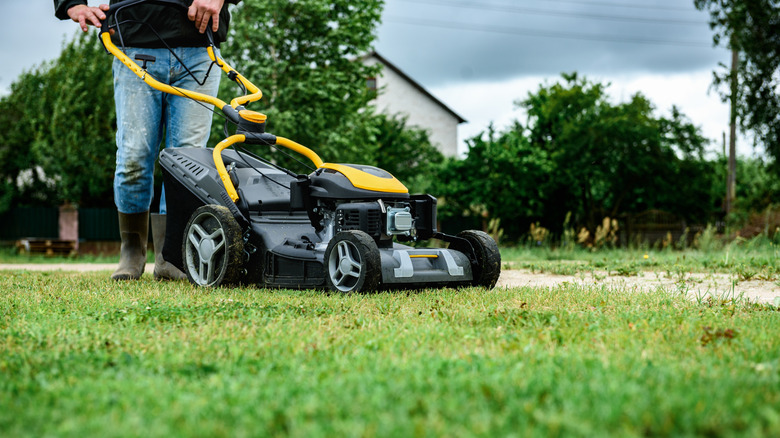
The dream of a lush, manicured lawn has inspired many homeowners to leave the coziness of their family room and brave the heat for the near-weekly mowing rendezvous. But sometimes, in the haste to mow faster, you may end up bumping your lawnmower against the very trees anchoring your yard. Although trees are resilient against minor damage, this sharp blade can do quite a number on them. In extreme scenarios, it might even kill them. This phenomenon is also called "mower blight."
Basically, underneath their bark, trees have a cambium layer, which is responsible for carrying essential minerals, nutrients, food, and water between roots and leaves. When mower blades slice through the bark, this layer gets damaged, and plant processes are impaired. Wood-decaying fungi may also enter the tree through these wounds, weakening it. This may eventually make the tree structurally unsafe. If this mistake happens often enough, you may end up girdling the tree. In other words, the damage may extend all the way around the base, cutting off resource access entirely. This damage may not always be prominent, for instance, if it occurs near ground level, as grass or weeds may mask it.
Preventing mower damage to trees
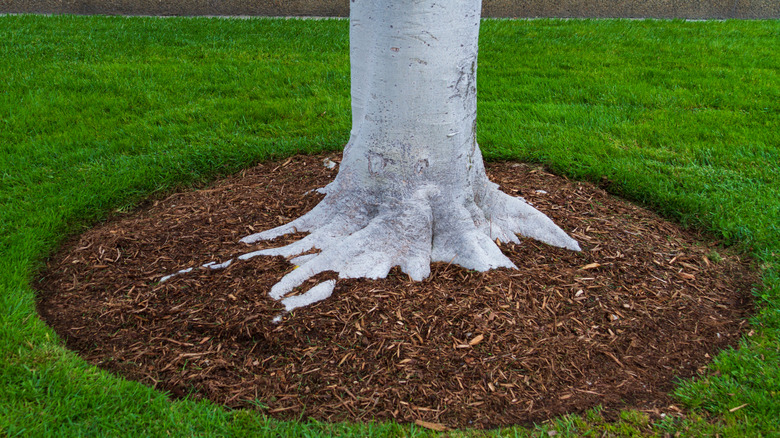
The easiest way to avoid mower blight is to mulch around your trees. Aside from serving as a visual reminder that you're nearing the sentinel and should slow down your pace, it adds additional protection around the trees. However, don't indulge in mulch volcanoes; it's a harmful practice taking over America's lawns, wherein you mound mulch against the bark. As it stays wet for longer, the bark may decay. Since mulch retains water, adopt the 3-3-3 rule. This means, spread a 3-inch-thick layer of organic mulch (like shredded bark, pine, or wood chips) in a 3-foot-wide diameter, while maintaining a gap of 3 inches from the main trunk. This also improves moisture retention, drainage, soil fertility, and aeration.
As young, newly-planted, and thin-barked trees like flowering dogwoods, birch, and maples are more susceptible, you may further fortify them with tree guards, like Dimex's EasyFlex Plastic Tree Trunk Protectors. Thanks to the expansion tabs, they can accommodate the tree's widening girth, while the open slashes permit adequate air circulation. They also offer limited protection against winter injury.
To deal with overgrown turf, simply trim it down with a handy pair of shears. Or, set the mower at its highest setting, so it won't run into the tree's root flare (the area where the trunk meets the roots). Alternatively, consider planting shade-loving, well-behaved groundcovers underneath trees to avoid having to deal with grass, which competes for resources.
Dealing with a mower-hit tree
Although bark damage is usually irreversible, you don't have to entirely lose hope. Anecdotal evidence says that trees can usually tolerate up to 25% damage to their bark tissue. That's because they tend to compartmentalize their wounds and grow new tissue around them.
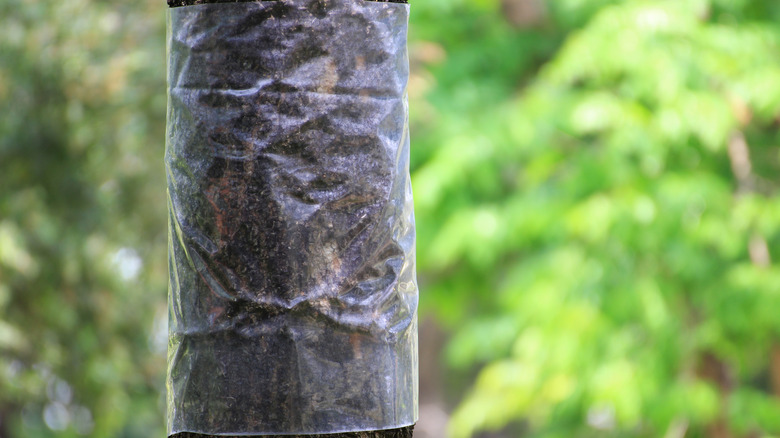
When bark splits away from the tree or is precariously hanging from one end, your first step to redress it involves making a clean cut. Since jagged cuts take longer to heal, you should, using a sharp knife, smooth the edges and remove any loose bits. Leave the wound as it is to allow the tree to callous over it. However, if you want to speed up the process, you can staple black plastic over the bruised area (without touching the wound) so the area remains moist enough for the tree to successfully harden it. Don't forget to remove the plastic after a year.
Avoid any other wound dressings, such as painting the wound, as they can block oxygen access, which delays healing. That being said, note that for reasons related to genetics or lack of resources, not all trees will successfully recover. And even if they do, they're unlikely to do so overnight, though you will notice progress starting at the bruise's edges. Until then, make sure to give them optimal care by keeping them well-watered through dry spells and fertilizing them as necessary.