

The Low-Maintenance Material That Gives Your Driveway An Upscale, Historic Look

If you're trying to add driveway curb appeal that makes a statement, there's one material that's been doing the job for centuries. Cobblestone has been a staple of roads and streets since the ancient Romans — safe to say it's tried and true. And even today, as people spend fortunes for modern minimalist houses that look out of sci-fi movies, cobblestone remains a timeless choice that isn't going out of style. There is something about those chunky stones that looks historic and old money, and it can transform your home into something that looks like it's been in your family for generations, even if you've just moved in.
When looking at materials to use on your driveway, there's much more than concrete. Gravel, bricks, and asphalt are all fairly common alternatives, but cobblestone is one of those stunning historic home designs that gives your driveway an upscale charm. Cobblestone can be installed by professionals or on your own. It's not a quick afternoon makeover, but rather a serious DIY project. You don't need any expensive machinery and equipment, but you do need time, patience, and materials. If you're not the DIY type, you can hire professionals to do the job for you, for a fee. Professionals can also create unique designs and patterns perfectly fitted to your driveway's dimensions and curves.
Cobblestone isn't just stunning, it's also one of the more durable driveway options. When they're installed properly, cobblestone driveways can last decades. They also allow water to infiltrate the ground, which is great if you live in rainy areas prone to floods. Because they're so durable, cobblestone driveways are fairly expensive. Therefore, they are best used for homes where you plan to grow old and enjoy them for years.
How to integrate cobblestone in your driveway
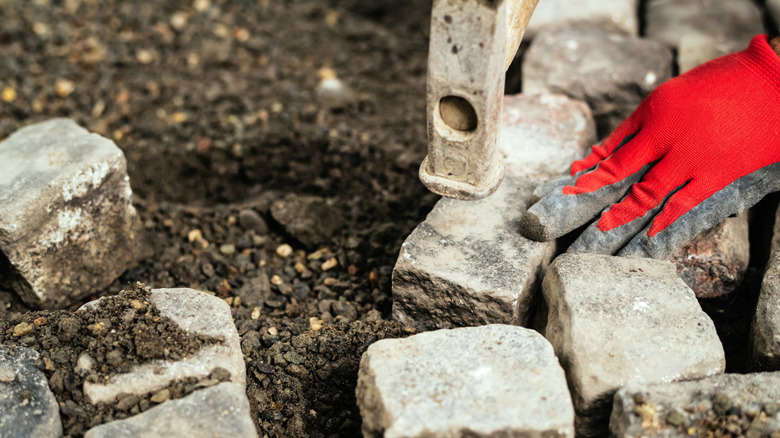
First things first, what even is cobblestone? It's not, as some people might think, a type of stone. Instead, it's a ground paving method that can be done with different stones like basalt, granite, or sandstone. These are cut into small pieces (the sizes and dimensions vary), which helps avoid the cracking and breaking that would otherwise happen with larger slabs or tiles. Cobblestone is strong, even stronger than concrete, which is why it's often found in old, historic towns or sites. These stones have been used for centuries, and were typically laid out using sand and dirt. Today, we might use mortar to lock the stones in place, polymeric sand that hardens, or even a concrete base.
If you'd like to build a cobblestone driveway on your own, you'll need to follow a detailed tutorial and make some precise measurements. But here are the main steps: You'll need a base layer of gravel on the ground, topped with some concrete. Then, you'll add the cobblestones on the concrete following a pattern and making sure that all the stones are leveled. Finally, the stones are locked in place using mortar as jointing.
Once dry, cobblestone will transform your home into something that looks stunningly historic. The best part is that it's low-maintenance, something that's rare with expensive and upscale projects. If the cobblestone is laid out properly, you won't have to worry about driving on it. If you live in a cold area where it freezes often, repeated thawing could cause the joints to crack. Still, fixing and replacing jointing or individual stones is fairly simple.