

Don't Throw Away Nursery Pots, They're A Game Changer For Houseplants
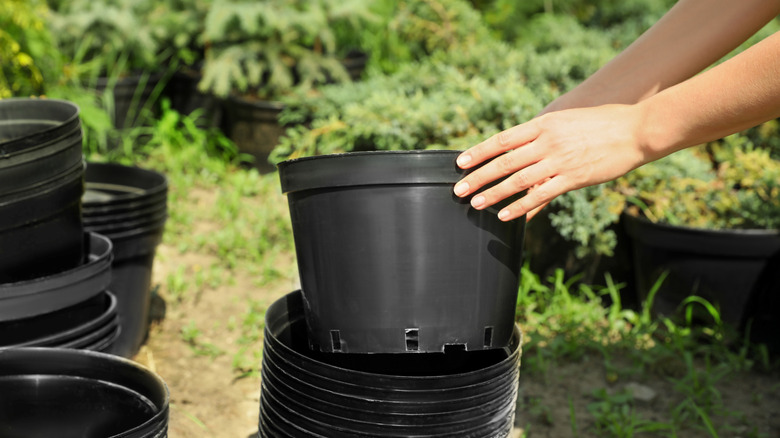
Imagine you have a large houseplant, like a monstera, planted in a huge, decorative planter. You dread having to move it, repot it, or even water it because it's so heavy and doesn't have drainage holes. Nursery pots to the rescue! If social media is any indication, more and more indoor plant enthusiasts are eschewing direct placement of houseplants in decorative planters and instead leaving them in nursery pots slipped inside a stylish housing.
If you do the same, you are instantly making your plant more portable; you can easily pull the nursery pot with plant out of the planter and move it separately. Repotting, which should be done every other year, is much easier, even if the plant is rootbound. Instead of struggling with a large, inflexible pot, you can just squeeze the malleable sides of the nursery pot to ease the plant out.
Given that decorative planters often have no drainage holes or just one, you can manage watering and drainage when you use a nursery pot with multiple drainage holes. This double-pot approach isn't limited to large houseplants, either — you can use it on any size planter a nursery pot will fit into.
Place plants in nursery pots inside your decorative planters
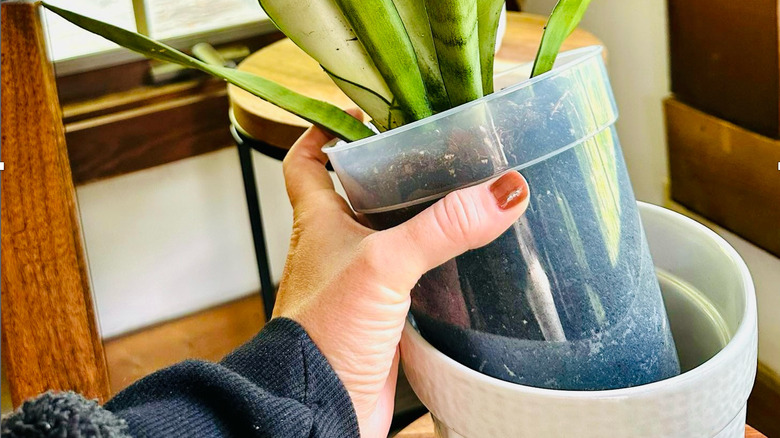
The nursery pot technique, also known as a cachepot system, offers even more benefits. You probably know that you should be cleaning your pots, but you don't have to do much cleaning of planters that haven't had plants and soil inside them. You also don't have to worry about water being absorbed from the soil when using porous planters, like terracotta, when you use a plastic nursery pot inside.
Your decorative pots will last longer without the wear and tear of regularly having soil and plants being put in and taken out. You won't get those white salt and mineral deposit on your decorative planters with the plastic pot shield in place. Roots get protection via the nursery pot nestled inside the planter, and the pot poses a barrier to pests, like soil mites in houseplants.
Keep in mind that professional growers wouldn't be using millions of plastic nursery pots if they weren't intended to provide optimal growing conditions. Even the shape is intentional — decorative pots often have flat bottoms where roots sit, whereas nursery pots have an indented bottom that slightly raises the roots so they're not sitting on the bottom or in water. If you decide you don't like the way a double-potted plant looks in a decorative container, you can easily switch it up with a different one without disturbing the plant's roots.
How to care for double-potted houseplants
To implement this method, use a plant you've grown in a plastic nursery pot or one you've purchased. Match the pot to a planter it will fit into. A 2-inch gap between pots will allow you to peer into them to monitor water and drainage. Slip the nursery pot in; its rim should be just beneath the host pot's rim.
The trickiest part of this setup is watering and drainage. Users of this method typically use a saucer under the plastic pot in planters with drainage holes and nothing under the nursery pot in planters with no drainage holes. Both situations should be monitored, especially the one without a saucer. You'll want check regularly that no standing water is lingering in the outer pot and drain any water that appears. Best practice is to water the plant by taking the nursery-potted plant out of the planter, waiting till all excess water has drained out, and then returning it to the planter. Don't believe sand and gravel myths for pots without drainage; they will likely worsen the situation.
If there's one thing even better than a nursery pot inside your planter, it's a clear nursery pot that offers the added benefits of enabling you to see what's going on with your plant's roots and soil and check for any problems. Is it rootbound? Do the roots look mushy? Is it dried out and in need of water? It's challenging to spot problems in an opaque pot, but simple in a clear pot.