

Think Twice Before Putting This Invasive, Tree-Killing Vine In Your Yard

An easy way to suffocate the trees in your yard and cause all kinds of issues is to plant one unassuming vine species. Although it can look nice, oriental bittersweet (Celastrus orbiculatus) is a highly problematic perennial vine with a bad attitude that you would rather keep far, far away from your yard. Oriental bittersweet, also known as Asian bittersweet, is one of the worst invasive plants to avoid at all costs due to its highly unmanageable growth. Instead of planting this invasive plant, think again and opt for a native alternative that will not choke surrounding trees.
Back in the 1860s, settlers in the U.S. brought oriental bittersweet from East Asia without realizing the long-term repercussions. Fans of its red berries spread this species for use in ornamental decoration, and birds did the rest of the job. Today, it has become a major problem wherever it pops up along roadsides or in natural woodland areas. This vine is listed as a noxious weed or invasive species in several states, including Pennsylvania, North Carolina, and Connecticut.
The main reason why you want to never plant this vine in your yard is to protect your trees. One vine can grow 60 feet long and have significantly thick growth of over 10 inches in diameter. Because it grows along supports, typically trees, it can even climb 90 feet tall trees. The weight of this aggressive growth pulls and chokes trees, eventually smothering them to death.
Getting rid of oriental bittersweet and what to plant instead
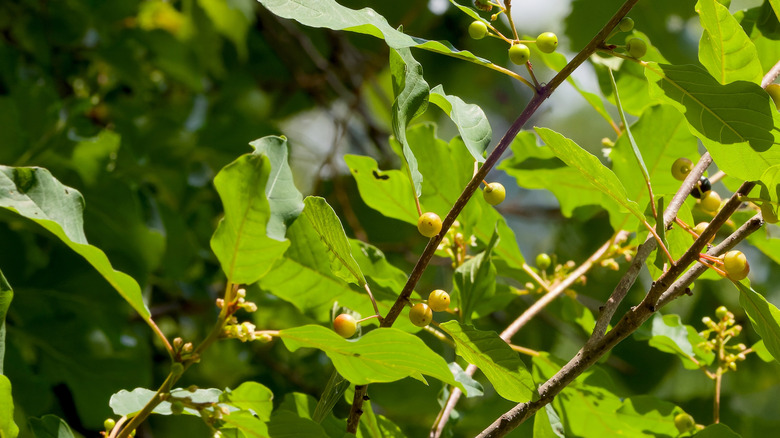
If you suspect that it is already growing in your yard, it's best to learn how to get rid of fast-growing oriental bittersweet as efficiently as possible. You must use a combination of mechanical and chemical control methods, or you will not have much success. Start by cutting back and removing vines, or pulling out the roots when soil is moist. This step is very important if oriental bittersweet is actively growing around any trees. Then apply herbicide to the leaves, main stem, or a fresh-cut stump. Your goal is to make sure that the herbicide gets to the roots of the plant to properly kill it and prevent further spread. Pay attention to the area around the vine's stump, as you may deal with pop up seedlings due to its spreading system of roots.
Not all vining species are as aggressive as this one, although it is best you avoid any type of non-native species. An alternative to oriental bittersweet, American bittersweet (Celastrus scandens) is a berry-producing vine that attracts beautiful birds. American bittersweet is from the same genus, so it looks a little similar, but without the same aggressive growth. Another native option is American rattan (Berchemia scandens), which is a woody vine with a slower growth rate.