

The Invasive Perennial That We Recommend Skipping In Your Garden

It's always tempting to add easy growers to our yards. A neighbor might offer us divisions of a perennial growing rampant in their beds, or we might be enchanted by a fast-growing flower that is touted as growing in nearly any conditions. The problem is that the same quality that makes a plant attractive in the short term can end up causing you years of regret. This is why we recommend skipping lily of the valley (Convallaria majalis) in your garden. Depending on your location, it can be considered an invasive plant to avoid at all costs.
With its attractive, elliptical green leaves that reach 5 to 10 inches long and its showy, fragrant bell-shaped flowers, it's no wonder gardeners are attracted to lily of the valley. This plant thrives in USDA Hardiness Zones 3 to 7, where it can grow in all types of sun exposure and is adapted to different soil types. Its pretty little flowers give way to striking red berries. Overall, this perennial is a lovely plant, but sadly, lily of the valley can take over your garden and is considered invasive in several U.S. states, including Arkansas, Wisconsin, Michigan, and Virginia, as well as Ontario, Canada.
Grow plants like foamflower instead of lily of the valley
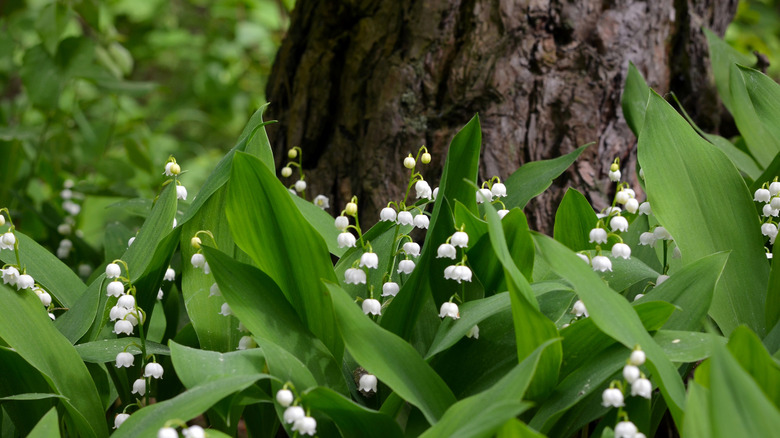
Lily of the valley is native to most of Europe, and its natural range extends into the Caucasus region of Asia, but know before planting lily of the valley that in other favorable locations, it can spread aggressively. While many plants naturalize in areas beyond their native ranges, only those that cause negative impacts are considered invasive, but even if you don't live in a location where lily of the valley falls into this category, it's a good idea to be cautious with it. In particular, yards with cool, moist winters encourage these plants to reproduce. This perennial colonizes locations through its rhizomes, which can overpower neighboring species. And those pretty red berries it produces? They contain seeds, which also allow this invasive species to spread into new locations.
Especially if you live in a state or province where lily of the valley is already considered invasive, you'll want to skip this pretty but problematic plant — and there are lovely alternatives. Choose substitutes for your garden that thrive in similar conditions – part or full shade, and moist, rich soil. One option is foamflower (Tiarella cordifolia), a U.S. native perennial that grows in Zones 3 to 8 and has foliage that looks like maple leaves and sprays of fluffy white or pink flowers.
Wood anemone (Anemonoides quinquefolia), another U.S. native, works in Zones 4 to 8 and has pretty, cup-shaped white blooms held above lobed green leaves. A third substitute is Canada mayflower (Maianthemum canadense), also known as false lily of the valley, which is very cold hardy, adapted to Zones 1 to 8. It bears star-like white flowers above its oval-shaped leaves and has small red fruit.