

The Durable Edging Material That Helps Keep Grass Out Of Gravel Driveways
We may receive a commission on purchases made from links.
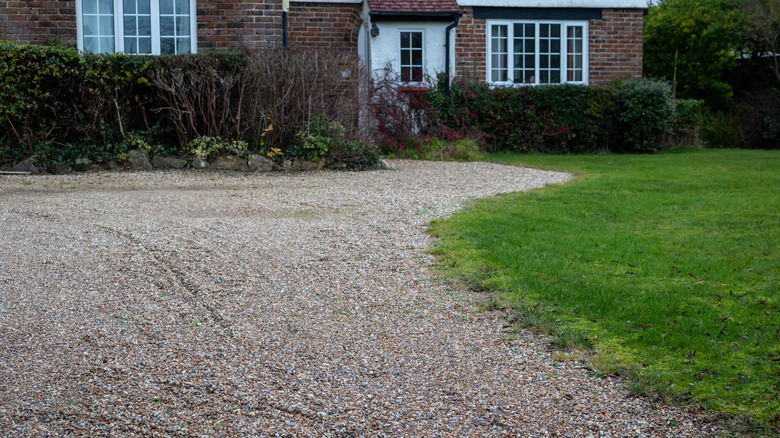
It's easy to understand why gravel is one of the top materials to use on non-concrete driveways. It's affordable, relatively straightforward to install, and there are plenty of different types to fit in with the style of your home. Sometimes, the pristine appearance can be spoiled by unwanted plant growth, but there are tricks to prevent weeds from growing in the gravel. The other potential issue is if you have grass running up to the edge. It can look untidy. Fortunately, there's a durable edging material you can use to keep it from encroaching on your driveway. It's called hammer-in landscape edging.
As you might have guessed from the description, these are metal strips, typically 4 feet long, that you hammer into the ground. They have a serrated lower edge, a lot like a saw blade, to enable you to do this. The top edge is rolled over so you don't damage it, and you use a wooden block on top rather than hitting it directly with a hammer or mallet. Slender joining clips are usually included with the purchase.
Hammer-in landscape edging is offered in several different heights, from 4 to 14 inches tall. Heights of 6 and 8 inches appear to be the most common, and they could well be what you want to keep the grass out of your driveway. If you also have flower borders, particularly if you mulch, the taller ones might be more appropriate.
Durability features to consider when choosing hammer-in edging
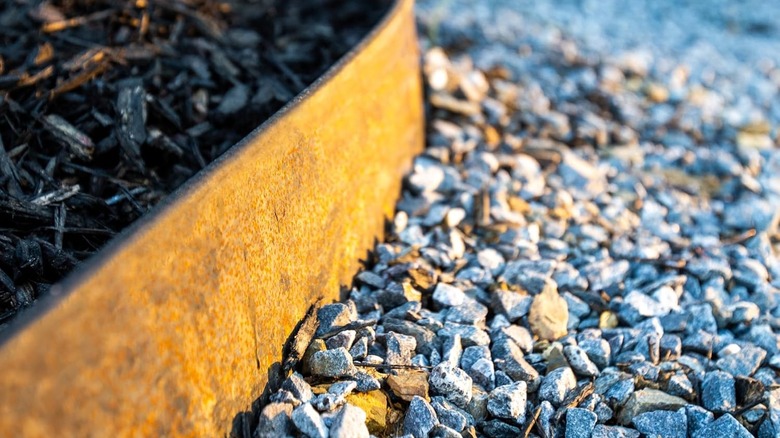
The thickness of the steel will have some impact on how long the edging lasts, with both 14-gauge and 16-gauge available (14-gauge is slightly thicker). Although it takes a little effort, both can be bent to accommodate curves. However, the key feature to consider for durability is not the thickness but the type of steel used. There are two: galvanized steel and Corten steel (also called weathering steel).
Galvanized steel is coated with zinc for rust resistance, but if the surface is damaged or wears away, water can get in and it will deteriorate. Corten steel is deliberately allowed to rust, but rather than weakening it, this particular rust layer actually protects the steel underneath. As a result (and environmental conditions can have an effect), galvanized steel landscape edging can be good for 30 years or more, but the Corten steel equivalent might last 50 years or longer. That said, if you don't like the rusty patina that Corten steel develops, galvanized steel is still an effective, durable option.
Either of the steel options will give you an attractive barrier that will keep grass at bay for many years. And unlike pavers or blocks, hammer-in landscape edging is relatively easy to install yourself. It's also one of the best ways to keep your gravel driveway locked in place, so you aren't constantly having to rake it back into shape.